

Meeting the artisan's family in Tay Ho village.
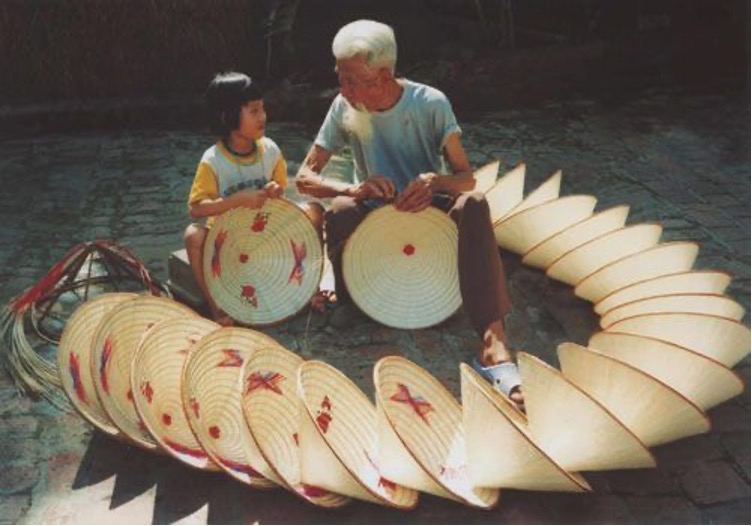
These conical hats embody the spirit of the countryside, containing within them a whole world of poetry and emotion.
Tay Ho Village, located in Phu Ho Commune, Phu Vang District, Thua Thien Hue Province, is not only famous for the beauty of the Nhu Y River but also for its traditional conical hat-making craft. The hat-making tradition here dates back hundreds of years, but it was the creation of the "poem hat" around 1959-1960 that truly brought the village closer to tourists. The ingenuity of artisan Bui Quang Bac transformed the traditional hat into a unique product, possessing not only artistic beauty but also poetic verses.
During our visit to Tay Ho village, we had the opportunity to meet the family of Mr. Hoang Van Minh, one of the village's veteran artisans. Mr. Minh's house is located near the Nhu Y River, and from afar, we could see rows of lush green palm leaves drying in the sun – a characteristic sight of the craft village. Mr. Minh and his family welcomed us warmly and hospitably. In the cozy atmosphere, the whole family gathered around piles of palm leaves and palm rims, working diligently and attentively.
Mr. Minh shared: "The craft of making conical hats has been preserved and developed by my family for many generations. For us, it's not just a job, but also a source of pride in the culture and traditions of our homeland."
The image of Mr. Minh, his wife, and children diligently making conical hats not only reflects their deep attachment to the traditional craft but also highlights the love and dedication they have for this work.
The process of making conical hats
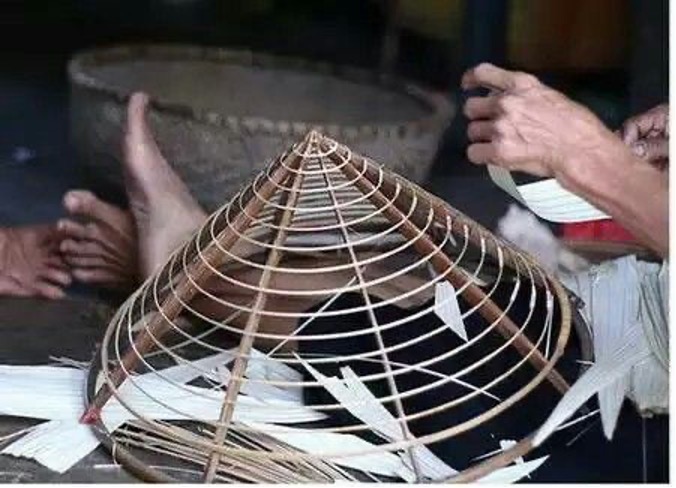
The conical hat, adorned with poems, was created by the skillful and meticulous hands of experienced craftsmen.
When asked about the process of making conical hats, Mr. Minh explained in detail: “We start by selecting fresh, green leaves, as they are more pliable and durable than older leaves. These leaves are soaked in water to soften them, then spread out and ironed flat. This is a very important step because it creates a solid foundation for the subsequent steps. If the leaves are not ironed flat, the hat will not achieve the necessary perfection and sturdiness.”
After the palm leaves have been flattened, they are cut into round or oval pieces, depending on the style and size of the hat. These pieces of leaf are then carefully layered and attached to the hat frame. He emphasized, "Laying and attaching the leaf pieces requires skill and precision to ensure that the hat is durable and leak-proof during use."
One of the equally important steps is carving poems onto the conical hats. This process requires exceptional meticulousness and skill. “The poems are carved between the layers of leaves using a special technique that prevents them from fading over time. This technique not only makes the poems stand out but also helps them blend seamlessly into the hat's structure, creating a unique work of art. We have to be very careful in each carving step to ensure that each hat reflects the spirit and values of Hue culture,” Mr. Minh shared while working.
Challenges of traditional crafts

Retaining the younger generation to continue the craft is also a major challenge, as many young people today seek other opportunities and are no longer interested in traditional hat-making.
Although the craft of making conical hats remains popular, it is currently facing many challenges. "The market is very competitive. Many hat products are produced quickly and at low cost, making it difficult for us to maintain quality and reasonable prices," Mr. Minh said.
He added that retaining the younger generation to continue the craft is also a major challenge, as many young people today are seeking other opportunities and are no longer interested in the traditional hat-making profession.
Mrs. Nguyen Thi Hoa (Mr. Minh's wife) shared their concerns about the future of the craft: "We are making great efforts to pass on the craft to our children, but the younger generation tends to choose other jobs rather than making conical hats. We hope that our hard work and love will be preserved and passed on to the next generation."
Mr. Minh's family is hoping that their efforts, and those of the entire village, will help preserve this traditional craft and maintain the cultural identity of Tay Ho conical hat village.
The Perfume River flows gently, like the slow beat of time, but the conical hat remains steadfast, preserving its beauty, just as the people of Hue preserve their traditions and sentiments.
On each conical hat, verses are engraved, serving as a reminder that love and longing are enduring, always connected to the river and the land that has nurtured and sheltered so many souls.
Thanh Thao
Source: https://www.congluan.vn/ghe-tham-lang-non-tay-ho--bieu-tuong-dam-chat-tho-post310643.html


![[Photo] General Secretary and President To Lam visits and delivers a policy speech at Tsinghua University.](https://vphoto.vietnam.vn/thumb/1200x675/vietnam/resource/IMAGE/2026/04/14/1776164592318_vna-potal-tong-bi-thu-chu-tich-nuoc-tham-va-phat-bieu-chinh-sach-tai-dai-hoc-thanh-hoa-trung-quoc-8700658-5437-jpg.webp)






















































































Comment (0)