

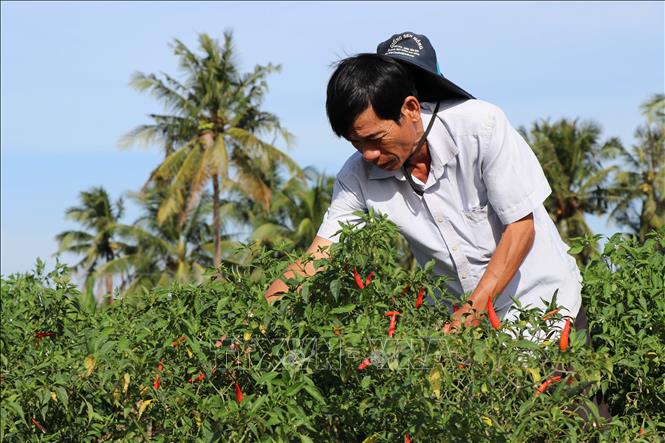
Currently, Grade I bird's eye chili peppers are being purchased by traders directly from the fields at prices ranging from 90,000 to 105,000 VND/kg, which is 30,000 to 45,000 VND/kg higher than two weeks ago and about 70,000 VND/kg higher than the same period in 2024. Notably, last week, the price of bird's eye chili peppers reached a record high of 150,000 VND/kg.
Mr. Nguyen Van A, Secretary of the Party Branch of Ngai Hiep hamlet, Hung My commune, said that the entire hamlet has 258 hectares of agricultural land, which was previously mainly used for rice cultivation. Following the policy of restructuring crop patterns to increase production efficiency on the same area, many households have switched to growing vegetables and short-term crops; in particular, the area converted to growing chili peppers has yielded about 10 times higher economic returns compared to rice cultivation.
This year, due to unfavorable weather conditions, many chili fields experienced a 10-20% decrease in yield compared to previous seasons. However, the high price of bird's eye chili has made farmers very happy. They hope this price will last until the end of the season. Chili plants don't require much care, and the investment costs are low. If the selling price remains stable at an average of 80,000 VND/kg, and the yield reaches 1.5-2 tons per 1,000 m2, chili growers can achieve a profit of over 100 million VND per 1,000 m2 after 6 months of cultivation," Mr. A said.
Mr. Tran Van Doi, from Ngai Hiep hamlet, shared that his family planted 2 acres of bird's eye chili peppers and harvested the first crop of 60 kg last week. At this time, traders are buying the chili peppers at 150,000 VND/kg, bringing his family a considerable profit. In over 30 years of growing chili peppers, this is the first time they've sold them at such a high price.
Ms. Vo Thi Phuong's family in Ngai Hiep commune planted 2 acres of chili peppers and has harvested them three times, yielding over 200 kg. Traders bought them at prices ranging from 105,000 to 135,000 VND/kg (depending on the harvest). Ms. Phuong said that chili plants grown during the rainy season are susceptible to anthracnose disease, requiring farmers to put in more effort in caring for them. The life cycle of a chili plant lasts about 6-7 months.
After 2.5 months of planting, the chili plants begin to yield their first harvest, followed by continuous harvests every 3-7 days until the end of the chili plant's cycle. On average, each crop, lasting over 6 months, yields approximately 5 tons from Mrs. Phuong's 2-acre chili field. Investment costs such as seedlings, fertilizers, and pesticides are around 10 million VND per acre, while harvesting costs are 7 million VND per ton. If the selling price remains stable at an average of 80,000 VND/kg this season, her family will earn a profit of over 300 million VND.
According to some traders, the high price of chili peppers is due to reduced supply while market demand surges at the end of the year. In addition, the impact of unfavorable weather during the rainy season has caused many chili pepper crops to be affected by pests and diseases, resulting in reduced yields, especially for grade I chili peppers.
Chili peppers are one of the crops that the provincial agricultural sector encourages farmers to switch to inefficient rice-growing areas that often lack irrigation water during the dry season. This is also one of the eight key agricultural and aquatic products that the Provincial Department of Agriculture and Environment, in coordination with the Management Board of the Climate-Smart Agricultural Value Chain Development Project in Tra Vinh (CSAT), is upgrading the value chain towards sustainable linkages and climate change adaptation, applying science and technology.
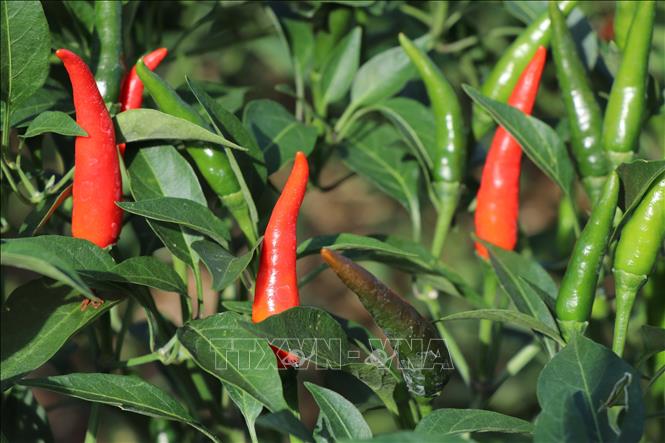
According to Mr. Le Van Dong, Deputy Director of the Department of Agriculture and Environment of Vinh Long province, the chili pepper value chain has been identified as one of the sectors with potential for development in the locality thanks to suitable soil conditions, short growing season, and stable market demand. However, the current chili pepper cultivation area is mainly on a small scale, linkages are limited, and it depends heavily on traders, so prices often fluctuate.
According to the plan to upgrade the chili value chain, the province's agricultural sector is focusing on reorganizing production areas, improving product quality, and expanding consumption markets. Accordingly, the province aims to develop concentrated chili growing areas linked with cooperatives and production groups; apply safe production processes according to VietGAP and GlobalGAP standards; and strictly control the use of pesticides and fertilizers.
Simultaneously, the agricultural sector will support farmers in applying advanced techniques in seed selection, cultivation, and integrated pest management; promoting mechanization in land preparation, irrigation, and harvesting to reduce production costs. The application of water-saving irrigation technology, the use of agricultural mulch on the soil surface, and crop rotation are considered important solutions to help chili plants adapt better to adverse weather conditions.
In the post-harvest stage, the province encourages organizations and individuals to invest in preliminary processing and preservation to extend shelf life, reduce losses, and improve product quality. Purchasing and processing facilities are encouraged to participate more deeply in the supply chain through contracts with cooperatives and farmers. Besides fresh consumption, chili products will be diversified into processed products such as dried chili, ground chili, and chili sauce, serving both domestic and export markets.
In addition, the province is strengthening market linkages, focusing on developing planting area codes, traceability systems, and collective trademarks for Vinh Long chili products; gradually connecting with businesses, wholesale markets, supermarket systems, and modern distribution channels. At the same time, it is enhancing the provision of market information, prices, and consumer demand to help farmers proactively adjust their production plans.
According to the plan, in the coming period, the province strives to establish specialized chili-growing cooperatives, build stable production-consumption linkage models, and gradually increase the percentage of production area meeting safety standards. The agricultural sector will also strengthen training and technical instruction on value chain management for cooperative officials and farmers.
Upgrading the chili value chain is expected to contribute to reducing risks for growers, increasing income, and promoting the shift in crop structure towards sustainability, in line with market demands and local climate change conditions.
Source: https://baotintuc.vn/kinh-te/gia-ot-chi-thien-cao-ky-luc-nong-dan-thu-lai-lon-20251216092311561.htm
![[Photo] Prime Minister Pham Minh Chinh receives the Governor of Tochigi Province (Japan)](/_next/image?url=https%3A%2F%2Fvphoto.vietnam.vn%2Fthumb%2F1200x675%2Fvietnam%2Fresource%2FIMAGE%2F2025%2F12%2F16%2F1765892133176_dsc-8082-6425-jpg.webp&w=3840&q=75)

![[Photo] Prime Minister Pham Minh Chinh receives Lao Minister of Education and Sports Thongsalith Mangnormek](/_next/image?url=https%3A%2F%2Fvphoto.vietnam.vn%2Fthumb%2F1200x675%2Fvietnam%2Fresource%2FIMAGE%2F2025%2F12%2F16%2F1765876834721_dsc-7519-jpg.webp&w=3840&q=75)

![[Image] Leaked images ahead of the 2025 Community Action Awards gala.](/_next/image?url=https%3A%2F%2Fvphoto.vietnam.vn%2Fthumb%2F1200x675%2Fvietnam%2Fresource%2FIMAGE%2F2025%2F12%2F16%2F1765882828720_ndo_br_thiet-ke-chua-co-ten-45-png.webp&w=3840&q=75)
![[Live] 2025 Community Action Awards Gala](/_next/image?url=https%3A%2F%2Fvphoto.vietnam.vn%2Fthumb%2F1200x675%2Fvietnam%2Fresource%2FIMAGE%2F2025%2F12%2F16%2F1765899631650_ndo_tr_z7334013144784-9f9fe10a6d63584c85aff40f2957c250-jpg.webp&w=3840&q=75)








































![[Photo] Prime Minister Pham Minh Chinh attends the Vietnam Economic Forum 2025](https://vphoto.vietnam.vn/thumb/402x226/vietnam/resource/IMAGE/2025/12/16/1765893035503_ndo_br_dsc-8043-jpg.webp)


















Comment (0)