


A civil servant is responsible for 18 tasks.
Mr. Nguyen Thanh Binh, a staff member at the Office of the People's Council and People's Committee of Linh Xuan Ward, begins his workday at 7:00 AM to check all 18 tasks in the judicial field that he is responsible for. Although he is familiar with the work, the pressure of 18 tasks is considerable. Mr. Binh usually finishes his morning shift at 12:00 PM and leaves the office and goes home after 7:00 PM. The Economic, Infrastructure and Urban Planning Department of the ward also has a civil servant responsible for 18 tasks in the financial field.
According to Nguyen Thi Kim Cuc, Chairwoman of the Linh Xuan Ward People's Committee, the total number of officials, civil servants, and non-specialized personnel in the ward is 156. The Ward's Public Administrative Service Center previously had 13 staff members, but now only has 9 due to the reassignment of 4 civil servants to specialized departments within the Ward People's Committee.
Currently, the ward is lacking 8 positions in specialized fields. Specifically, the Department of Economic Infrastructure and Urban Development lacks 2 positions; the Department of Culture and Social Affairs lacks 4 positions; and the Department of People's Council and People's Committee lacks 2 positions.
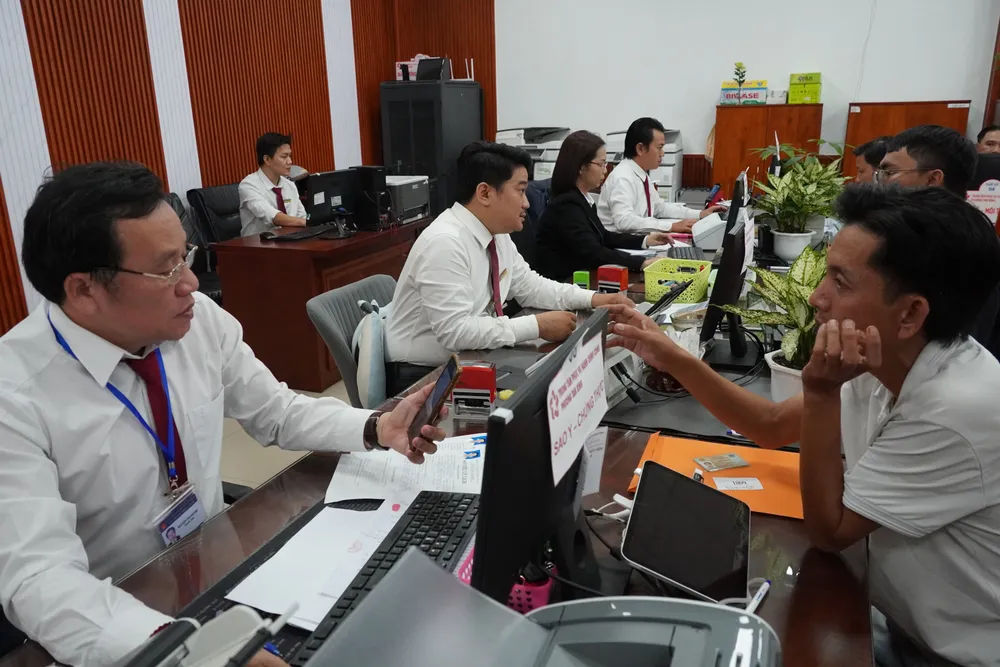
This situation is not unique to Linh Xuan ward but is a common problem in many other localities in the city. The workload has increased, while civil servants lack in-depth expertise in areas such as land, investment, planning, and construction, forcing them to take on multiple roles, leading to immense pressure in processing paperwork.
According to Mr. Bui Truong Son, Head of the Economic Department of Binh Hung Commune, the department has 17 people but has to handle approximately 250 tasks. This means that on average, each person has to handle nearly 15 tasks, not including any unforeseen assignments. Meanwhile, Ben Thanh Ward has been allocated 113 officials and civil servants but lacks positions such as those in foreign affairs or information technology. Significantly, according to the civil servant framework regulations, the ward has a surplus of 19 positions by the end of 2030.
The leaders of Binh Trung Ward People's Committee are also struggling due to a shortage of highly specialized personnel. The current decentralization and delegation of authority have not been accompanied by the allocation and supplementation of personnel, funding, and corresponding support mechanisms. The current job structure of the ward remains unchanged, while the workload is increasing and becoming more complex.
Some newly assigned specialized fields require in-depth knowledge, but officials and civil servants have not received timely training and professional development. This has led to many civil servants having to take on multiple responsibilities, resulting in overload and affecting the quality and effectiveness of advice and task implementation.
Find fundamental solutions.
Regarding the operation of the two-tiered local government model, during monitoring sessions by working groups under the Ho Chi Minh City Party Committee, many localities requested that the city allocate total staffing quotas so that wards and communes can proactively distribute them to their subordinate units.
Following the city leaders' directives, the Department of Internal Affairs has advised on the development of a plan to review, reorganize, and assign officials and civil servants in communes, wards, and special zones to determine the surplus and shortage of specialized civil servants, analyze and assess the current situation, and address this issue locally.
Mr. Phan Viet Tan, Deputy Head of the Department of Government Building and Youth Affairs, Ho Chi Minh City Department of Internal Affairs, informed that the city will prioritize assigning staff within each ward first, then arranging and coordinating with neighboring localities. The final option is coordination across the entire city. This approach aims to reduce delays in personnel processing, ensuring that administrative work is not interrupted when wards lack staff. At the same time, it allows for a thorough review and assessment of staff capabilities, maximizing the utilization of available resources and avoiding the situation of "requesting additional staff."
Regarding addressing the shortage of highly specialized personnel, Deputy Secretary of the Ho Chi Minh City Party Committee Dang Minh Thong emphasized that the city has established and continues to establish task forces and second personnel to support localities. Localities lacking personnel in any field must proactively propose that the city allocate personnel to provide specialized support in that field.
Regarding long-term solutions, the city is focusing strongly on training. Ho Chi Minh City Party Secretary Tran Luu Quang requested that general training courses be limited, and that priority be given to specific professional guidance, even hands-on training, to ensure effective task implementation at the commune level.
Localities and units need to proactively exchange and learn from each other's experiences. This has been effectively implemented in some places. Mr. Luu Van Tan, Director of the Thu Duc City Technical Infrastructure Development Center (the unit has not changed its name - PV), said that the center has provided advice and repeatedly sent personnel directly to wards lacking specialized expertise to guide and share experiences on the process of carrying out tasks related to urban infrastructure. Through this activity, ward officials and civil servants have quickly absorbed the experience to perform similar tasks.
However, personnel coordination or incident support are only temporary solutions. For a more fundamental approach, the city should comprehensively assess the leadership, management, and task execution capabilities of officials and civil servants in each ward and commune. This will help identify weaknesses early on, thereby providing a basis for appropriate training, development, and rotation. More importantly, when staffing is managed in an open and flexible manner, based on job requirements rather than simply counting personnel, the problem of both surplus and shortage of staff will have a sustainable solution.
According to the Ho Chi Minh City Department of Internal Affairs, the total number of civil servants currently assigned to specialized departments and equivalent units in 168 communes, wards, and special zones is 7,533 (while the number of specialized civil servants allocated according to job positions is 7,415), but in reality, there is still a situation where some areas have an excess of civil servants while others have a shortage.
Source: https://www.sggp.org.vn/go-kho-nhan-su-cho-co-so-post825093.html

































































































Comment (0)