

From the “Sustainable Coffee Women Ambassadors Club”…
On the vast coffee plantations in Dak Lak, most of the work from tending, harvesting to garden management is done by women. The province currently has more than 214,000 hectares of coffee, providing livelihoods for more than 300,000 households, and women account for more than 70% of the production workforce. Despite being an important pillar in the coffee value chain, their role in agricultural development has not been properly appreciated.
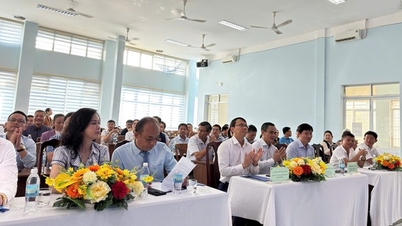
To support this important group of workers, in May 2025, Bayer coordinated with the Dak Lak Agricultural Extension Center and Simexco Dak Lak to launch the Sustainable Coffee Women Ambassador Club initiative .
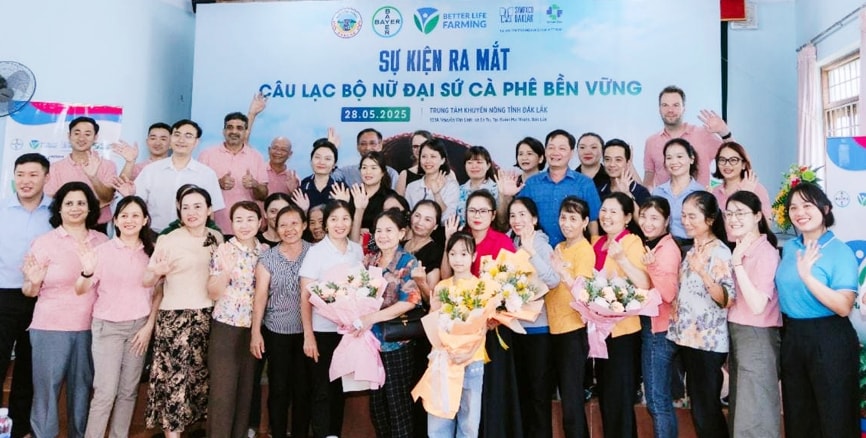
This is not only a place for community activities, but also a forum for women to access advanced farming knowledge, health care skills and practical content in life. The goal of the model is to build a team of confident female farmers, mastering techniques and better adapting to climate change.
From the very beginning, the Club attracted a large number of women from key coffee growing regions. Training courses focused on integrated crop management, solutions for recovering diseased coffee plantations, using pesticides according to the “4 rights” principle and practices that meet export standards for many international markets.
In addition to technical content, the Club also focuses on women's health topics - from self-care to common disease prevention, which are very practical for agricultural workers.
Ms. Tran Thi Thanh Thuy, an active member of the Club, said: “Since joining the project, I have learned many new techniques to help take better care of my coffee garden. Thanks to that, I am more confident in managing my home garden.”
In fact, the pilot models directly applied sustainable techniques by the female ambassador have brought about clear results: trees grow healthily, the rate of dry branches is reduced, fruit is kept better and the length of reserve branches, an important factor for the following year's yield, has increased significantly. Thanks to that, the income of many households has increased by 10 - 15% compared to traditional farming.
Mr. Dinh Van Dang, Director of Dak Lak Agricultural Extension Center, commented: “The Sustainable Coffee Ambassador Club operates effectively, bringing many practical benefits to farmers. We aim to empower each household, equip them with knowledge and build strong families, thereby improving productivity and contributing to the development of sustainable rural communities.”
…to public-private partnerships to promote sustainable agriculture
The Sustainable Coffee Ambassadors Club is part of the large-scale Better Life Farming (BLF) project, a sustainable agriculture initiative, implemented by Bayer and its partners from the end of 2024. BLF is built on a close public-private partnership model between Bayer, Dak Lak Agricultural Extension Center, Simexco, Netafim, Yara and the Western Highlands Agriculture and Forestry Science Institute (WASI).
Each unit takes on a separate role in the support chain: NAEC connects projects with farmer networks; WASI provides training, consulting and technical solutions transfer; Netafim provides drip irrigation systems, the foundation of precision agriculture; and Yara provides nutritional solutions to maintain and improve long-term soil health.
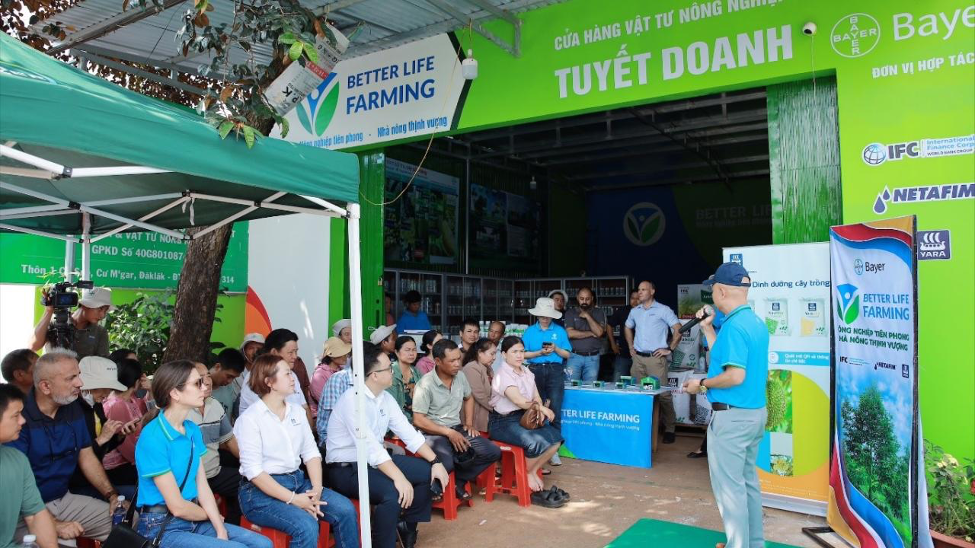
BLF’s goal is to support coffee and durian farmers to transition to a sustainable agricultural model that increases productivity, improves soil quality, protects public health, and better adapts to climate change. To do so, the project synchronously applies many modern solutions, from smart irrigation, precision agricultural tools, in-depth agronomic consulting to digitalizing farming processes.
Within the framework of the project, Bayer introduced the Much More crop protection product line, which helps control pests effectively but limits residues, meeting increasingly strict export standards.
Community activities are comprehensively implemented. BLF builds demonstration models and BLF Centers to visually introduce sustainable farming techniques, creating spaces for farmers to observe, learn and apply them in practice. In addition, the project closely coordinates with experts from NAEC, WASI and technology partners to improve farmers' capacity in advanced farming techniques, agricultural product quality management and meeting export standards.
In Dak Nong, the pilot model on durian in 2024 recorded many outstanding results: pests and diseases reduced by 80 - 90%, trees recovered quickly and developed evenly; productivity increased by about 20%, reaching 20 tons/ha; 70 - 80% of output was classified as A, meeting export standards. In parallel with the field model, the project organized training for 50 agricultural extension officers and 400 farmers, covering all techniques from irrigation, fertilization to pest management.
According to Mr. Ngo Duy Hai, an expert from the Department of International Cooperation (Ministry of Agriculture and Rural Development), BLF shows the important role of public-private partnership in sustainable agricultural development. “Sharing knowledge, experience and resources among parties helps to best support farmers. Close cooperation in the value chain not only improves productivity but also contributes to economic development and community sustainability,” he said.
In the context of Vietnamese agriculture facing many challenges, from climate change to clean production requirements and strict export markets, BLF is expected to become a model of modern agricultural practices based on science, technology and multi-stakeholder cooperation. Based on the initial results, the project is expected to continue to expand in many localities, aiming at the long-term goal of building a pioneering agriculture and improving the lives of smallholder farmers.
Source: https://daibieunhandan.vn/hop-tac-cong-tu-thuc-day-nong-nghiep-ben-vung-va-phat-trien-cong-dong-o-tay-nguyen-10397668.html















![[Photo] Dan Mountain Ginseng, a precious gift from nature to Kinh Bac land](/_next/image?url=https%3A%2F%2Fvphoto.vietnam.vn%2Fthumb%2F1200x675%2Fvietnam%2Fresource%2FIMAGE%2F2025%2F11%2F30%2F1764493588163_ndo_br_anh-longform-jpg.webp&w=3840&q=75)







































Comment (0)