

Foreign direct investment (FDI) businesses invest in high-tech zones primarily to take advantage of incentives, so representatives of the high-tech zones want to shift their focus towards research and development (R&D) activities.
This viewpoint was expressed by leaders of the Hoa Lac High-Tech Park ( Hanoi ), Da Nang, and Ho Chi Minh City at a conference on improving the operation of high-tech parks by 2030, held on the morning of May 16th in Ho Chi Minh City.
Mr. Tran Dac Trung, Deputy Head of the Hoa Lac High-Tech Park Management Board, stated that in attracting FDI enterprises to the high-tech park, the essence is that they do not bring core technologies to Vietnam but invest to maximize the benefits of incentives. Besides the positive aspects, according to Mr. Trung, this will cause significant social and environmental consequences. Based on this reality, the Hoa Lac High-Tech Park has a strategy to shift from focusing on attracting FDI to enhancing endogenous capacity by developing domestic technology enterprises. "A high-tech park that still relies on foreign enterprises cannot be sustainable in the long run; it must promote domestic research activities," Mr. Trung said.

Mr. Tran Dac Trung, Deputy Head of the Hoa Lac High-Tech Park Management Board, speaks on the morning of May 16th. Photo: Ha An
According to the leaders of Hoa Lac High-Tech Park, promoting domestic businesses, organizations, and individuals in R&D, business incubation, and human resource training is not easy to implement. Research activities are time-consuming, expensive, and inherently risky. Therefore, there is a need for units with sufficient financial resources and a strong network to support the output of research.
According to Mr. Trung, R&D, incubation, and human resource training activities should be implemented according to the science and technology park model because these are places that create inventions, technical innovations, and form a community of technology businesses. These businesses can return to invest when they develop strongly.
According to Mr. Trung, the Hoa Lac High-Tech Park benefits from its proximity to universities and improved transportation infrastructure, initially forming a link between training and research institutions and manufacturing businesses. Here, businesses commission research institutions to help them innovate their production technologies. The research institutions, in turn, understand business needs to develop new products. Training activities are concentrated with universities that have high-quality human resources, and vocational schools, in addition to teaching, establish research institutes to collaborate with businesses. "In the future, the Hoa Lac High-Tech Park will focus on two fields: biotechnology and electronics," Mr. Trung stated.
Sharing the same view, Mr. Tran Van Ty, Deputy Head of the Management Board of Da Nang High-Tech Park and Industrial Zones, said that currently, the unit only has 5 R&D projects out of a total of 29 projects (accounting for 17%), which is a modest number. He believes that instead of focusing on production, the high-tech park's activities in the future should focus on business incubation and R&D as the core of high-tech development. Projects that are slow to implement will be revoked to focus on the high-tech park's priorities in the future. "If only 50% of the investment projects have research and incubation activities, that would be very good for developing high technology," Mr. Ty said.
Mr. Nguyen Anh Thi, Head of the Management Board of Ho Chi Minh City High-Tech Park (SHTP), acknowledged that in reality, the unit has only focused on attracting manufacturing businesses in the past. Investment in and support for connecting R&D activities, incubation, and human resource training in these functional zones have not received adequate attention. Therefore, SHTP aims to establish a Science and Technology Park with the goal of enhancing domestic endogenous capacity through research and commercialization of high-tech products in foundational industries such as semiconductor microchips, biotechnology, and information technology. "This aims to create new technology businesses and a highly skilled workforce to meet the requirements of socio-economic development," Mr. Thi said, adding that this year, they will focus on promoting investment in the electronics and microchip industries.
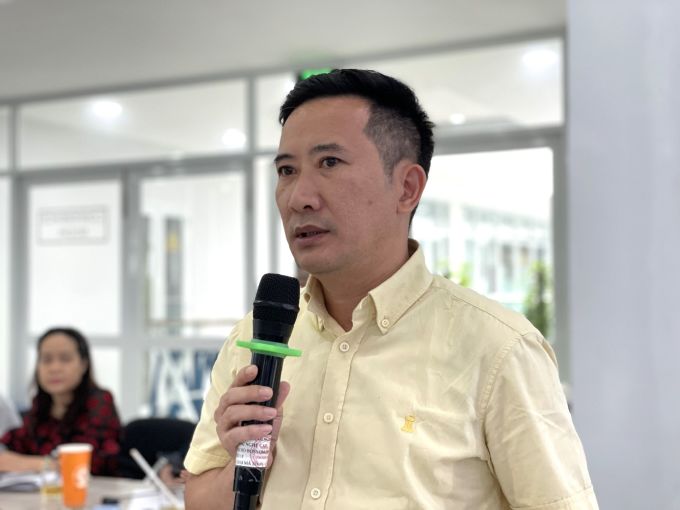
Mr. Nguyen Le Hung, Deputy Director of the High Technology Department, shared his insights at the conference. Photo: Ha An
Mr. Nguyen Le Hung, Deputy Director of the High-Tech Department (Ministry of Science and Technology), said that the draft regulations on the operation of high-tech zones are being finalized by the drafting agency and will be submitted to the Government in June.
According to Mr. Hung, the new Decree will clarify the legal framework for the high-tech industry, promote the operation of high-tech zones, and focus on improving the capacity of domestic businesses and developing human resources.
Regarding attracting investment, Mr. Hung said that the draft will create conditions for private and foreign investors to participate in infrastructure development and promote research activities in high-tech zones.
Ha An
Source link



![[Image] Hanoi's urban life under the challenge of a "scorching hot" environment](https://vphoto.vietnam.vn/thumb/1200x675/vietnam/resource/IMAGE/2026/05/25/1779706979265_nang-nong-t5-2026-minh-duy-7-4636-jpg.webp)



































































Comment (0)