The Vietnam Association of Financial Investors (VAFI) has recently sent a letter to the Prime Minister, the Ministry of Finance , the State Bank of Vietnam (SBV), etc., proposing the application of value-added tax (VAT) using the deduction method to the trading of physical gold.
Low taxes lead to a flow of money into gold speculation.
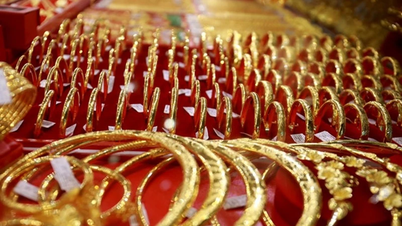
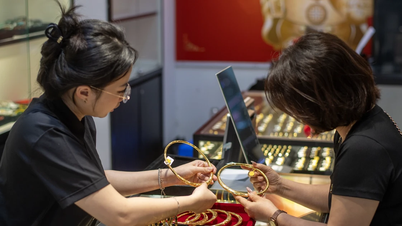
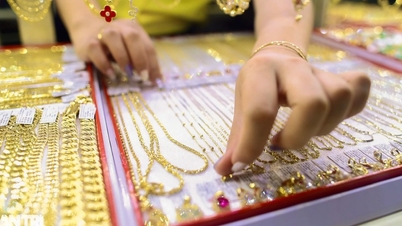
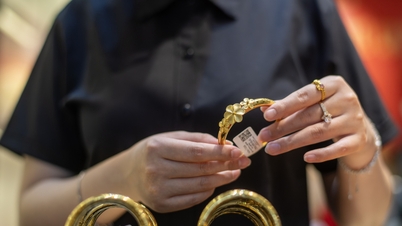
Regarding current tax policies for gold trading, according to VAFI, gold bars are exempt from VAT, while VAT on gold jewelry is determined by subtracting the purchase price from the selling price and multiplying it by a tax rate of 10% (according to the listed price).
"Assuming a business buys and sells 1 tael of gold jewelry for 97 to 100 million VND, with a difference of 3 million VND between the buying and selling price, it would only have to pay about 300,000 VND in tax."
"If VAT is calculated using the deduction method, an invoice of 110 million VND would result in a tax payable of 10 million VND. Thus, the difference in VAT collected between the deduction method and the direct method is 30 times," the association analyzed.

The proposal suggests that businesses dealing in gold jewelry and gold bars should be subject to value-added tax using the deduction method at a rate of 10%.
Recently, the Ministry of Finance proposed adding a tax of 0.1% on the transfer value of gold bars sold. For example, if a seller sells one SJC gold bar for 100 million VND, they would pay 100,000 VND in tax. VAFI argues that this low tax rate would be ineffective in curbing the massive influx of money into the gold market.
Conversely, the aforementioned tax policy strongly encouraged speculative capital flows into the gold market, allowing for easy short-term speculation with minimal fees. This even led to the creation of artificial supply and demand at various times, creating a ripple effect that attracted many participants and generated enormous demand for gold.
According to VAFI's estimates, Vietnam's gold reserves are approximately over 2,000 tons, equivalent to about $250 billion at current prices. Most of these 2,000 tons are purchased and then "kept under beds," never returning to the commercial banking system.
From a macroeconomic perspective, accumulating gold is more dangerous than accumulating hard currency because when people buy hard currency, most of that currency returns to the banking system.
"Over the years, if there were a VAT policy on gold as a consumer good, the banking system would have gained approximately $100 billion instead of losing it, and could use this foreign currency to settle import and export payments. The domestic currency would also strengthen significantly due to this foreign currency, and the State Bank of Vietnam could easily stabilize the exchange rate and sharply lower deposit interest rates."
"The tax exemption policy for gold trading (primarily trading in gold bars) has significantly increased the 'goldization' of the economy . The current tax policy for the gold trading industry is enjoying the most preferential treatment, even more so than many other industries that need tax incentives and investment encouragement," the VAFI document stated.
A 10% tax should be applied to invoices for gold sales.
VAFI recommends a change to the current tax policy. Specifically, the association proposes that the trading of gold jewelry and gold bars should be subject to VAT using the deduction method, like other ordinary goods, with equal tax obligations at a rate of 10%.
"If we compare the gold business to real estate, then when selling houses and land using the VAT deduction method, the individual buying the house has to pay 10% VAT, and when selling the house, they also have to pay personal income tax at 2% of the selling price. In short, the sale of gold bars, gold jewelry... (collectively referred to as physical gold) from businesses should be subject to a 10% tax on the sales invoice," VAFI stated.
The association believes that this policy revision will almost completely eliminate short-term speculation; completely put an end to speculative trading and price manipulation for profit. At the same time, the demand for speculation and investment in the gold market will decrease sharply, and money will shift towards the banking system; strongly protecting the domestic currency and increasing foreign exchange reserves in the banking system.
The demand for gold will decrease sharply when other stabilizing policies are implemented. According to the association, the State Bank of Vietnam should maintain a stable exchange rate policy in the short, medium, and long term to attract foreign direct and indirect investment.
Currently, the State Bank of Vietnam should implement a policy to increase savings deposit interest rates at a reasonable level. After implementing new gold tax and property tax policies at reasonable levels, the State Bank of Vietnam can completely maintain a low interest rate policy, much lower than the current level, while still ensuring exchange rate stability.
Vietnamnet.vn
Source: https://vietnamnet.vn/vang-mua-xong-de-duoi-gam-giuong-dau-co-cho-gia-tang-kien-nghi-ap-thue-10-voi-kinh-doanh-vang-2458469.html






![[Photo] General Secretary and President To Lam presides over a meeting on preparations for the review of one year of operation of the three-tiered government system.](https://vphoto.vietnam.vn/thumb/1200x675/vietnam/resource/IMAGE/2026/06/02/1780391821195_a1-bnd-4595-9717-jpg.webp)





























































































Comment (0)