

The Low Altitude Economy (LAE) is an economic ecosystem operating in airspace below 1,000 meters, encompassing activities related to unmanned aerial vehicles (UAVs/Drones), vertical take-off and landing (eVTOL) aircraft/Air Taxis, along with the support of key technologies such as artificial intelligence (AI) and semiconductors.
Cooperation for development
On December 15th, the Vietnam Low-Level Economic Alliance (LAEP) signed a strategic cooperation agreement with the Japan UAV Association (JUIDA), opening up new avenues for development in next-generation transportation, particularly in the applications of UAVs, drones, and related technology ecosystems.

The low-altitude economy is an economic ecosystem that operates in airspace below 1,000 meters (Photo: Minh Nhat).
LAEP and JUIDA will collaborate to share experiences in building institutions, legal frameworks, and international standards for the UAV and intelligent transportation sectors. Specifically, LAEP will learn from the management and operational models that Japan has successfully implemented.
The agreement also promotes connectivity, facilitating interaction between businesses of the two countries, enabling them to seek business cooperation opportunities, develop products, and expand markets.
In addition, the two sides will cooperate in training and developing human resources, especially in the fields of UAV operation and coordination, new technologies, and management according to international standards, thereby transferring experience and systematic training processes from Japan to Vietnam.
Representing LAEP, Chairman Nguyen Van Khoa emphasized the desire for both sides to enhance information exchange and mutual support in building a legal framework and standards for the UAV industry in Vietnam, while also promoting connections between Vietnamese technology companies and Japanese partners.
He argued that Vietnam has a significant advantage in its young, dynamic workforce that can quickly adapt to new technologies, while Japan has strengths in standards, processes, and practical implementation experience.
This collaboration will contribute to enhancing national competitiveness, promoting a next-generation transportation ecosystem, and deepening Vietnam-Japan technological cooperation in the future.

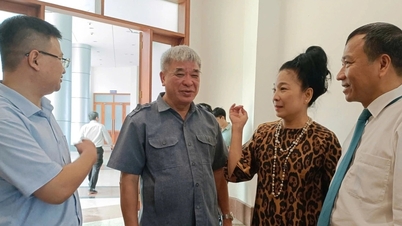
Mr. Nguyen Van Khoa, Chairman of LAEP, representing the company in signing the strategic cooperation agreement with JUIDA (Photo: LAEP).
JUIDA's representative, President Shinji Suzuki, stated that the association has been deeply involved in the development of institutional frameworks, standards, and operational guidelines for drones, and has also developed a network of over 200 training schools in Japan and other regions.
The association also plays a crucial role in training human resources for UAV operation, organizing training programs, and holding specialized exhibitions.
The potential of $10 billion from the lower-income economy.
The low-level economy is primarily based on the application of unmanned aerial vehicles (UAVs) and related technologies in sectors such as agriculture , logistics, environmental monitoring, transportation, communications, and entertainment.
This is a new economic space that leverages the underutilized lower atmosphere to create value through advanced technology.
According to Mr. Tran Anh Tuan, CEO of the Vietnam Aerospace and Drone Network, Vietnam has all the advantages to become a low-level economic hub.

The potential of the lower-income economy is estimated to reach $10 billion (Photo: Minh Nhat).
Vietnam possesses a stable geographical and political position, the potential to master core technologies (software, AI, and UTM systems), hardware manufacturing capabilities, and a well-developed ecosystem of supporting industries.
"UAVs are a new and rapidly growing industry in the last 10 years. Vietnam is fully capable of mastering this field and becoming a pioneering nation," Mr. Tuan emphasized.
To promote the development of the lower-income economy, he put forward several proposals such as building a legal framework, investing in the development of domestic R&D centers and LAE industrial parks, training and developing high-quality human resources, building a comprehensive interconnected ecosystem, and fostering international cooperation.
Mr. Vo Xuan Hoai, Deputy Director of the National Innovation Center, said that many countries around the world have considered aerospace and UAVs as strategic technology sectors. With the explosion of aerospace technology and unmanned aerial vehicles, a new economic model, specifically the low-level economy, is becoming a prominent development trend globally.
In Vietnam, the potential of the low-tech economy is estimated to reach $10 billion. With geopolitical advantages, policies encouraging innovation, and a young and dynamic workforce, Vietnam is facing a once-in-a-lifetime opportunity to become a low-tech industrial hub for the region and the world.
Source: https://dantri.com.vn/cong-nghe/kinh-te-tam-thap-xu-huong-toan-cau-va-co-hoi-cho-viet-nam-20251216232701445.htm
![[Image] The tenacious fighting spirit of Vietnamese women's football](/_next/image?url=https%3A%2F%2Fvphoto.vietnam.vn%2Fthumb%2F1200x675%2Fvietnam%2Fresource%2FIMAGE%2F2025%2F12%2F17%2F1765990260956_ndo_br_4224760955870434771-copy-jpg.webp&w=3840&q=75)
![[Photo] Prime Minister Pham Minh Chinh receives the Governor of Tochigi Province (Japan)](/_next/image?url=https%3A%2F%2Fvphoto.vietnam.vn%2Fthumb%2F1200x675%2Fvietnam%2Fresource%2FIMAGE%2F2025%2F12%2F16%2F1765892133176_dsc-8082-6425-jpg.webp&w=3840&q=75)
![[Image] Leaked images ahead of the 2025 Community Action Awards gala.](/_next/image?url=https%3A%2F%2Fvphoto.vietnam.vn%2Fthumb%2F1200x675%2Fvietnam%2Fresource%2FIMAGE%2F2025%2F12%2F16%2F1765882828720_ndo_br_thiet-ke-chua-co-ten-45-png.webp&w=3840&q=75)
![[Live] 2025 Community Action Awards Gala](/_next/image?url=https%3A%2F%2Fvphoto.vietnam.vn%2Fthumb%2F1200x675%2Fvietnam%2Fresource%2FIMAGE%2F2025%2F12%2F16%2F1765899631650_ndo_tr_z7334013144784-9f9fe10a6d63584c85aff40f2957c250-jpg.webp&w=3840&q=75)

![[Photo] Prime Minister Pham Minh Chinh receives Lao Minister of Education and Sports Thongsalith Mangnormek](/_next/image?url=https%3A%2F%2Fvphoto.vietnam.vn%2Fthumb%2F1200x675%2Fvietnam%2Fresource%2FIMAGE%2F2025%2F12%2F16%2F1765876834721_dsc-7519-jpg.webp&w=3840&q=75)





















































![[Live] Closing Ceremony and Award Presentation for the "Impressive Vietnam Tourism" Video/Clip Creation Contest 2025](https://vphoto.vietnam.vn/thumb/402x226/vietnam/resource/IMAGE/2025/12/17/1765974650260_z7273498850699-00d2fd6b0972cb39494cfa2559bf85ac-1765959338756946072104-627-0-1338-1138-crop-1765959347256801551121.jpeg)





















Comment (0)