

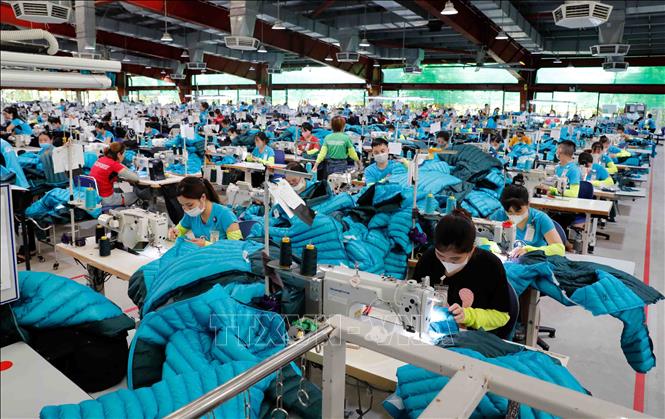
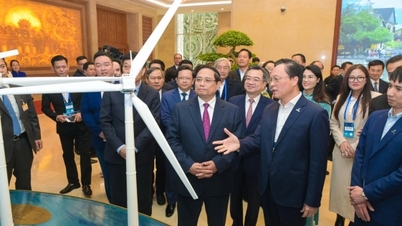
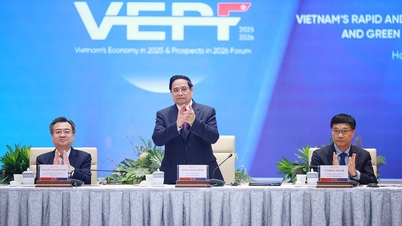
The Vietnam Economic Forum 2025, Outlook 2026 attracted more than 500 delegates attending in person and over 1,000 delegates online at 34 locations nationwide.
In the morning session, the Forum featured two thematic discussion sessions: Session 1 on Finance and Banking with the theme "Mobilizing and effectively utilizing financial resources for economic growth targets in the 2026-2030 period"; Session 2 on Circular Economy with the theme "Promoting green transformation and developing a circular economy to realize high growth and sustainable development goals".
Mobilizing and effectively utilizing financial resources.
At Session 1 on Finance and Banking, delegates focused on discussing solutions to effectively mobilize and utilize financial resources, aiming for economic growth targets in the 2026-2030 period. Effective mobilization and allocation of financial resources is identified as a key condition for Vietnam to realize its double-digit economic growth target during this period.
In his opening remarks at the thematic session, Mr. Pham Thanh Ha, Deputy Governor of the State Bank of Vietnam, emphasized that the Party and State have set a target of achieving at least 8% economic growth in 2025 and aiming for double-digit growth in the 2026-2030 period. According to the Deputy Governor, this is an important foundation for Vietnam to rise to the group of upper-middle-income countries by 2030 and move towards the goal of becoming a high-income country by 2045.
Mr. Pham Thanh Ha raised the issue: one of the crucial challenges for achieving high growth is ensuring sufficient capital for the economy, while also using it effectively to promote a growth model based on science and innovation.
The Deputy Governor affirmed that, to realize that aspiration, the economy not only needs to maintain a high growth rate over a long period but also must ensure stability and sustainability; at the same time, he pointed out that mobilizing sufficient capital resources to meet practical requirements and promote the economy to operate according to a new growth model based on science, technology, and innovation is one of the important tasks with a decisive impact on achieving double-digit growth targets.
From a financial and budgetary management perspective, Deputy Minister of Finance Do Thanh Trung affirmed that, with the motto of prioritizing domestic resources as a long-term strategy and external resources as an important, regular, and breakthrough factor, mobilizing sufficient capital is a major task. However, allocating it correctly, using it efficiently and transparently to create high added value is even more important and should be prioritized.
According to the Deputy Minister, the current growth model, which relies heavily on cheap capital, cheap labor, and outsourcing, is gradually revealing its limitations, necessitating a significant expansion of total social investment.
Deputy Minister Do Thanh Trung also stated that fiscal policy needs to continue playing a constructive role in long-term growth, managed proactively, sustainably, and with a focus on prioritizing the structure of state budget expenditures for development investment and ensuring social security.
During the discussion session, Dr. Can Van Luc – Chief Economist of BIDV Bank and a member of the Prime Minister's Policy Advisory Council – presented a paper on breakthrough solutions for mobilizing financial resources for high growth in the 2026-2030 period. He pointed out that the development model in the coming period needs to shift from relying heavily on capital and labor to relying more on "science, technology, innovation, and productivity (TFP)".
Opinions expressed at the discussion session suggested that the capital market needs to be further strengthened and developed to become the primary channel for mobilizing medium and long-term resources for the economy, thereby reducing pressure on the banking credit system while enhancing transparency and safety. Strengthening close coordination between fiscal and monetary policies is considered a key factor in ensuring macroeconomic stability, controlling inflation, and supporting high growth amidst increasing risks. Furthermore, significantly improving the investment and business environment, along with institutional reforms and building a transparent and stable legal framework, is identified as a fundamental and decisive solution to attract and retain high-quality, long-term financial resources.
The path to sustainable development
During the second thematic discussion on the Circular Economy, themed "Promoting Green Transformation and Circular Economy Development to Realize High Growth and Sustainable Development Goals," Mr. Pham Dai Duong, Deputy Head of the Central Policy and Strategy Committee, emphasized that to realize strategic development goals, Vietnam needs a strong impetus for innovation in its growth model. Mr. Pham Dai Duong stated that this new growth model must ensure sustainability, comprehensiveness, and inclusiveness, focusing not only on speed but also on quality, efficiency, and competitiveness. The core of the model is revolutionary transformations, including digital transformation to create a digital economy and digital society, and green transformation to develop harmoniously with nature, adapt to climate change, and fulfill strong international commitments, especially the goal of net zero emissions by 2050.
Mr. Pham Dai Duong affirmed that digital transformation and green transformation are not choices, but objective requirements of development practice. These two processes are closely linked, complementing each other, forming a "dual transformation"—a driving force for global growth in the coming decades. The Deputy Head of the Central Policy and Strategy Committee also pointed out that the circular economy, as a crucial driver of green transformation in the digital age, is closely linked to the development of science and technology, innovation, and digital transformation, and has been identified as a strategic pillar of the new growth model.
From a state management perspective, Mr. Le Cong Thanh, Deputy Minister of Agriculture and Environment, stated that Vietnam has built a fairly comprehensive system of guidelines and legal frameworks for the development of a green and circular economy. The merger between the Ministry of Agriculture and Rural Development and the Ministry of Natural Resources and Environment reflects a shift towards an integrated management mindset based on ecological space, closely linking resources and climate, creating an important foundation for promoting the goal of sustainable green economic development.
Deputy Minister Le Cong Thanh also emphasized that the green transformation process in Vietnam still faces many challenges, as many businesses, cooperatives, and farmers still maintain traditional methods, facing difficulties in capital, technology, and management capacity, while new markets such as the carbon market and biodiversity credits have not yet operated synchronously...
From an international perspective, Francesca Nardini, Deputy Resident Representative of the United Nations Development Programme (UNDP) in Vietnam, stated that international forecasts indicate that the circular economy could help Vietnam reduce urban waste by 30–34% and cut greenhouse gas emissions by 40–70% between 2030 and 2060, creating jobs and reducing dependence on imported raw materials. Ms. Nardini also shared that the UNDP recommends implementing the circular economy through pilot models to quantify risks and benefits before scaling up.
Drawing on local examples, Mr. Cung Trong Cuong, Director of the Hue City Development Research Institute, presented the city's practical model for implementing a circular economy. He stated that the city has issued a Plan for implementing the National Action Plan for Circular Economy until 2035 (Plan No. 284/KH-UBND), aiming for the development of a green, smart city, reducing emissions and efficiently using resources. The plan sets specific milestones by 2030, such as the proportion of renewable energy reaching 20% or more of total primary energy, 100% of household solid waste being collected and treated, and over 60% of urban wastewater being treated. To achieve this goal, Hue has identified 14 priority circular economy interventions across 6 sectors, including construction, food and agriculture, transportation, waste management, textiles, and tourism.
Experts at the Forum affirmed that the green transition and circular economy are the only path for Vietnam to achieve high growth coupled with sustainable development in the digital age.
Source: https://baotintuc.vn/thoi-su/kinh-te-viet-nam-chuyen-doi-xanh-trong-ky-nguyen-so-20251216132605863.htm

![[Photo] Prime Minister Pham Minh Chinh receives the Governor of Tochigi Province (Japan)](/_next/image?url=https%3A%2F%2Fvphoto.vietnam.vn%2Fthumb%2F1200x675%2Fvietnam%2Fresource%2FIMAGE%2F2025%2F12%2F16%2F1765892133176_dsc-8082-6425-jpg.webp&w=3840&q=75)

![[Image] Leaked images ahead of the 2025 Community Action Awards gala.](/_next/image?url=https%3A%2F%2Fvphoto.vietnam.vn%2Fthumb%2F1200x675%2Fvietnam%2Fresource%2FIMAGE%2F2025%2F12%2F16%2F1765882828720_ndo_br_thiet-ke-chua-co-ten-45-png.webp&w=3840&q=75)
![[Live] 2025 Community Action Awards Gala](/_next/image?url=https%3A%2F%2Fvphoto.vietnam.vn%2Fthumb%2F1200x675%2Fvietnam%2Fresource%2FIMAGE%2F2025%2F12%2F16%2F1765899631650_ndo_tr_z7334013144784-9f9fe10a6d63584c85aff40f2957c250-jpg.webp&w=3840&q=75)
![[Photo] Prime Minister Pham Minh Chinh receives Lao Minister of Education and Sports Thongsalith Mangnormek](/_next/image?url=https%3A%2F%2Fvphoto.vietnam.vn%2Fthumb%2F1200x675%2Fvietnam%2Fresource%2FIMAGE%2F2025%2F12%2F16%2F1765876834721_dsc-7519-jpg.webp&w=3840&q=75)



































![[Photo] Prime Minister Pham Minh Chinh attends the Vietnam Economic Forum 2025](https://vphoto.vietnam.vn/thumb/402x226/vietnam/resource/IMAGE/2025/12/16/1765893035503_ndo_br_dsc-8043-jpg.webp)


















Comment (0)