

This assessment was made by lecturers and experts at a panel discussion held as part of the Technology Festival, in response to World Innovation Week, recently organized in Ho Chi Minh City.
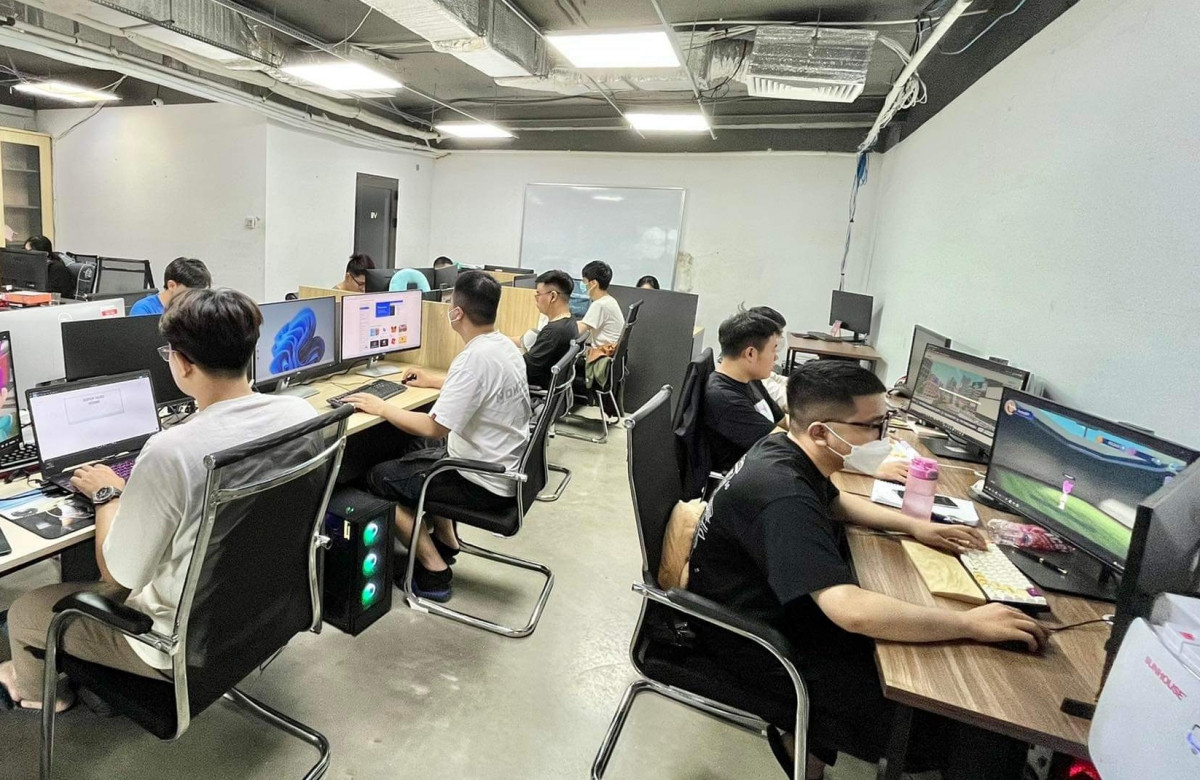
A short-term education model is needed for new technologies.
A question posed to lecturers and experts is how to quickly train human resources in new technologies at a time when technology is changing so rapidly, especially in the fields of AI, Blockchain, or semiconductors, aiming to train 50,000 to 100,000 personnel in the near future.
According to Dr. Nguyen Thanh Binh, Senior Program Manager at RMIT University, one of the weaknesses of current technology workforce training in Vietnam is the lack of a solid foundation. Regarding education, there needs to be in-depth research into the depth of technology and its application in both finance and business. This is crucial, and the foundation here is research.
Mr. Nguyen Thanh Binh stated that the challenge for universities is deciding what research topics to pursue amidst the rapid pace of technological development. The solution lies in collaborating with businesses. Universities should examine the current challenges faced by businesses and the economy to conduct research and find solutions. A foundation needs to be created, and new educational methods should be developed based on this foundation.
Representatives from RMIT University argued that we must consider the evolution of educational models, where students don't need to spend 3-4 years to complete a major. Specifically, we need shorter educational models; for example, to train 100,000 new technology professionals in fields like AI and Blockchain within 6 months, we need to select working professionals to update their knowledge and specialize in a particular area.
"We have no way of training 100,000 students with the latest technological knowledge in the next 3-4 years. The solution here is to create new educational products and models for working professionals and train them within 6 months," said Mr. Nguyen Thanh Binh.
Mr. Vu Anh Tuan from the Ho Chi Minh City Informatics Association (HCA) also agreed with this viewpoint. According to him, we must constantly chase after technology, and this applies to human resource training as well. For example, when Intel built its semiconductor factory in Vietnam, they spent a year recruiting personnel and sending them abroad for intensive training to ensure they could meet the factory's requirements. However, not every company can do this. Therefore, the solution is to organize short-term training courses by selecting engineers with 5-10 years of experience to train them in new fields for a period of one year.
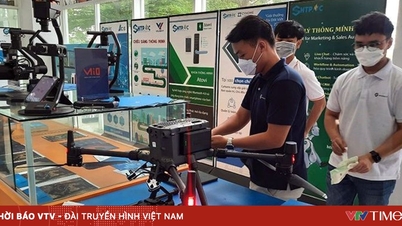
According to Dr. Le Khanh Duy, Head of the Human-Computer Interaction Research Group at the University of Science (Vietnam National University Ho Chi Minh City), one difficulty in training in new technologies in Vietnam is the lack of equipment in training institutions to teach using models and prototypes. The current solution for universities is to rely on the help of international professors, conduct interdisciplinary and inter-university collaborations, and share infrastructure... so that students can both practice the latest technologies and access world-class knowledge.
Mr. Le Khanh Duy shared that, in the short term, it can be seen that students are very quick to absorb new technologies. However, whether talented students choose to study abroad after graduation and whether they will return is a question that needs to be addressed.
Representatives from the University of Natural Sciences hope that the mechanism will change in both the public and private sectors to retain talented individuals to conduct research, contribute, and solve problems for businesses and society, rather than leaving for overseas. In the future, it may be possible to combine universities and businesses to train a team of experts in Vietnam.
Focus on community education.
Another aspect of training new technology personnel, highlighted by Lynn Hoang, Country Director of Binance Vietnam, is the emphasis on community education.
Specifically, Binance believes that popularizing new technologies like Blockchain among all students and across various fields is especially important. That's why Binance Academy is designed to serve the community, the majority of people who want to learn from basic to advanced levels. To achieve this, the training facility must first make people interested and see the real value, then those with the need and passion can continue to delve deeper.
According to Lynn Hoang, this requires a variety of approaches, from open data repositories for the community to courses with exams and certifications, or programs in collaboration with universities and research institutes across the country.
In Vietnam, Binance has partnered with over 20 universities across 7 provinces and cities, bringing knowledge about new technologies to more than 5,000 students. All content and teaching materials are designed and presented under the close supervision of faculty members to ensure they are most suitable for students.
Source
![[Photo] Prime Minister Pham Minh Chinh receives Lao Minister of Education and Sports Thongsalith Mangnormek](/_next/image?url=https%3A%2F%2Fvphoto.vietnam.vn%2Fthumb%2F1200x675%2Fvietnam%2Fresource%2FIMAGE%2F2025%2F12%2F16%2F1765876834721_dsc-7519-jpg.webp&w=3840&q=75)
![[Photo] Prime Minister Pham Minh Chinh receives the Governor of Tochigi Province (Japan)](/_next/image?url=https%3A%2F%2Fvphoto.vietnam.vn%2Fthumb%2F1200x675%2Fvietnam%2Fresource%2FIMAGE%2F2025%2F12%2F16%2F1765892133176_dsc-8082-6425-jpg.webp&w=3840&q=75)
![[Image] Leaked images ahead of the 2025 Community Action Awards gala.](/_next/image?url=https%3A%2F%2Fvphoto.vietnam.vn%2Fthumb%2F1200x675%2Fvietnam%2Fresource%2FIMAGE%2F2025%2F12%2F16%2F1765882828720_ndo_br_thiet-ke-chua-co-ten-45-png.webp&w=3840&q=75)
![[Image] The tenacious fighting spirit of Vietnamese women's football](/_next/image?url=https%3A%2F%2Fvphoto.vietnam.vn%2Fthumb%2F1200x675%2Fvietnam%2Fresource%2FIMAGE%2F2025%2F12%2F17%2F1765990260956_ndo_br_4224760955870434771-copy-jpg.webp&w=3840&q=75)

![[Live] 2025 Community Action Awards Gala](/_next/image?url=https%3A%2F%2Fvphoto.vietnam.vn%2Fthumb%2F1200x675%2Fvietnam%2Fresource%2FIMAGE%2F2025%2F12%2F16%2F1765899631650_ndo_tr_z7334013144784-9f9fe10a6d63584c85aff40f2957c250-jpg.webp&w=3840&q=75)










![[Video] Exhibition space "Great Poet Nguyen Du - Remembered for a Thousand Years"](https://vphoto.vietnam.vn/thumb/402x226/vietnam/resource/IMAGE/2025/12/17/1765983645796_khong-gian-trung-bay-dai-thi-hao-nguyen-du-ngan-nam-nho-mai-3610-jpg.webp)



















































![[Live] Closing Ceremony and Award Presentation for the "Impressive Vietnam Tourism" Video/Clip Creation Contest 2025](https://vphoto.vietnam.vn/thumb/402x226/vietnam/resource/IMAGE/2025/12/17/1765974650260_z7273498850699-00d2fd6b0972cb39494cfa2559bf85ac-1765959338756946072104-627-0-1338-1138-crop-1765959347256801551121.jpeg)


















Comment (0)