

(NLĐO) - The planet Barnard b weighs only 37% of Earth's mass and is described as a rare astronomical treasure.
According to Sci-News, a research team led by Dr. Jonay González Hernández from the Canary Islands Institute of Astrophysics (Spain) has identified a "miniature Earth" orbiting the single closest star to the Sun, named Barnard.
Barnard is a 10-billion-year-old red dwarf star, and the new planet—named Barnard b—orbits Barnard at a distance only 1/20th the distance between the Sun and Mercury.
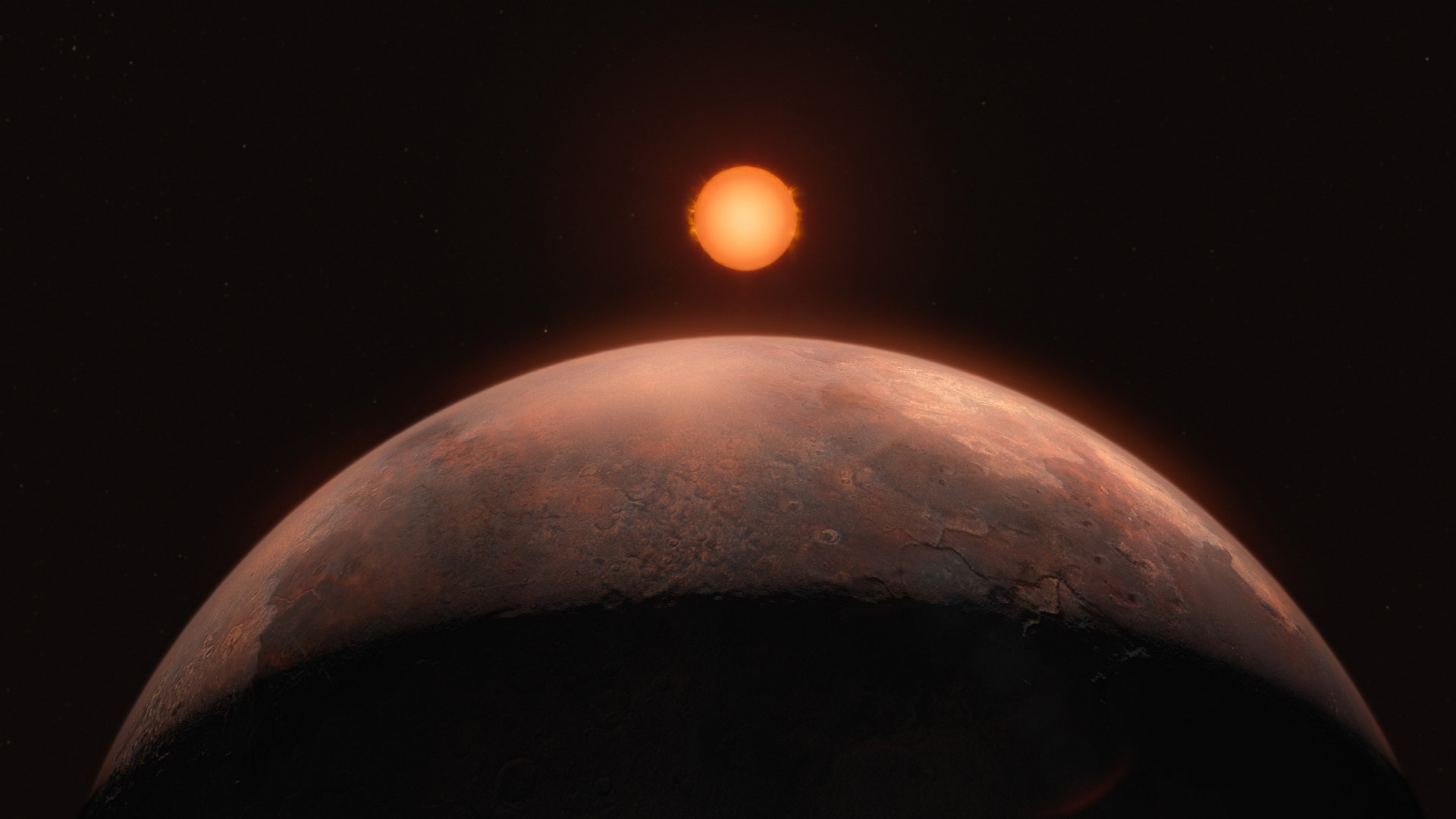
Barnard b, a "miniature Earth," orbits a red dwarf star less than 6 light-years from us - Photo: ESO
With a mass only 37% that of Earth and about half that of Venus, Barnard b is the smallest exoplanet ever identified by humankind.
Because it is a rocky planet, scientists describe Barnard b as a "miniature Earth".
It is precisely its modest size and mass that makes Barnard b a rare astronomical treasure.
The distances between star systems are vast, so even with humanity's advanced observational tools, searching for small planets around other stars is incredibly difficult. Even finding rocky planets the size of Earth is a major challenge. Most known exoplanets are giant gas planets .
Therefore, Barnard b presents a great opportunity for scientists to study how small rocky planets form and evolve. The star system it inhabits is only 5.96 light-years from Earth, making the study quite convenient.
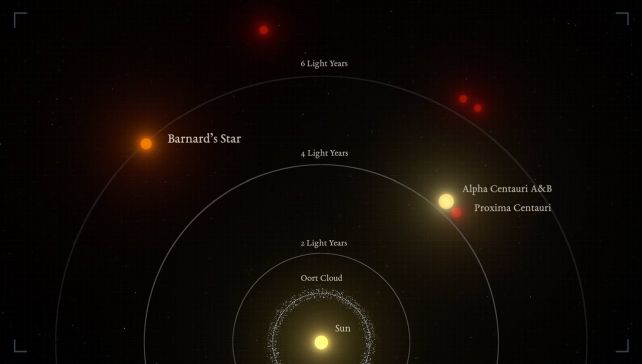
The diagram shows the positions of the nearest stars around the Sun, including Barnard, which is only slightly farther away than the Alpha Centauri A&B pair - Image: IEEC
To find this "miniature Earth," researchers had to sift through data from five years of observations by the ESPRESSO instrument on the Very Large Telescope (VLT) owned by the European Southern Observatory (ESO), located at the Paranal Observatory in Chile.
Although further research will be conducted on Barnard b, the authors do not expect to find life there.
This planet is so close to its parent star that it takes only 3.15 days to complete one orbit around it. Therefore, despite the red dwarf star Barnard being 2,500 degrees Celsius cooler than the Sun, the temperature on Barnard b would still be too hot to keep water in a liquid state.
In addition to Barnard b, scientists have also identified suspicious signs of three other exoplanets orbiting this red dwarf star.
Research on "miniature Earth" has just been published in the scientific journal Astronomy & Astrophysics .
Source: https://nld.com.vn/lo-dien-trai-dat-thu-nho-cach-chung-ta-chi-6-nam-anh-sang-196241003100508298.htm




![[Photo] General Secretary and President To Lam presides over a meeting on preparations for the review of one year of operation of the three-tiered government system.](https://vphoto.vietnam.vn/thumb/1200x675/vietnam/resource/IMAGE/2026/06/02/1780391821195_a1-bnd-4595-9717-jpg.webp)
















![[Video] What to do when changing phones from June 15, 2026?](https://vphoto.vietnam.vn/thumb/402x226/vietnam/resource/IMAGE/2026/06/02/1780386426938_dt-jpg.webp)

















































































Comment (0)