

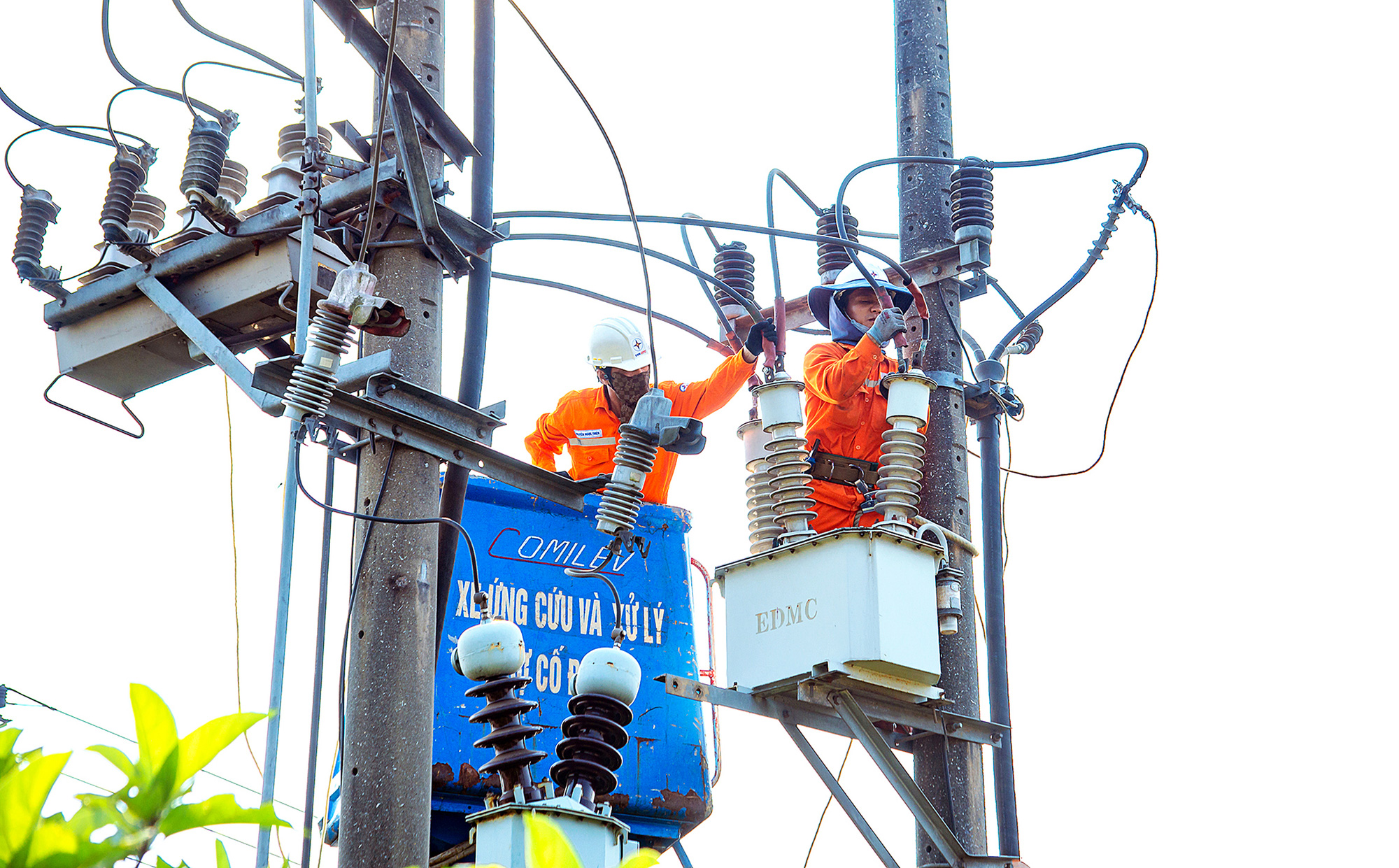
The current power system's operation relies heavily on coal-fired power, accounting for 60% of its needs - Photo: D. Tuyen
In mid-June, as the dry season peaked, intense heat in many provinces and cities caused electricity consumption to continuously exceed its peak. According to the Electricity Regulatory Authority ( Ministry of Industry and Trade ), the highest load demand from June 10th to 16th reached its highest value of the year in the North.
With rising water levels, hydroelectric power plants have to release floodwaters.
As of June 14th, the total system capacity reached 48,954 MW, with electricity production of 1,019 million kWh, of which the North alone accounted for 504.9 million kWh, the highest load since the beginning of the year with an average daily output of 945.6 million kWh.
From the beginning of the year until now, national electricity demand has grown by approximately 11.5% compared to the same period in 2023 (Northern Vietnam increased by 11.1%, Central Vietnam by 10.2%, and Southern Vietnam by 12%). According to the Electricity Regulatory Authority, the national power dispatch system has recently increased the operation of Son La , Hoa Binh, Tuyen Quang, and Ban Chat reservoirs to gradually bring the water levels back to pre-flood levels.
However, since June 11th, the Tuyen Quang reservoirs have had to open 1-2 bottom sluice gates. On June 15th, starting at 1 PM, the Son La reservoir had to open one bottom sluice gate and closed it again at 6 PM the same day. This development differs from previous events, when, since April, the electricity sector stated that it had to store and conserve water, "saving" it to prioritize power generation during the peak of the dry season.
The remaining electricity production in the reservoirs as of 0:00 on June 16th for the entire system was 7,973.3 million kWh, 2,987.3 million kWh higher than the annual plan. Water inflow into hydropower reservoirs in the North was 109-230% higher than planned, such as Ban Chat, Thac Ba, Tuyen Quang, Trung Son, and Bac Ha reservoirs, but the remaining reservoirs had low water inflow, only reaching 33-92%.
Meanwhile, reservoirs in Central Vietnam experienced significantly lower water inflows than average, ranging from 7% to 84%, while all reservoirs in Southern Vietnam had lower-than-average water levels (except for Dong Nai 2 and Da Nhim reservoirs).
Speaking to Tuoi Tre newspaper, an expert in the electricity sector said that due to the relatively safe and flexible design of the reservoirs, which have both bottom and surface discharge gates, the reservoirs will operate according to actual conditions when water levels rise. In the context of a strained electricity supply during the dry season, water storage and conservation for power generation during peak periods of the dry season will be a top priority.
According to this source, large hydropower plants like Hoa Binh, Son La, and Thac Ba... have reservoirs, allowing them to store water. "For smaller hydropower plants without reservoirs, water cannot be stored when it comes in, so investors are forced to release floodwaters during heavy rains or sudden water inflows to ensure the safe operation of the facility," this source explained.
In fact, in the North, the capacity of small hydropower plants is about 4,500MW, equivalent to that of large hydropower plants, so the release of water when there is a sudden surge in water is a normal safety principle for these structures.
Many countries are running generators but are still worried about electricity shortages.
Although water levels in the reservoirs have improved and there is some water release, according to electricity industry experts, during peak periods of continuous hot weather, electricity supply will face many difficulties because the available capacity of hydropower plants will decrease sharply according to the water level in the reservoirs.
For example, with Hoa Binh reservoir, if the water level is sufficient, the capacity reaches 1,920MW, but this figure drops to only 1,400MW if the water level in the reservoir decreases due to increased use. However, according to this source, hydropower no longer accounts for a large proportion. The balance depends on coal-fired thermal power.
In fact, to proactively manage operations, many coal-fired power plants have accelerated coal imports even before the peak season. Nghi Son Thermal Power Plant - one of the large-scale coal-fired power plants with a capacity of 600MW belonging to Power Generation Corporation 1 (GENCO 1) - stated that the electricity production and mobilization of the company are both higher than the plan approved by the Ministry of Industry and Trade.
According to a representative of this company, to meet the increased demand for energy mobilization in the first four months of the year, the company signed coal supply contracts with the Vietnam Coal and Mineral Industry Group (TKV) and the Northeast Corporation with a higher volume of 109,000 tons, ensuring an additional 250 million kWh of electricity generation compared to the assigned plan.
To date, coal inventories have remained on schedule, meeting operational needs and maintaining inventory levels higher than the minimum required level.
With 20 power plants boasting a total installed capacity of 7,150 MW, accounting for 8.9% of the total system capacity, ensuring the operation of GENCO 1's (under EVN) power plants plays a crucial role. According to GENCO 1 representatives, coal-fired power plants must always be prepared and maintain the highest level of operational reliability to maximize power generation.
This enterprise also proactively requires the chairmen and general directors of its affiliated power units to uphold the spirit of responsibility as leaders, and to increase discipline and order. They must strictly adhere to operating procedures and inspection and monitoring to identify potential risks early and prevent incidents in power generation, and prepare materials and personnel in advance to operate the system...
It is necessary to ensure sufficient electricity supply during peak hot weather periods.
According to the Ministry of Industry and Trade, from now until the end of June, coal-fired power plants will continue to be operated according to system needs, ensuring optimal operation and maintenance in conjunction with gas turbine power plants.
Hydropower plants are also operated according to actual hydrological conditions, flexibly mobilizing to ensure available capacity to meet the peak hot season in the northern region. Maximum utilization is being made at the Tuyen Quang, Son La, Hoa Binh, and Ban Chat hydropower plants due to good water inflow and increased flood control capacity.
The Ministry also directed power generation units to proactively report and provide accurate information on the operation of generating units, causes of incidents, remediation time, coal inventory, projected progress and coal import plan to A0.
Under no circumstances should a power plant be ready to generate electricity but lack sufficient coal fuel to operate at full capacity, in order to have a basis for planning operations for the remaining months of 2024.
Source: https://tuoitre.vn/lo-thieu-dien-vi-sao-van-xa-lu-20240621093505885.htm
































![[Photo] Reception to welcome General Secretary and President To Lam and his wife on their State visit to the Philippines](https://vphoto.vietnam.vn/thumb/1200x675/vietnam/resource/IMAGE/2026/06/01/1780295488620_vna-potal-chieu-dai-chao-mung-tong-bi-thu-chu-tich-nuoc-to-lam-va-phu-nhan-tham-cap-nha-nuoc-toi-philippines-8798060-7855-jpg.webp)































































Comment (0)