

In the US, Atom Computing has created the first quantum computer with 1,180 qubits, which could improve the machine's accuracy.
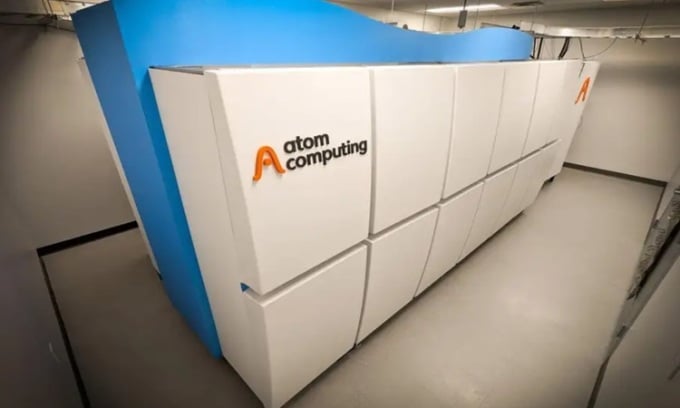
The largest quantum computer was built by Atom Computing. Photo: Atom Computing
The world's first quantum computer has more than double the number of quantum bits (qubits) of the previous world record holder, IBM's Osprey computer (433 qubits). While more qubits don't necessarily translate to better performance, a large number of qubits is essential for future error-free quantum computers, unlike today's noisy research machines. The largest quantum computers, such as those from IBM and Google, use superconducting circuits cooled to extremely low temperatures. But the record-breaking machine from California startup Atom Computing boasts 1,180 qubits, using neutral atoms held in place by lasers in a two-dimensional network, New Scientist reported on October 24.
One advantage of this design is the ease with which the system can be scaled and more qubits added to the network, according to Rob Hays, CEO of Atom Computing. Any future useful quantum computer that is error-free (a characteristic known as fault tolerance) will need at least tens of thousands of error-correcting qubits operating in parallel with the programming qubits.
"If we only scale up to tens of qubits, like most current superconducting and ion-trapping systems, it will take a very long time to reach the era of fault-tolerant machines. With the neutral atom approach, we can reach that milestone much faster," Hays explained. According to him, the Atom Computing research team aims to increase the number of qubits in the machine by about tenfold every two years.
Unlike conventional computer bits, which have a value of 1 or 0, qubits are more diverse, possessing a range of different characteristics depending on how they are created. Neutral atoms are better suited to quantum entanglement, a strange quantum effect in which two qubits are coupled and can influence each other even over vast distances. They are also more stable. Qubits in Atom Computing's computers prevent quantum states from collapsing, thereby achieving fault tolerance, for nearly a minute. In comparison, IBM's Osprey computer has qubit coupling times of only about 70-80 microseconds.
The long binding time comes from the ytterbium atom that Hays and colleagues used as a qubit. Most atomic-neutral machines use the atom's electrons as quantum elements to perform calculations, but these are easily affected by the powerful lasers used to fix them. With ytterbium, researchers can use a quantum property of the atomic nucleus called spin (the particle's intrinsic angular momentum), which is less susceptible to disorder. According to researcher Ben Bloom at Atom Computing, the nucleus doesn't interact with the external environment as strongly as the electron.
Because qubits have so many different characteristics, it's difficult to compare them between different machines. However, Bloom says Atom Computing's machine has processing capabilities comparable to IBM's computer. The research team hopes to be able to provide the computer to customers next year for cloud computing applications.
An Khang (According to New Scientist )
Source link












![[INFOGRAPHIC] Top world events of 2025](https://vphoto.vietnam.vn/thumb/402x226/vietnam/resource/IMAGE/2025/12/24/1766534568261_thumb-su-kien-the-gioi-jpg.webp)





















































































Comment (0)