

Attending the ceremony were Party Central Committee members: Politburo member, Secretary of the National Assembly Party Committee, Chairman of the National Assembly Tran Thanh Man; Deputy Prime Minister, Chairman of the Central Council for Coordinating Legal Education and Dissemination Ho Quoc Dung; Secretary General of the National Assembly, Chairman of the National Assembly Office Le Quang Manh; Chairman of the Law and Justice Committee Hoang Thanh Tung; Minister of Justice , Permanent Vice Chairman of the Central Council for Coordinating Legal Education and Dissemination Nguyen Hai Ninh.
Also attending were representatives of central departments, ministries, branches, Provincial Party Committees, City Party Committees, People's Councils, People's Committees, Vietnam Fatherland Front Committees and National Assembly delegations of provinces and cities, members of the Coordinating Council for Dissemination of Law Education; representatives of departments, branches, unions, provincial and city business associations; representatives of Party committees, authorities, socio -political organizations at commune level...

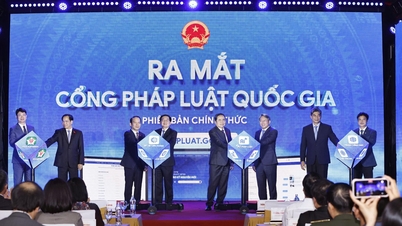
National Assembly Chairman Tran Thanh Man and delegates pressed the button to launch the official version of the National Law Portal.
With the orientation of not only being an information page but also a working space, looking up and experiencing digital law, the official version of the National Law Portal was directed by the Ministry of Justice with the companionship of FPT Group with six key breakthroughs: (1) The Portal interface is designed in a modern, multi-platform optimized manner, continuously updating important political events of the country and policy highlights; (2) Integrated with VNeID, allowing users to log in with electronic identification and track legal content on the digital citizen application; (3) Open data warehouse connected to many ministries, branches and localities, supporting analysis, comparison and monitoring of document validity; (4) English page developed separately, targeting investors and the international community, with official news sources from Vietnam News Agency; (5) Connecting with social networks to spread accurate legal information to the wider community; (6) Applying artificial intelligence in operations, legal AI assistants analyze, summarize and support users to access legal information effectively.

National Law Portal is integrated on VNeID
New features such as satisfaction rating, text processing tools, automatic extraction and summarization, and electronic judicial practice handbook have also been added to support professionals and enhance user experience.
With outstanding features, the official version of the National Law Portal is a unified national legal platform, providing a system of official legal documents, interpretations and real-time search support. In the context of focusing on digital transformation and the increasing need for policy transparency, with the spirit of realizing the goals of Resolution 57-NQ/TW and Resolution 66-NQ/TW of the Politburo, the platform plays a key role in helping people easily access legal information, proactively learn and update new policies, and at the same time create conditions for businesses to promptly grasp regulations governing production and business activities. For State agencies and staff, the Portal contributes to improving the effectiveness of law enforcement, supporting management and training in judicial profession, thereby enhancing the quality of public administrative services and promoting the construction of a socialist rule-of-law state in the digital age.

The National Law Portal was introduced at the event.
A representative of FPT Corporation affirmed that when the law is more easily accessible, transparent and convenient, it is not only a technological achievement, but also a step forward to strengthen and improve law enforcement capacity in life.
The official launch of the National Legal Portal affirms the determination of the Ministry of Justice in particular and the Government in general in institutional reform, serving people and businesses, and creating a modern, transparent, internationally integrated governance platform.
Previously, on May 31, 2025, the pilot version of the Portal was deployed, creating an open legal platform with a "user-centric" orientation. After only 5 months of trial operation, the system recorded more than 1 million visits, 200,000 questions answered by AI Law and thousands of comments from ministries, branches and localities. Notably, during the period when localities deployed the two-level government model, the National Law Portal promptly supported decentralization and delegation of power according to the new organizational structure, ensuring people's rights in key areas such as nationality and civil status, contributing to strengthening trust in the transparent and modern legal system.
In 2025, the system will continue to connect to the National Legal Database, expand the ability to apply contextual AI, including a tool to support searching for more than 1.4 million case laws, and develop a set of policy impact analysis tools to serve the planning and appraisal of documents by the Government and competent agencies.

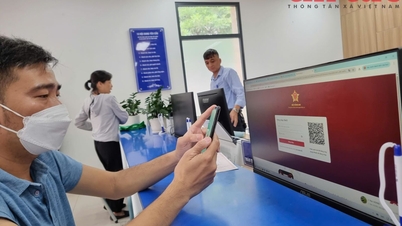
The National Law Portal is integrated with VNeID, allowing users to log in with their electronic identification and track legal content on the digital citizen application or access the portal from the VNeID application.

The official version of the National Law Portal has many breakthrough technological features.
The National Legal Portal is not only a technology platform, but also a bridge connecting people and businesses with the legal system in a more convenient, transparent and accessible way, thereby promoting trust and enhancing law enforcement capacity in society. FPT is committed to accompanying the Government, ministries and localities in the journey of national digital transformation, closely following Resolution 57-NQ/TW, towards a transparent, modern and people-centered legal ecosystem, helping Vietnam grow in the digital age.
PV
![[Photo] Cutting hills to make way for people to travel on route 14E that suffered landslides](https://vphoto.vietnam.vn/thumb/1200x675/vietnam/resource/IMAGE/2025/11/08/1762599969318_ndo_br_thiet-ke-chua-co-ten-2025-11-08t154639923-png.webp)






























![[Photo] "Ship graveyard" on Xuan Dai Bay](https://vphoto.vietnam.vn/thumb/1200x675/vietnam/resource/IMAGE/2025/11/08/1762577162805_ndo_br_tb5-jpg.webp)



![[Video] Hue Monuments reopen to welcome visitors](https://vphoto.vietnam.vn/thumb/402x226/vietnam/resource/IMAGE/2025/11/05/1762301089171_dung01-05-43-09still013-jpg.webp)




























































Comment (0)