

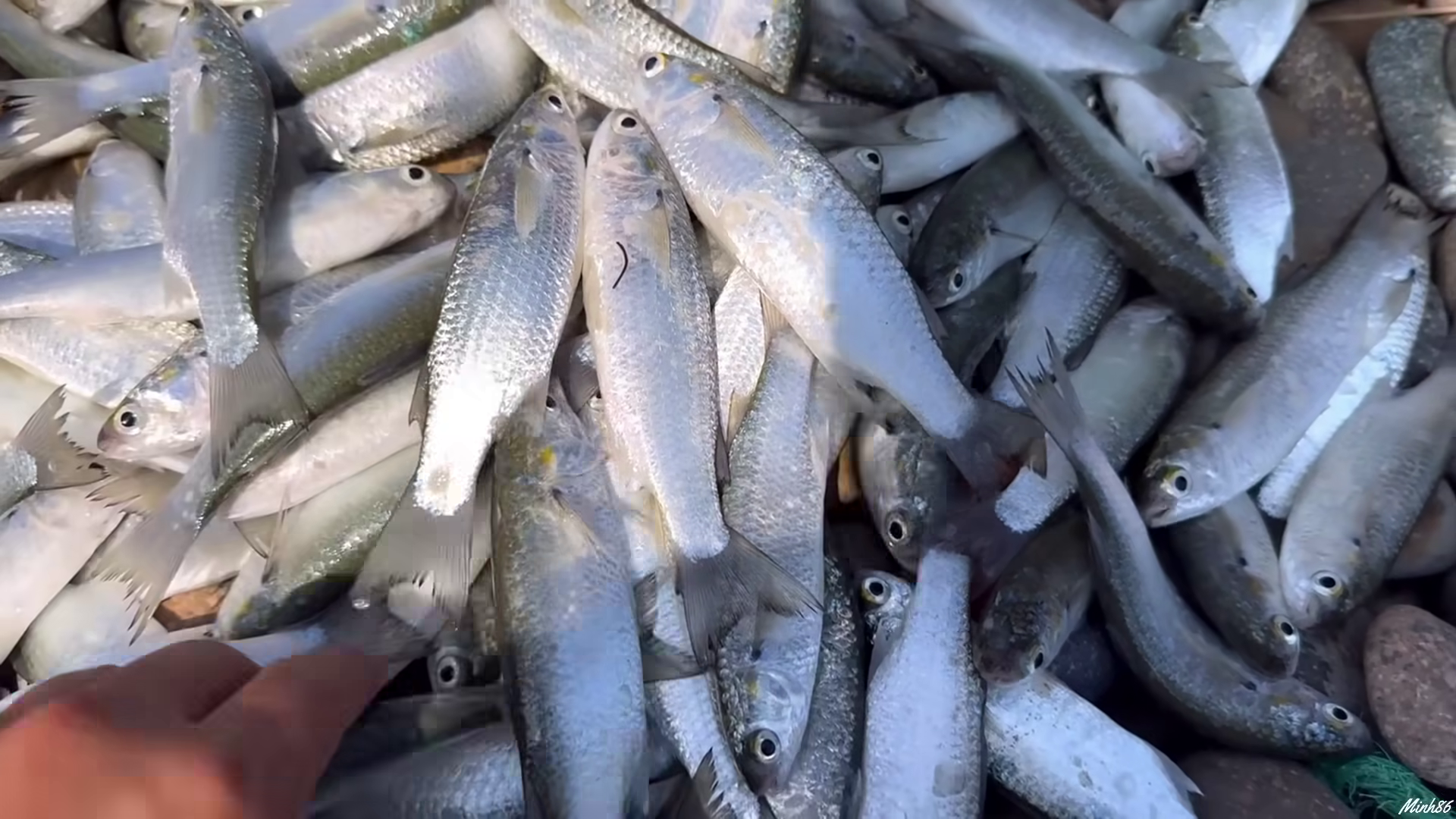
Mullet, like many other fish species, migrate seasonally in search of better living conditions, such as water temperature, salinity, or abundant food sources. Therefore, when the seasons change, mullet migrate in large numbers, often in schools, to find food or reproduce. As the fish move, they create waves and noise on the water's surface, giving fishermen the impression that they are "running" (sometimes referred to as the mullet migration season in certain regions). Mullet mainly live in the surface layer near the shore, so they can be caught by casting nets about 7-9 nautical miles from the shore. From July and August to the end of the year is the peak season for mullet, when they are fat and abundant. The fresh fish, glistening with scales, are gathered on the shore by fishermen as they untangle their nets, creating a bustling atmosphere.
Around 9-10 a.m., on La Gàn beach, a group of 5-6 fishermen sit on the shore, watching the waves to find schools of mullet. Only experienced fishermen can spot these mullet schools. Pointing to the dark blue-black currents moving in the distance, the men on shore quickly shout, "Fish! Fish!" Then, one fisherman grabs his net and rushes into the sea to cast it. The net soars high, spreading wide across the water's surface, a beautiful sight. About five minutes later, they pull in the net, hauling it ashore to remove the fish amidst bursts of laughter. The fish jump and splash, showing off their plump bellies and shimmering scales. One person pulls up the net, then another takes turns. "Occasionally, schools of fish will surface to catch prey, revealing their white backs, which you can then see. Few people who don't work in the fishing industry can identify where there are mullet," said Hau, a fisherman who has been catching mullet for many years in the La Gan sea.
Compared to other sea areas, the La Gàn strait is not too deep. Long-time coastal residents believe that the arrival of mullet is a positive sign for the natural marine environment here. This season, the mullet are mainly leaf mullet and pointed mullet, which have very delicious meat. Mullet fishermen say that this profession has an unstable income, sometimes having a catch, sometimes not; however, during the peak season, it can bring in a decent income. "Small mullet, about the size of two fingers, sell for 30,000 - 40,000 VND/kg; larger ones cost 80,000 - 100,000 VND/kg. Hardworking people can earn an average of 300,000 - 400,000 VND per day. During the peak fishing season (August and September in the lunar calendar), some days each person can earn 700,000 VND to even a million VND," said Mr. Ngo Van Tuan, an old fisherman with over 30 years of experience.
Mackerel is very fatty and has sweet, fragrant flesh during the season. Coastal people often grill mackerel over hot charcoal and eat it with tamarind sauce, which is very appetizing. Mackerel has thick scales; removing the scales reveals a layer of golden fat, which gives off an irresistible aroma when grilled. Coastal people eat the scales as well, considering them the fattiest part. If you're not used to eating scales, you can easily remove them by peeling them off from the belly upwards.
The coming months will be the peak season for mullet, so the nearly kilometer-long La Gàn beach becomes bustling with groups of people from all over, calling out to each other as they come to cast nets and catch mullet, even children joining in. Harvesting mullet not only provides fishermen with extra income but also offers an exciting experience in searching for "sea bounty" during the northerly winds. The fishermen here always remind each other that when they catch small fish, they should release them back into the sea so they can grow and catch more next time. This way, the marine resources are not depleted and the fishermen can continue to enjoy "sea bounty" for a long time.
Source: https://baolamdong.vn/mua-ca-doi-chay-o-bien-la-gan-382921.html



![[Photo] General Secretary and President To Lam presides over a working session with the Central Policy and Strategy Committee on the development of the materials industry.](https://vphoto.vietnam.vn/thumb/1200x675/vietnam/resource/IMAGE/2026/05/21/1779359935432_a3-bnd-3129-1412-jpg.webp)


















































































Comment (0)