

 |
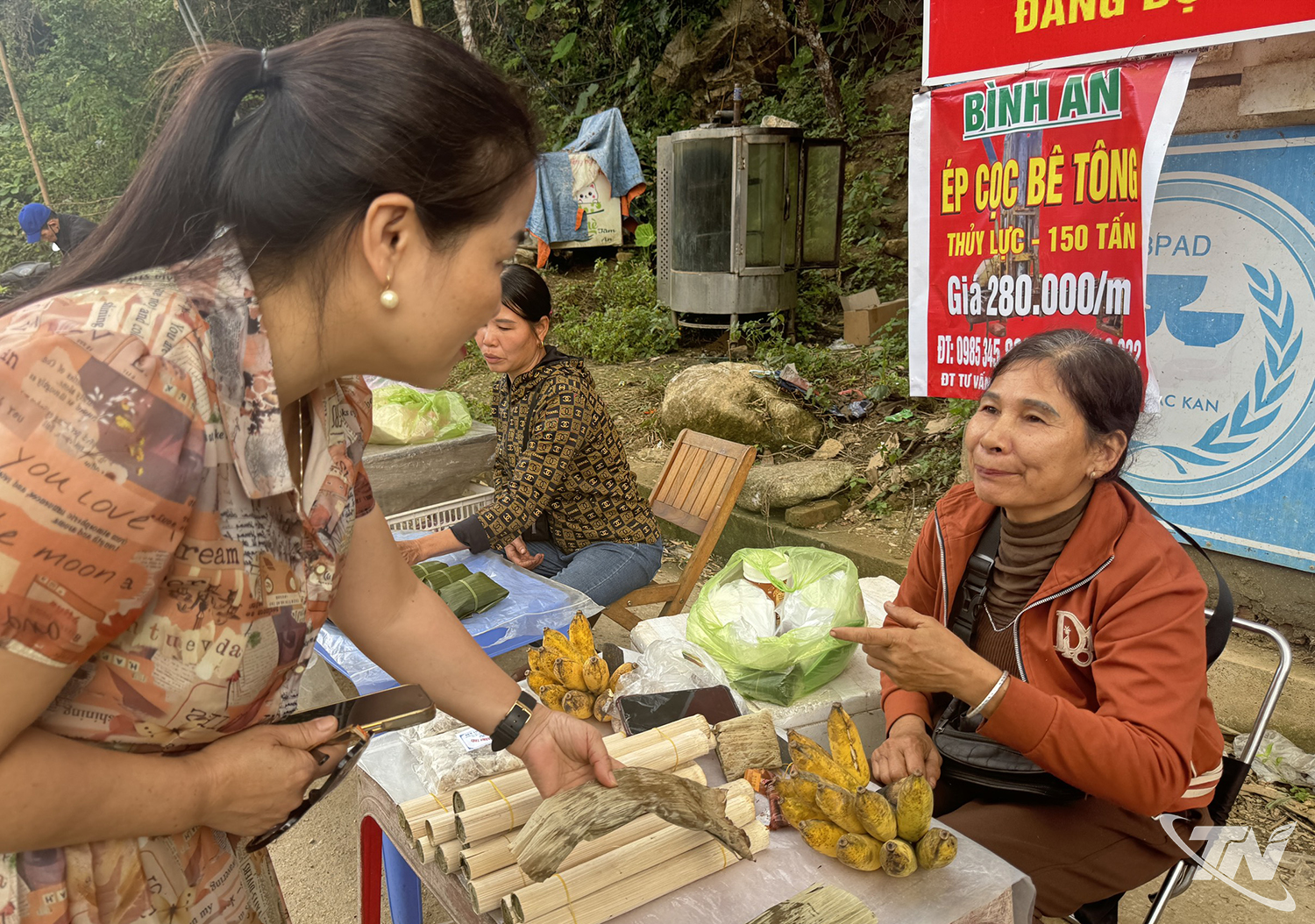
| Ms. Duong Thi Vuong sells banana cakes to tourists visiting Ba Be Lake. |
Ba Be is famous for its freshwater lake nestled in the mountains, its dense, ancient forests, and its rich ecosystem. Within these forests, wild banana trees grow naturally, with tall trunks, broad leaves, and roots that penetrate deep into the soil. Unlike cultivated bananas, wild bananas yield firm, less fibrous tubers with a distinctive nutty flavor – a valuable ingredient for making the rustic yet soulful banana cake.
According to Ms. Vuong, the banana cake-making profession has been passed down in her family since her grandparents' time. Back then, life was difficult, with little arable land and limited hillside farming, so people had to rely on the forest for survival. Wild banana roots, something seemingly discarded, were transformed by the skillful hands of highland women into a cake that sustained the entire family.
"Since I was little, I followed my mother into the forest to dig up banana roots, then helped wash, slice, and dry them. As I grew up, I continued the trade, and now it's my turn to pass it on to my children," Ms. Vuong shared.
Making banana cake is not simple, nor is it a quick-fix profession. First, the baker must go into the forest to select mature banana trees with large, firm corms. Digging up the corms is a laborious process, requiring strength and experience to avoid damaging the corms and to minimize damage to the surrounding young trees.
The banana rhizomes are washed to remove dirt and sand, sliced thinly, and then dried in the sun. Sometimes they have to be dried for several days, and on rainy or windy days, they have to be air-dried over a fire to ensure even drying.
When making the cake, dried banana stems are boiled until tender in lye water – water filtered from kitchen ash – which gives the cake its characteristic chewy texture and dark brown color. After boiling, the baker squeezes the soft pulp, then cooks it with molasses to enhance the aroma, and then grinds it into a paste. The filling is usually made from cooked mung beans or peanuts, mixed with sugar, creating a rich, creamy, and subtly sweet flavor. All the ingredients are combined, wrapped in wild banana leaves, tied with bamboo string, and then steamed until cooked.
According to Ms. Vuong, the most important factor in making delicious banana cake is the glutinous rice. The better the rice, the chewier the cake, and the longer it sits, the more fragrant it becomes. Therefore, her family always chooses local glutinous rice, with plump, naturally fragrant grains. "Banana cake doesn't need to be fancy, but it must be honest from the ingredients to the method of preparation," she said.
Each banana cake is currently sold for between 5,000 and 7,000 VND, depending on the size. On average, Ms. Vuong sells 50-100 cakes a day. During the tourist season, when visitors flock to Ba Be Lake, the cakes are sold out. Tourists enjoy this simple, rustic local delicacy, which is both delicious and carries the flavor of the mountains and forests.
On weekdays, selling cakes is more leisurely, but still steady enough to cover family expenses. On average, the family's income from baking is about 7-10 million VND per month, not a large sum in urban areas, but an important source of livelihood for people in the highlands.
Besides banana cake, Ms. Vuong's family also maintains many other traditional cakes such as sticky rice cake in bamboo tubes, gac fruit cake, thorn cake, and mugwort cake. Each type of cake is a slice of culture, reflecting the farming practices, daily life, and cuisine of the people here. The batches of cakes produced not only bring income but also preserve the flavors of their homeland amidst a changing pace of life.
Source: https://baothainguyen.vn/xa-hoi/202601/muusinh-tu-cu-chuoi-rung-6fc2365/
![[Photo] Prime Minister Pham Minh Chinh receives the Chinese Ambassador to Vietnam](https://vphoto.vietnam.vn/thumb/1200x675/vietnam/resource/IMAGE/2026/04/05/1775397481797_ndo_br_dsc-5512-jpg.webp)





















































Comment (0)