

And high up on that mountain, there is an old memorial plaque bearing the names of 13 border guards from the Lung Nam outpost, aged 18-20, who fell in the northern border war, defending the frontier…
The young soldiers sacrificed their lives.
These were the first two border guards to fall in the battle to defend the northern border. Their gunshots alerted the entire rear lines.
Losing the element of surprise, at 4:00 AM on February 17, 1979, the Chinese side unleashed a barrage of artillery fire and sent infantry along the Cay Tac, Keo Yen (currently Marker 681), Nam San, and Lung Nam (currently Marker 686) trails to attack the border outpost. The battle, fought by nearly 40 border guards against an entire infantry regiment supported by artillery, lasted until the following day. On the afternoon of February 18, 1979, two machine gunners, Ngo Chau Long (from Xuan Cam, Hiep Hoa, Bac Giang) and Phung Van Xit (from Kien Thanh, Luc Ngan, Bac Giang), both just 20 years old, perished after firing their last bullets.
Mr. Luu Van Dinh (55 years old), Secretary of the Party Committee of Lung Nam commune, who was a militia member in the commune in 1979, recalled: “Chinese soldiers were intercepted by the Border Guard at Lung Nam,” and added in a somber tone: “On February 20, 1979, another soldier, Ha Van Con from Cho Don, Bac Kan, died before he was even 18 years old. We buried our comrades in a temporary cemetery; those who survived had to give their clothes to the deceased because the clothes they wore after several days of fighting were all tattered.”
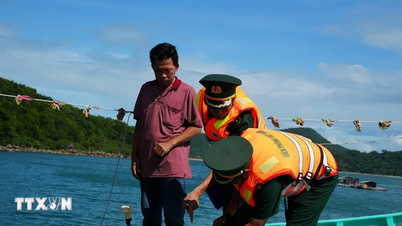
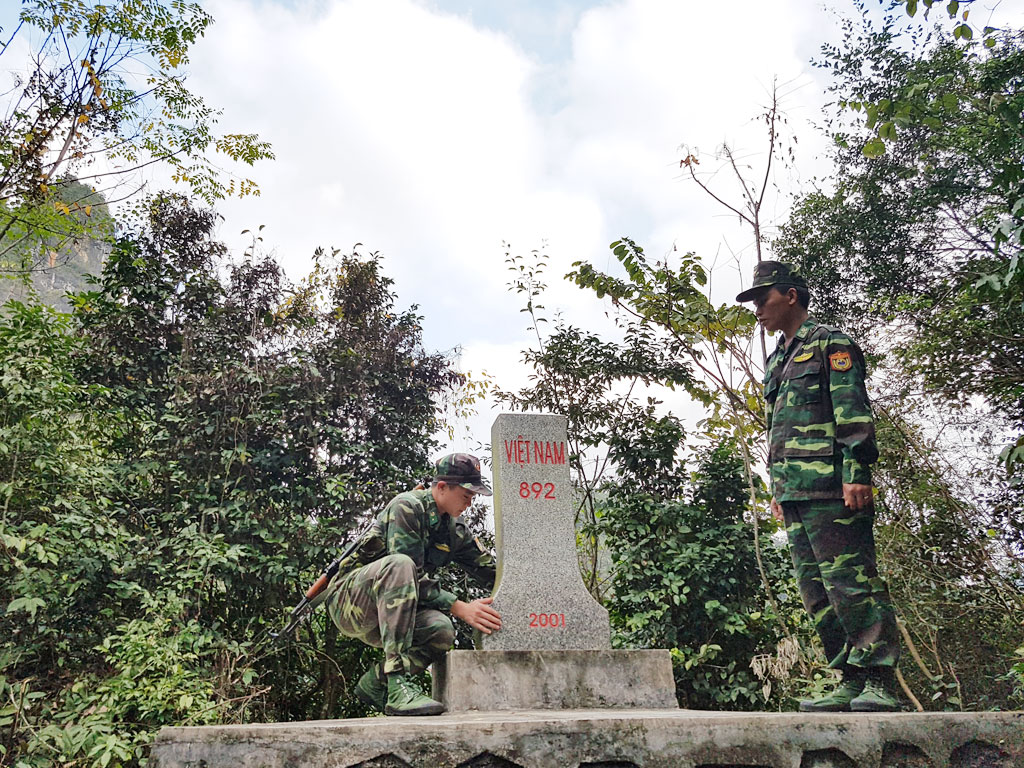 Border guards in Cao Bang inspect the condition of border markers |
He spoke about his comrades, his eyes welling up with tears.
Colonel Ma Quang Nghi, now retired in Binh Yen commune (Dinh Hoa district, Thai Nguyen province), formerly the Political Commissar of the Border Guard Command of Cao Bang province, still fondly remembers his time as Political Commissar of the Lung Nam Border Guard Post from 1983 to 1987. After the surprise attack (February 17, 1979) and withdrawal (March 13, 1979) from Cao Bang, the Chinese side consolidated their positions and sent many reconnaissance teams to infiltrate our territory… “They fired provocative shots and planted mines deep inside our land. In many places, they deployed forces close to the border to maintain a defensive position,” Colonel Nghi recounted, shaking his head: “The Cao Bang border could see renewed armed conflict. The troops along the entire border were under intense pressure.”
|
“Commune officials also abandoned their duties, following their families, leaving the area without anyone in charge,” Major Hoang Van Lo, former commander of the Lung Nam Border Post from 1982 to 1987, recounted, adding: “Since the border war broke out, the unit had no barracks and had to live and hold meetings in people's homes. The soldiers didn't have enough clothes to wear, and they had to share beds because of a lack of blankets and sheets. Anyone going on duty had to borrow hats and backpacks from others. There was a shortage of pots and pans, so when eating, 9-10 people had to crowd together at each table.”
In early 1983, Mr. Ma Quang Nghi took up the position of Deputy Political Officer (now Political Commissar) of the Nam Nhung Border Guard Post. At this time, the Chinese side intensified their infiltration, ambushes, kidnappings, and attacks on our soldiers and officers. “Before returning, I heard about the incident on the afternoon of May 25, 1982, when Vu Van An and soldier Vo Van Viet were ambushed and captured while on patrol,” Mr. Nghi recounted, his voice somber. “The most painful incident was on April 23, 1984.”
That morning, while Colonel Nghi was on duty, a soldier from the Nhi Du outpost (Van An commune, Ha Quang district) rushed back, his clothes tattered and his face smeared with blood, reporting: "The outpost has been attacked." He dispatched troops to rescue them, arriving near dusk to find casualties scattered everywhere. Six soldiers were killed on the spot, including three soldiers from the outpost, only 18-19 years old. "The Chinese soldiers crawled across and launched a surprise attack at 5 a.m. B40 rockets melted the cast-iron pots we were cooking rice in. Our men died before they could eat a single grain of rice," Colonel Nghi recalled.
He rambled on, reading the names of the fallen soldiers: Private Do Van Khanh, 19 years old, from Trung Son, Viet Yen, Bac Giang; Private Nong Van Ky, 19 years old, from Dan Chu, Hoa An, Cao Bang; Private Lanh Duc Duy, from The Duc, Nguyen Binh, Cao Bang...; Private Tran Van Cuong (from Trung Son, Viet Yen, Bac Giang) was seriously wounded and taken to the rear, but died two days later.
“During the years 1983-1987, the Chinese side even sniped at our soldiers on patrol duty. On September 5, 1985, Corporal Chu Van Cu, from Coc Dan, Ngan Son, Bac Can, then only 19 years old, died while patrolling in the Ang Bo - Keo Quyen hamlet area. Corporal Ly Van Thanh, from Ngoc Dong, Quang Uyen, Cao Bang, died at the age of 20. On the morning of November 19, 1983, Thanh was ambushed while inspecting the border at markers 105-106 (old). Our soldiers fought fiercely, and it took a week to recover Thanh's body,” Colonel Ma Quang Nghi said, his eyes welling up with tears.
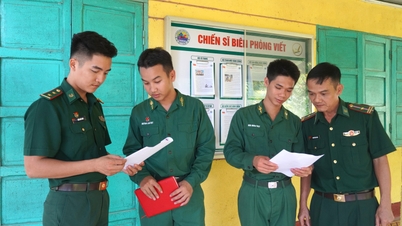
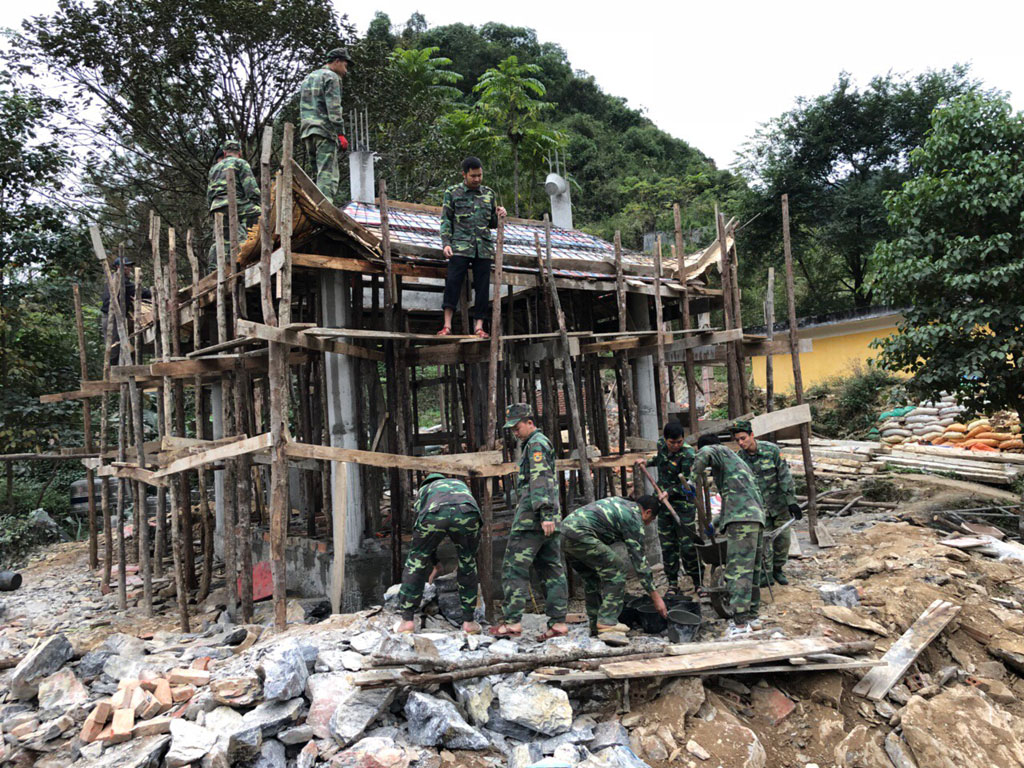 Border Guard officers and soldiers at Lung Nam Border Guard Post focus on building a memorial monument funded by Thanh Nien Newspaper |
"I wish the memorial stele could be rebuilt to be more sturdy."
Mr. Tran Van Huyen (56 years old), formerly a squad leader working at the Lung Nam Border Guard Post from 1982 to 1985, is currently retired in Duong Duc commune, Lang Giang district (Bac Giang province). However, every few years he takes a bus or hires a motorbike taxi to Lung Nam to revisit the place where he fought.
On the day we crossed the high mountains to reach "Luc Khu," Lieutenant Colonel Lo Ngoc Dung, Political Commissar of the Lung Nam Border Guard Post, led us to the area between the post and the gate of Nam Nhung Primary School (Ha Quang, Cao Bang), pointing to the old memorial stele on the stream bank: "The stele was built in the 1990s and is severely dilapidated. When it rains, water from the mountains rushes down, overflowing the altar, and we have to run out in the rain to grab the incense burner and move it, only bringing it out when the water recedes."
We left the harsh, rocky "Luc Khu" mountain region just as white clouds rolled down onto the outpost's courtyard. Veteran Tran Van Huyen whispered, "Every time visitors from the lowlands come up, the spirits of our comrades return to bid farewell," and wished, "If only we could rebuild the memorial house more securely. We and those of us who are still alive owe a great debt to the 13 young soldiers who fell..."
Source: https://thanhnien.vn/cuoc-chien-dau-bao-ve-bien-gioi-phia-bac-nam-lai-giu-luc-khu-185823320.htm


















































































![[Photo] Hanoi residents on the first day after the official cessation of E5 RON 95 gasoline sales.](https://vphoto.vietnam.vn/thumb/402x226/vietnam/resource/IMAGE/2026/06/02/1780370815909_666523_thumb_1780357660_06474202.jpeg)




![[Infographic] Market starts June 2026 with negative sentiment, VN-Index drops nearly 19 points.](https://vphoto.vietnam.vn/thumb/402x226/vietnam/resource/IMAGE/2026/06/02/1780370839687_666534_thumb_1780357795_06495602.jpeg)





Comment (0)