

How wonderful it is when, upon opening our eyes, we suddenly see that our Tet – the Tet of our homeland – has arrived. A tolerant, expansive gaze opens up, like a gateway to the realm of memories, where countless layers of emotion and the rich cultural soul of Vietnam, steeped in millennia, are preserved.
Tet (Vietnamese New Year) is always visually apparent first. Even before hearing the nostalgic sound of firecrackers at midnight, or tasting the rich, fragrant flavor of sticky rice cakes peeled by mother, just a glimpse of the red of Tet couplets, the warm yellow of marigolds, the delicate pink of peach blossoms… is enough for the brain to whisper: Tet has arrived at our doorstep.
 |
| Generations of the family prepare together for Tet (Lunar New Year). Photo: VNA |
Tet (Vietnamese Lunar New Year) sweeps across every house and every village road. A branch of white apricot blossoms, a golden plum tree at a street corner or at the end of the market; a small stall selling bright red lucky money envelopes; a stream of people in traditional and modern ao dai dresses, carrying with them the full spectrum of spring colors… All of these combine to form a “Tet map.” With just a glance, one can fully grasp the spring atmosphere spreading throughout the S-shaped land of Vietnam.
Images of Tet (Vietnamese New Year) possess a special emotional power. The emotions evoked by sight often precede thought, because the brain processes images much faster than the richness of language. Looking at the abundant plate of five fruits, carefully arranged on the ancestral altar, we suddenly feel a sense of fullness, completeness, and togetherness for a long and prosperous new year ahead.
Looking at the glowing embers of the wood-fired stove simmering sticky rice cakes on the last night of the year, we feel the warmth, the harmony of heaven and earth, and the hope for a year of favorable weather. Then, suddenly, our gaze falls on the faces of our parents – a few more wrinkles added by the years – and our hearts suddenly fall silent, deeply, very deeply. Especially when, this Tet, a familiar person is missing from the family reunion dinner table. The visual experience during Tet can bring joy, but it can also bring tears to our eyes. Tet – with its two-sided view of life: joy and sorrow, abundance and absence.
Seeing Tet (Vietnamese New Year) is like looking back in time. Looking at Dong Ho folk Tet paintings on rough, textured paper, we feel as if we've stepped into a realm of old memories, where colors are drawn from nature, where Tet is connected to the countryside, rice paddies, and simple joys – the couple in the painting "Collecting Coconuts" evokes simple yet complete happiness.
Glancing at Hang Trong New Year paintings, we get a different feeling – more somber, deeper – like a gentle reminder of fortune and misfortune, of the wish for peace for each family in the new year.
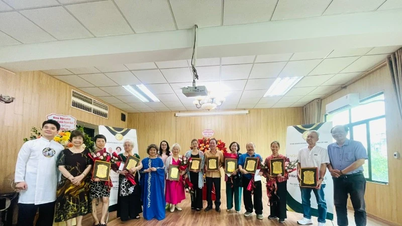
This year, during the Lunar New Year of the Horse (Bính Ngọ), if you have the opportunity to visit Tiên Điền – Hà Tĩnh , the birthplace of the great poet Nguyễn Du, you will have the chance to admire a special work of art: 3,254 verses of the Tale of Kiều, transcribed in calligraphy on traditional Vietnamese paper with ink by eight elementary school teachers over nearly eight days, spanning 600 large pages. To read it, viewers must stand before the stand holding this massive book. It is even more moving to learn that one of the teachers – the eldest sister, also the principal and a former soldier – has memorized the Tale of Kiều for many years. This work is like a simple, pure gift from the homeland, encapsulating the subtle nuances offered to the ancestors in this land of learning, right in the chilly early days of spring.
During the Lunar New Year – a moment of transition between the old and the new – the gaze becomes a bridge between the present, memories, and aspirations for the future. We look to recognize that Tet has arrived, that spring has returned. We look to preserve moments that time waits for no one.
Perhaps that's why Tet (Vietnamese New Year) needs to be observed slowly. Observe to preserve the beauty of spring that is gently slipping through our fingers. Observe to know that we still cherish, remember, and long for the beauty that lies ahead. Because as long as our eyes still tremble at the sight of Tet, our hearts haven't lost their spring, and spring still remains.
Source: https://www.qdnd.vn/van-hoa/doi-song/nhin-thay-tet-tet-que-1025381
![[Photo] General Secretary and President To Lam presides over a meeting on assessing national development resources.](https://vphoto.vietnam.vn/thumb/1200x675/vietnam/resource/IMAGE/2026/05/20/1779253785852_a1-bnd-2943-8519-jpg.webp)




![[Photo] National Assembly Chairman Tran Thanh Man working with the Standing Committee of the Economic and Financial Committee](https://vphoto.vietnam.vn/thumb/1200x675/vietnam/resource/IMAGE/2026/05/20/1779249584387_ndo_br_1-jpg.webp)




















































Comment (0)