

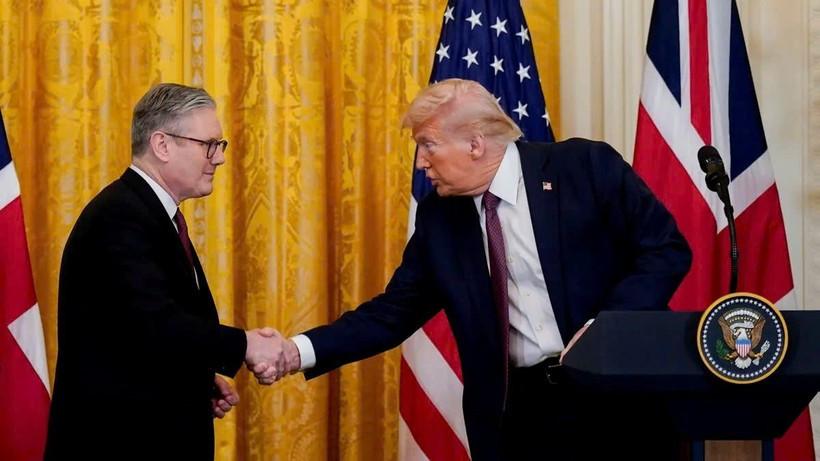
A challenging decision.
In early April 2025, as previously announced, US President Donald Trump officially announced the application of retaliatory tariffs on goods entering the United States. In addition to the basic 10% tariff on imported goods from countries and territories around the world , the White House announced the implementation of additional retaliatory tariffs against partners that Washington considers to be creating a trade imbalance with the US.
After much deliberation, in late July 2025, US President Donald Trump signed an executive order imposing new tariffs on most of America's trading partners, ranging from 10% to 41%. The White House emphasized that the tariff increase would help narrow the long-standing trade deficit and protect domestic jobs, especially in industries facing intense foreign competition such as steel, aluminum, consumer goods, textiles, and technology.
Notably, the scope of the US tariffs this time is very broad, affecting major partners in Europe, Asia, and Latin America. This means the White House's policy is considered to be "shaking" the global trade system, which is still struggling to fully recover from the Covid-19 pandemic and previous geopolitical upheavals. Countries quickly proposed negotiations with the US. Major economies are considering adjusting their policies, while small and medium-sized exporting nations face challenges in repositioning themselves in global supply chains.
The peak of the impact from Washington's tariff policies occurred as the world witnessed a "retaliatory spiral" between the US and its partners. Many countries declared strong opposition to the White House's policies. Among them, China warned of retaliation if the US imposed further tariffs; Brazil declared its readiness to respond in kind if diplomatic solutions could not be reached with the world's largest economy.
While expressing dissatisfaction with US tariffs, the European Union (EU) has strived to balance protecting domestic industries with the need to maintain economic and security relations with Washington, aiming to find common ground with its transatlantic partner.
Meanwhile, many ASEAN, South Asian, Middle Eastern, and Latin American countries that rely heavily on exports to the US face the risk of losing market share due to high US tariffs. This challenge has prompted these countries to focus on strengthening negotiations with Washington. Nevertheless, many countries are also seizing the opportunity to reposition themselves in the electronics, technology, or textile supply chains, determined to improve their production capacity, infrastructure, and investment environment.
Trade flows are changing direction.
The US announcement of new tariffs on its trading partners immediately sparked concern among economic experts. As predicted, 2025 has seen significant changes, from supply chains to market sentiment. US tariff policies not only affect exporting businesses from partner countries but also have a direct impact on American consumers.
According to analysts, the imposition of tariffs across the board forces American businesses to seek alternative sources of supply from countries not subject to high tariffs. American businesses importing goods from markets with increased tariffs may have to reduce profit margins or cut costs, potentially leading to job losses and impacting the US job market. Higher tariffs also increase production costs, especially for industries heavily reliant on imported components.
According to economists, if tariffs are strictly enforced, the prices of goods on online platforms or in US retail stores could increase significantly, reducing purchasing power. Recent forecasts from the International Monetary Fund (IMF) also indicate that the US economy will slow to 2% this year, marking a significant decline compared to 2024.
International organizations are also concerned that the "tariff war" could slow down global trade growth in the medium term. Some reasons include volatile input prices, disruptions to international investment flows, and businesses having to adjust their expansion plans into the US market. In fact, in October 2025, the IMF warned that the global economy was showing signs of strain due to US tariff policies and widespread protectionism, despite a more positive outlook than initially expected.
The recently released World Economic Outlook report shows that the IMF forecasts the global economy will grow by 3.2% in 2025, higher than the 3% forecast in July. Growth is projected to slow slightly to 3.1% in 2026. According to the IMF, the upward revision of this year's growth forecast is mainly due to current factors, such as the surge in activity as businesses and households increase purchases ahead of higher tariffs, coupled with a weaker US dollar, thereby supporting global trade.
New signals
In the aforementioned report, the IMF also stated that there are many signs indicating that the impact of high tariffs has begun to spread, including in the United States. However, according to experts, it is worth noting that despite the many negative impacts, there are still factors that help mitigate the effects of the tariff shock, including the boom in investment in artificial intelligence (AI). China has somewhat mitigated the impact of high tariffs by diverting exports to Asian and European markets and increasing fiscal support. Meanwhile, Germany's expansionary fiscal policy has also helped stimulate the rest of the Eurozone.
Notably, according to the IMF Managing Director, the decision of most countries not to retaliate against the tariffs imposed by US President Donald Trump is one of the leading factors strengthening the resilience of the global economy. This decision helped avoid the risk of escalating tariffs that could seriously harm world economic growth. Previously, many countries had reached "last-minute" trade agreements with the US before the retaliatory tariffs imposed by the Trump administration on many countries took effect. These included notable agreements between the US and the UK, the EU, several Asian countries, and other partners.
"Maintaining resilience" and "resilience" are the assessments of the global economy in 2025 by the Organization for Economic Cooperation and Development (OECD). The OECD stated that since the beginning of the year, the need for countries to cope with new trade and tariff barriers, geopolitical instability in some regions of the world, and declining investment have slowed growth. Nevertheless, consumer demand has remained relatively strong. This is thanks to some countries easing fiscal policies, implementing macroeconomic policies to boost growth, rising real incomes, and high demand for investments related to artificial intelligence, particularly in the United States.
The OECD also forecasts global economic growth of 3.2% in 2025, a slight decrease from the previous year's 3.3%. However, the OECD emphasizes that the global economy has shown unexpected resilience in 2025. Global growth could recover in 2026 after a slowdown in the second half of 2025, partly due to the impact of reduced tariffs, favorable financial conditions, supportive policies, and lower inflation, while emerging economies in Asia continue to contribute significantly to global growth.
From the fourth quarter of 2025, several signals indicate that the US wants to adjust its tariff policies to reduce the negative impact on domestic consumption and production. Some bilateral negotiations with major partners have been reopened and maintained. The US's continued announcement of trade agreements with other countries before the end of 2025, and the White House's release of details of the agreement reached between US President Donald Trump and Chinese President Xi Jinping in early November 2025, have brought many positive signals for global trade. However, according to experts, these developments are not enough to "end the tariff war," and the White House will continue to pursue tariff policies to protect its position and national interests in the future.
With its multifaceted and widespread changes, 2025 will be a pivotal year for world trade, raising many questions about the future of global supply chains, the multilateral economic order, and the role of major economic powers in shaping the new rules of the game. These impacts are projected to continue to have a profound effect in 2026 and beyond, as the world enters a phase of even more intense economic and trade competition.
Updated December 15, 2025
Source: https://laichau.gov.vn/tin-tuc-su-kien/chuyen-de/tin-trong-nuoc/nhung-chuyen-dong-cua-thuong-mai-toan-cau.html
![[Image] Leaked images ahead of the 2025 Community Action Awards gala.](/_next/image?url=https%3A%2F%2Fvphoto.vietnam.vn%2Fthumb%2F1200x675%2Fvietnam%2Fresource%2FIMAGE%2F2025%2F12%2F16%2F1765882828720_ndo_br_thiet-ke-chua-co-ten-45-png.webp&w=3840&q=75)

![[Photo] Prime Minister Pham Minh Chinh receives Lao Minister of Education and Sports Thongsalith Mangnormek](/_next/image?url=https%3A%2F%2Fvphoto.vietnam.vn%2Fthumb%2F1200x675%2Fvietnam%2Fresource%2FIMAGE%2F2025%2F12%2F16%2F1765876834721_dsc-7519-jpg.webp&w=3840&q=75)
![[Live] 2025 Community Action Awards Gala](/_next/image?url=https%3A%2F%2Fvphoto.vietnam.vn%2Fthumb%2F1200x675%2Fvietnam%2Fresource%2FIMAGE%2F2025%2F12%2F16%2F1765899631650_ndo_tr_z7334013144784-9f9fe10a6d63584c85aff40f2957c250-jpg.webp&w=3840&q=75)
![[Photo] Prime Minister Pham Minh Chinh receives the Governor of Tochigi Province (Japan)](/_next/image?url=https%3A%2F%2Fvphoto.vietnam.vn%2Fthumb%2F1200x675%2Fvietnam%2Fresource%2FIMAGE%2F2025%2F12%2F16%2F1765892133176_dsc-8082-6425-jpg.webp&w=3840&q=75)

















































![[Photo] Prime Minister Pham Minh Chinh attends the Vietnam Economic Forum 2025](https://vphoto.vietnam.vn/thumb/402x226/vietnam/resource/IMAGE/2025/12/16/1765893035503_ndo_br_dsc-8043-jpg.webp)


























Comment (0)