

 |
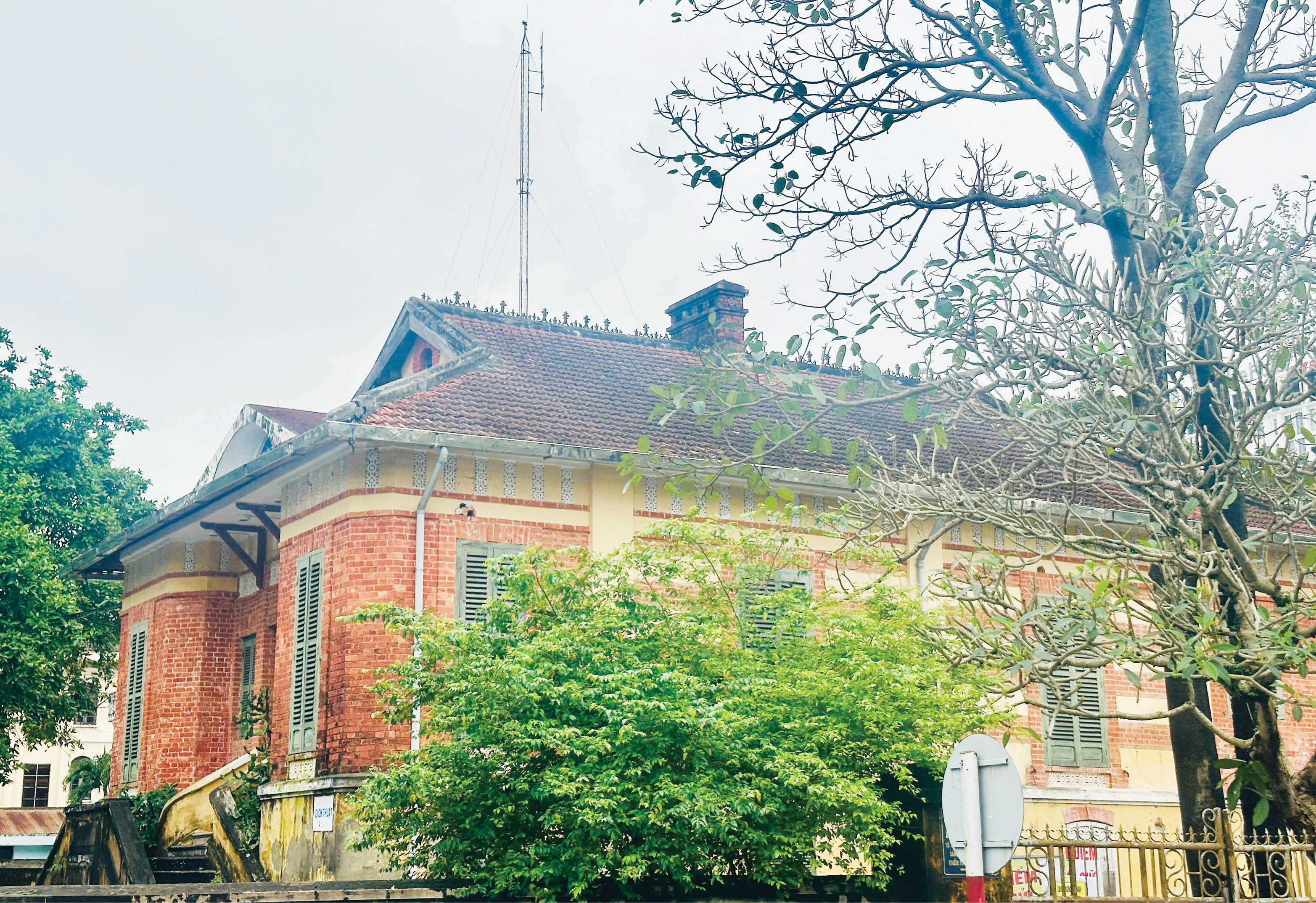
| The French-style villa at 26 Le Loi Street. Photo: Ngoc Hoa |
"The first time we met" was when he had stepped down as a member of the Politburo and head of the Central Propaganda Department and returned to being an ordinary citizen in Hue. At that time, he lived quietly and discreetly, "only showing my face in poetry," as the title of an interview I conducted with him, published in the newspaper, suggests.
During those years, due to the nature of my work, I was fortunate enough to meet, chat with, "exchange ideas with," and even become close friends with many writers, poets, painters, and researchers from Hue , despite the age difference between us being around 40 years. To me, they embodied a refined and fascinating Hue, so much so that if, one day, they were to pass away in various ways, Hue would be much quieter.
That idea prompted me to formulate an outline for a series of articles in a conversational style – interviews with all the people of Hue, and those currently living in Hue, whom I felt needed to be featured in books and newspapers. This series was later published as the book "Conversations with Interesting People of Hue," released in 2014, featuring 24 individuals. This book, which is later planned for reprinting, will include approximately 15 more individuals from Hue, both living in and outside of Hue, whom I hadn't had the chance to include before.
This reprint is also a dual project, as artist Hai Bang – the founder of bamboo paper art in Hue – planned to create bamboo paper paintings for each character instead of photographs for printing in the book, as well as organize an exhibition of the characters' paintings alongside the book launch. The manuscript was completed, the publisher agreed to the plan, and even the location for the exhibition and book launch was chosen by Venerable Thich Hai An – a character in the book – as the venue. However, artist Hai Bang kept delaying the painting project, and it has remained a project for several years.
 |
| The French-style villa at 26 Le Loi Street. Photo: Ngoc Hoa |
The book hasn't been reprinted yet, but in a short time, many of the characters in my book are no longer real. Now, occasionally, I dream of myself and my "old friend" Ho Tan Phan sitting thoughtfully under the Bodhi tree at the once bustling Garden of Paradise café on the banks of the Perfume River. I dream of myself and the painter Vo Xuan Huy debating philosophy at the café "This Afternoon," which no longer has the owner in her purple dress and long hair. I dream of myself sitting with the poet Tran Vang Sao under the sapodilla tree in front of his house in Vy Da every Tet holiday…
I recall that back in 2022, Mr. Nguyen Van Phuong - Secretary of the Quang Tri Provincial Party Committee, who at the time was Chairman of the Thua Thien Hue Provincial People's Committee (now Hue City) - made a very welcome decision to hire "master mover" Nguyen Van Cu from Ho Chi Minh City to Hue to relocate the French villa at 26 Le Loi Street to an empty plot of land opposite the Perfume River.
Previously, to serve the urban development of Hue according to the detailed plan for both banks of the Perfume River, including the project of a high-end hotel and commercial complex at 26 Le Loi Street, the French villa at 26 Le Loi Street was scheduled to be demolished. Although this villa was not on the list of 27 French villas in the city that are to be preserved, restored, and promoted, Mr. Nguyen Van Phuong still decided to keep it "with the desire to preserve the 'soul' of Hue city during its development."
However, due to many objective and subjective reasons, more than three years have passed since then, and this villa has still not been relocated by "miracle worker" Nguyen Van Cu, despite his numerous trips to Hue for surveys. Recently, there has been information suggesting that the villa will likely be demarcated and kept in its original location within the grounds of a high-end hotel and commercial complex project.
Recalling the story of the villa at 26 Le Loi Street serves to remember that many people, including top city leaders, wanted to preserve the soul of Hue through its tangible cultural heritage, but faced numerous difficulties. It's also to say that the "soul" of Hue is not only created by its architectural structures, but also by its vibrant people, including the poet Nguyen Khoa Diem and many others, both living and deceased, featured in the book project "Conversations with Interesting People of Hue," which I still hope will one day be fully republished.
But if preserving the "soul" of an architectural structure is already difficult, then preserving the "soul" of a human being is even more challenging.
Source: https://huengaynay.vn/van-hoa-nghe-thuat/nhung-hon-via-cua-do-thi-hue-161212.html
































![[Video] Sunset at Lap An Lagoon – Where the sun sets over the fishing nets](https://vphoto.vietnam.vn/thumb/1200x675/vietnam/resource/IMAGE/2026/05/31/1780192137701_beach-landscape-sea-water-nature-grass-745871-pxhere-com.jpeg)























Comment (0)