

The new UK government , led by the Labour Party, is facing its toughest choices yet.
This warning was issued by the International Monetary Fund (IMF) shortly after the party of newly elected Prime Minister Keir Starmer won a resounding victory in the general election, ending 14 years of Conservative rule.
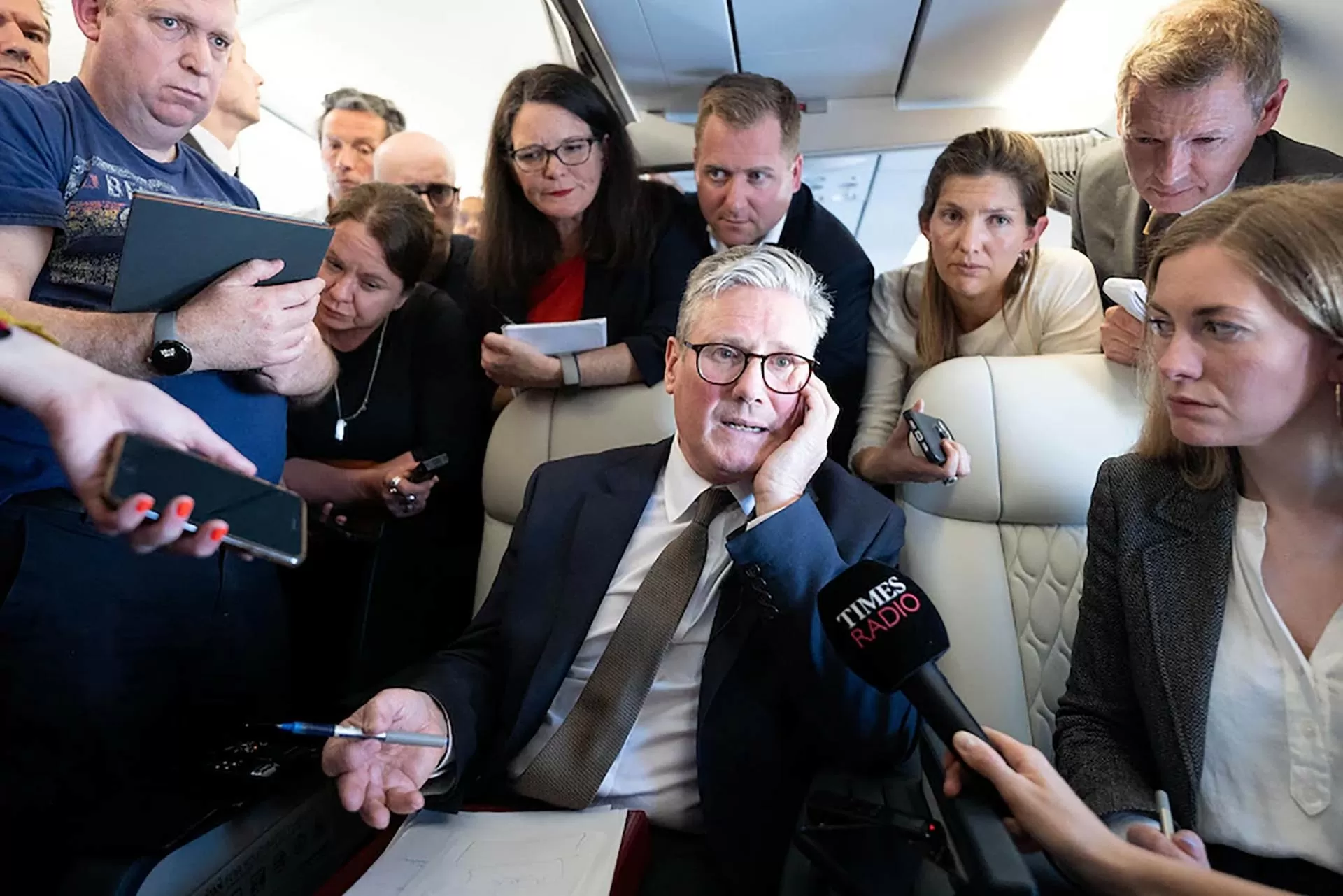 |
| British Prime Minister Keir Starmer and reporters en route to Washington for the NATO summit, July 2024. (Source: Reuters) |
The "bet"
The new government is betting that an economic plan modeled after US President Joe Biden's "Bidenomics" policies will reverse more than a decade of economic recession and improve the stagnant living standards in the UK economy, without requiring excessive spending.
Is that achievable?
Like President Biden, Prime Minister Keir Starmer is committed to a more dynamic government than his Conservative predecessor, as well as increased investment in green energy and industrial policies to boost domestic manufacturing.
However, observers believe that Prime Minister Starmer inherited an economy that had experienced more than a decade of political turmoil, inadequate business investment, and rigid planning from the previous government. Furthermore, the UK currently lacks readily available investment capital.
According to research by the Centre for Economic Performance (UK), adjusted for inflation, wages in this economy have remained virtually unchanged since 2007. As a result, they are falling behind, evidenced by the fact that the average German is now 20% wealthier than the typical British citizen.
The Washington Post quoted David Page, a researcher at AXA Investment Managers in London, as saying, “The UK economy is no longer in a position to recover quickly. Most people believe it will take at least a decade for the economy to show improvement.”
According to analysis, the root of Britain's economic difficulties lies in weak productivity growth. Boosting worker productivity to produce more goods per hour is key to expanding the economy and raising living standards. This is precisely what has been missing from the recent performance of the previous British government.
In fact, an American worker produced 23% more last year than a British worker. That gap has more than doubled since 2007. French and German workers both outperformed their British counterparts.
British manufacturing productivity had been steadily increasing for almost three decades, but has stalled since the 2008 financial crisis. Economists say government austerity measures and recurring political crises following the Great Recession have prevented companies from investing to help workers become more productive. The Covid-19 pandemic and government budget cuts leading to a shortage of personnel in the National Health Service have also impacted productivity. Statistically, in the US, business investment has increased by more than a third since 2016, nearly seven times the rate of increase in the UK.
Britain's problems are a legacy of years of interplay between public and private choices. The country's oversized financial services sector shrank after the 2008 crisis, making access to credit more difficult than elsewhere. The economy faced an austerity crisis, harming public services and stifling economic growth.
The Brexit process, which began in 2016, has taken up nearly a decade of time for three Prime Ministers and continues to cast a shadow over the economy. According to the Office for Budget Responsibility (OBR), the erection of barriers with the EU – once its largest trading partner – has caused the UK economy to shrink by 4% and exports and imports to be around 15% lower than when the country was still in the bloc.
Government instability and a multitude of short-term and long-term economic plans have become obstacles to growth.
Expect a difference.
In his first press conference, Prime Minister Starmer affirmed his commitment to driving change and fulfilling his campaign promises, including stimulating economic growth, investing in clean energy, and improving opportunities through a new skills agenda.
New Chancellor of the Exchequer Rachel Reeves affirmed that the government will pursue a new approach to growth based on stability, investment, and innovation, emphasizing that planning reform is crucial to driving growth. The Treasury is committed to immediate action to address the fundamental issues of the UK economy, reforming the national planning framework to develop infrastructure, promoting sustainable growth based on a new model, helping the economy to thrive while keeping taxes, inflation, and interest rates as low as possible…
The head of the UK's finance ministry pledged to make the country a haven for investment, supporting growth and an industrial strategy to boost investment, and working closely with the business community.
The new industrial strategy will focus on areas such as advanced manufacturing, innovative technologies and green technologies, emerging industries with potential such as life sciences, quantum computing and artificial intelligence – areas where the UK has a strong research base but lacks the conditions for growth. A £7.3 billion national investment fund will be established to invest in key projects.
According to its campaign promises, Prime Minister Starmer's government wants to demonstrate that the Labour Party is determined to implement serious planning reforms that stimulate growth without increasing public spending or national debt.
However, analysts believe the new growth stimulus plan will face considerable challenges. Given the weak financial outlook, UK government debt could exceed 90% of GDP this year.
Paul Johnson, director of the Institute for Financial Studies (IFS) in the UK, stated that with high inflation, high public debt, and record-high taxes, the outlook is "extremely difficult" for a new government wanting to implement breakthroughs without the financial means to do so.
Meanwhile, Paul Dales, chief economist at Capital Economics, said: “The reality will begin to emerge when Prime Minister Keir Starmer’s new government has to focus on areas where they can actually make a difference without spending a lot of money.”
Source: https://baoquocte.vn/chinh-phu-moi-cua-vuong-quoc-anh-nhung-lua-chon-kho-khan-279275.html
![[Photo] National Assembly Chairman Tran Thanh Man attends the groundbreaking ceremony for the National Highway 1A spatial axis project.](https://vphoto.vietnam.vn/thumb/1200x675/vietnam/resource/IMAGE/2026/05/19/1779161360398_ndo_br_bnd-1412-jpg.webp)
![[Photo] Capturing the moment the tide recedes at Yen Binh Son rapids - a million-year-old scenic spot in Quang Ngai.](https://vphoto.vietnam.vn/thumb/1200x675/vietnam/resource/IMAGE/2026/05/19/1779175463885_yen9-1199-jpg.webp)





















































![[Photo] General Secretary and President To Lam receives Indian Defense Minister Rajnath Singh](https://vphoto.vietnam.vn/thumb/402x226/vietnam/resource/IMAGE/2026/05/19/1779184046302_anh-man-hinh-2026-05-19-luc-16-46-58.png)
























Comment (0)