

According to the South China Morning Post , the circular hot tub, approximately 5 meters wide, is divided into two distinct areas: one side a vibrant red, the other a pristine white.
The "red" side evokes the image of a spicy hot pot broth with various chilies, while the "white" side offers a refreshing taste with milk, red dates, and goji berries.
According to an employee, the red color is actually created by rose petals that are replaced daily, and the chili peppers are selected as a "mild" variety to aid metabolism and blood circulation, while the milk helps moisturize and smooth the skin.
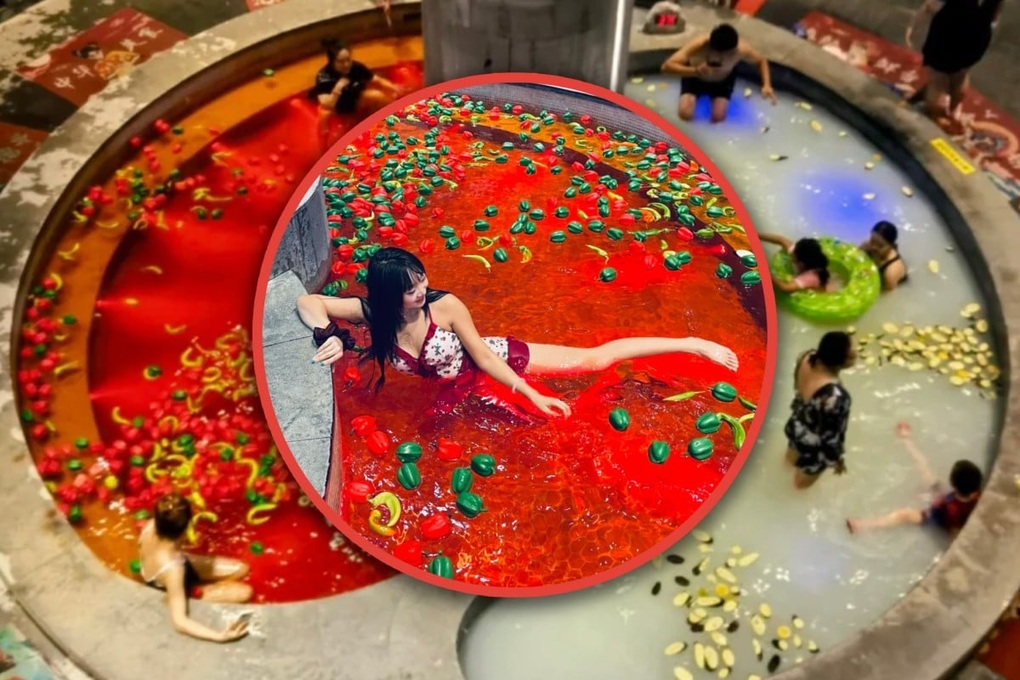
"Giant hot pot" with two separate compartments (Photo: SCMP).
For an adult ticket of approximately 160 yuan (about 600,000 VND), visitors to the resort have access to the "hot pot bath" experience, the sauna area, and a buffet meal.
There are no age or soaking time limits, but the resort recommends soaking for 15-20 minutes at a time. People with cardiovascular disease, skin conditions, or allergies should avoid this experience. All ingredients in the tub are labeled as non-edible.
On travel and food experience-sharing apps, many tourists have posted photos and comments such as: "The temperature is just right, the steam is gentle, truly relaxing." However, there are also opposing opinions, with some arguing that using chili peppers, red apples, etc., for "decoration" is a waste of food.
Representatives from the resort emphasized that this hot tub is a modern version of the herbal bath therapy in traditional Chinese medicine, a method that has existed for thousands of years, often using ginger, mint, or mugwort to prevent disease and improve health.
Although there is no scientific evidence to confirm the effects of soaking in chili peppers or milk, traditional beliefs hold that chili peppers can ward off cold, and milk helps relax the mind and improve sleep.
All kinds of hot pot bathtubs
Previously, in 2019, a hotel in Hangzhou also attracted attention for designing its hot spring baths to resemble giant hot pots.
Here, visitors can immerse themselves in a mineral bath divided into 9 compartments, each containing a hot pot ingredient such as chili peppers, lemons, corn, cabbage, fruits, etc.

The "hot pot" is divided into compartments with different ingredients (Photo: SCMP).
According to Sohu , guests are not allowed to eat the ingredients in the pool, but can enjoy grilled skewers and drinks served while soaking.
In 2018, tourists in Chongqing also experienced a 6.7-meter-diameter bathtub divided into four compartments, resembling a traditional spicy hot pot. According to China News , the water in the tub was infused with medicinal herbs such as mountain vine, mugwort, safflower, Polygonum multiflorum, and wine, advertised to improve health and blood circulation.
Meanwhile, in Luoyang, a local hot spring resort once introduced a fruit bath – visitors could soak in water mixed with apples, cucumbers, and lemon slices, which is said to have skin-brightening and beautifying effects.
According to Xinhua News Agency, hot pot is not only a national dish in China but has also become a cultural symbol and a source of creative inspiration in the service industry.
The emergence of "hot pot tubs" demonstrates how Chinese businesses are leveraging this culinary icon to transform it into an experiential tourism product.
However, many people believe that if this trend focuses solely on aesthetics, it will be difficult to sustain in the long run without a foundation of health and genuine value.
Source: https://dantri.com.vn/du-lich/noi-lau-nguoi-that-hut-khach-giua-mua-dong-o-trung-quoc-20251029221633842.htm
![[Photo] Prime Minister Pham Minh Chinh receives the Governor of Tochigi Province (Japan)](/_next/image?url=https%3A%2F%2Fvphoto.vietnam.vn%2Fthumb%2F1200x675%2Fvietnam%2Fresource%2FIMAGE%2F2025%2F12%2F16%2F1765892133176_dsc-8082-6425-jpg.webp&w=3840&q=75)
![[Photo] Prime Minister Pham Minh Chinh receives Lao Minister of Education and Sports Thongsalith Mangnormek](/_next/image?url=https%3A%2F%2Fvphoto.vietnam.vn%2Fthumb%2F1200x675%2Fvietnam%2Fresource%2FIMAGE%2F2025%2F12%2F16%2F1765876834721_dsc-7519-jpg.webp&w=3840&q=75)
![[Image] Leaked images ahead of the 2025 Community Action Awards gala.](/_next/image?url=https%3A%2F%2Fvphoto.vietnam.vn%2Fthumb%2F1200x675%2Fvietnam%2Fresource%2FIMAGE%2F2025%2F12%2F16%2F1765882828720_ndo_br_thiet-ke-chua-co-ten-45-png.webp&w=3840&q=75)

![[Live] 2025 Community Action Awards Gala](/_next/image?url=https%3A%2F%2Fvphoto.vietnam.vn%2Fthumb%2F1200x675%2Fvietnam%2Fresource%2FIMAGE%2F2025%2F12%2F16%2F1765899631650_ndo_tr_z7334013144784-9f9fe10a6d63584c85aff40f2957c250-jpg.webp&w=3840&q=75)

































![[Photo] Prime Minister Pham Minh Chinh attends the Vietnam Economic Forum 2025](https://vphoto.vietnam.vn/thumb/402x226/vietnam/resource/IMAGE/2025/12/16/1765893035503_ndo_br_dsc-8043-jpg.webp)



















Comment (0)