

Practical experience and recommendations for raising the water column of Ta Trach Lake
Mr. Nguyen Quy An, Deputy Head of the Ta Trach Lake Management Board, said that many years of managing and operating the lake have helped the unit understand the flood characteristics in the Huong River basin and the practical situations that may occur. Through historical floods, especially the floods in late October and early November 2025, the unit has accumulated more experience, from which it proposed to the Ministry of Agriculture and Environment to study raising the water column of the lake to create more flood prevention capacity.
Mr. Nguyen Quy An shared that during the 2025 flood, the General Secretary visited Hue City, worked with the locality and listened to reports on the flood situation. Here, the City proposed that the Central Government consider raising the water level so that Ta Trach Lake has more space to accumulate flood, reducing pressure on downstream. The Government assigned the Ministry of Agriculture and Environment to coordinate with ministries and branches to study and adjust the water column by about 1 meter to more than 1 meter.

Mr. Nguyen Quy An, Deputy Head of Ta Trach Lake Exploitation Management Board - Irrigation Investment and Construction Management Board 5 (Ministry of Agriculture and Environment): Photo: Minh Phuc.
According to Mr. Nguyen Quy An, this is a very important policy, suitable for actual conditions. The operating unit is currently coordinating with the relevant agencies to complete the dossier to submit to the competent authority, in order to soon deploy and serve in the following flood seasons. The increase in capacity is expected to create more room for regulation, helping to reduce the flood peak flowing to Hue City in situations of heavy rain.
From an operational perspective, Mr. Nguyen Quy An also proposed the need to modernize the equipment system of Ta Trach Lake. After nearly 10 years of operation, many items have degraded or no longer meet the requirements of real-time monitoring and control. He recommended putting the project into an intelligent operation management system, upgrading monitoring and control equipment, helping to increase the accuracy of monitoring and more effectively support flood regulation.
The need to expand large water storage facilities and improve operational processes
From the perspective of project analysis and basin planning, Mr. Pham Cong Thanh, Head of the North Central Irrigation Planning Department, Institute of Irrigation Planning (Ministry of Agriculture and Environment), said that in the context of increasingly unusual floods, increasing flood prevention capacity is an inevitable requirement of large reservoirs in the Central region.
He highlighted the need to review the inter-reservoir operating procedures, creating more flexible flood prevention space instead of rigidly applying water levels in all situations. Recent floods have shown rapid increase in rainfall, short flood arrival times, accompanied by many consecutive flood peaks, creating great pressure on reservoirs. Updating the procedures will help reservoir owners proactively lower water levels to receive floods in case of heavy rains exceeding forecasts.
He also stressed the importance of protecting and enhancing upstream vegetation cover to reduce flow velocity and increase water retention capacity during the dry season. This is a natural support solution to help reservoirs operate more effectively during the rainy season.
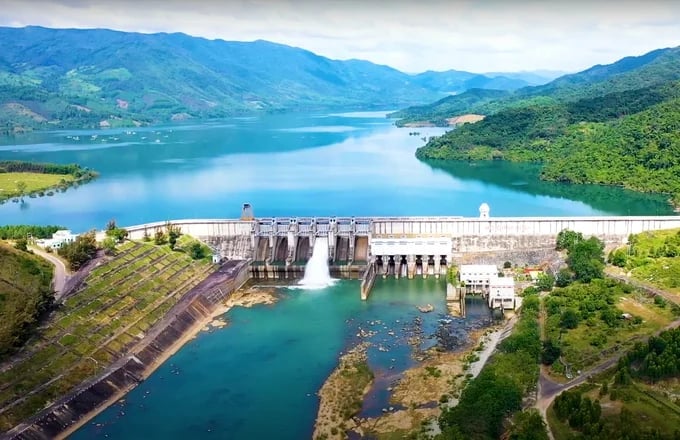
Dinh Binh Reservoir (Vinh Thanh District, Binh Dinh) is an irrigation project constructed using roller compacted concrete technology. Photo: Minh Phuc.
From the perspective of project planning, Mr. Pham Cong Thanh said that the Institute of Water Resources Planning has reviewed the entire Central region and assessed that there is not much room left to build new reservoirs. However, there are still some potential locations that can be studied to develop large water storages in the future. If implemented, the projects will contribute significantly to increasing the ability to regulate water for downstream areas, both in flood and dry seasons.
According to Mr. Thanh, the construction of new lakes or the expansion of existing lakes must carefully assess terrain conditions, the possibility of flooding the lake bed, flood prevention effectiveness and long-term water resource benefits. Each project needs comprehensive analysis to ensure practical effectiveness and conformity with the development planning of each locality.
Applying artificial intelligence to improve regulatory efficiency
Referring to the role of science and technology in the operation of irrigation reservoirs, Mr. Pham Cong Thanh acknowledged that operational consulting units often have to process multiple layers of data from rain forecasts to hydrological and hydraulic models. This process can sometimes take a long time in emergency situations. He suggested that the irrigation industry promote digital transformation, applying artificial intelligence combined with large databases to partially automate the forecasting process. New technology will allow for faster and more accurate scenarios, supporting reservoir owners in making operational decisions.

Mr. Pham Cong Thanh - Head of the North Central Planning Department - Institute of Water Resources Planning (Ministry of Agriculture and Environment). Photo: Minh Phuc.
From the perspective of project operations, Mr. Nguyen Quy An agrees with the view of enhancing technology. According to him, integrating artificial intelligence into the control system, combined with modernized equipment, will help forecast faster and improve reliability in monitoring the flow into the lake. This is a trend that is suitable for the context of highly volatile weather, requiring operational decisions to be made in a very short time.
Both experts agreed that increasing flood storage capacity, improving operational equipment and improving forecasting capacity are key factors for the Central region’s reservoirs to operate flexibly and ensure safety during the rainy and stormy season. These solutions not only help minimize damage but also contribute to maintaining water resources for daily life, production and socio-economic development in the entire region.
Source: https://nongnghiepmoitruong.vn/tang-dung-tich-ho-chua-nang-hieu-qua-cong-trinh-d787460.html


![[Photo] Prime Minister Pham Minh Chinh receives President of Cuba's Latin American News Agency](/_next/image?url=https%3A%2F%2Fvphoto.vietnam.vn%2Fthumb%2F1200x675%2Fvietnam%2Fresource%2FIMAGE%2F2025%2F12%2F01%2F1764569497815_dsc-2890-jpg.webp&w=3840&q=75)





















































































Comment (0)