

 |
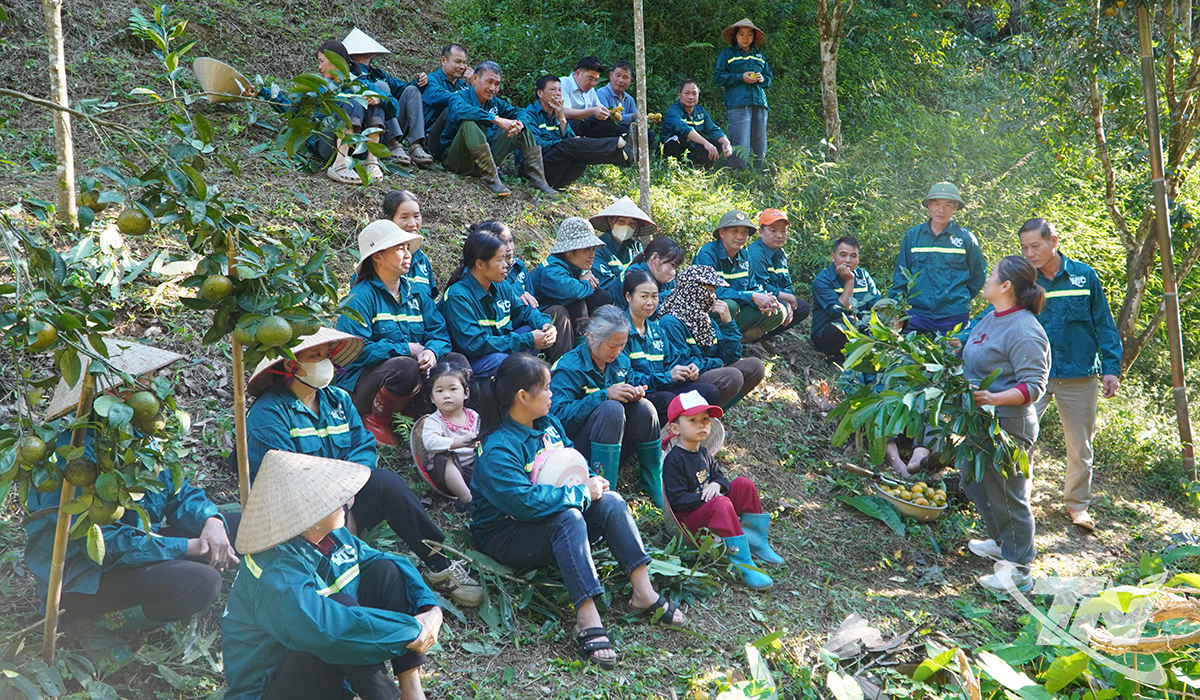
| Trainees in a vocational training class in Bach Thong commune practice in an orchard. |
For many years, a common reality in rural areas has been an abundant but limited workforce. Production relies primarily on experience, lacking scientific and technical knowledge, leading to low efficiency and unstable income.
This not only hinders sustainable poverty reduction but also makes it difficult for people to adapt to market changes. Therefore, vocational training cannot stop at simply "opening classes to meet quotas," but must aim for the core goal of equipping workers with skills and changing their mindset and work methods.
In Bach Thong commune, the vocational training course on waterfowl farming organized in Ban Pe village is a prime example of this approach. Nearly 30 trainees participated in the course, all of whom are directly involved in poultry farming at home.
Instead of theory, the training content focuses on the problems people are facing, such as techniques for building livestock shelters, selecting suitable breeds, and preventing diseases according to local climatic conditions.
Through each training session, the people realized that livestock farming is not just about "following habits," but requires careful planning and the application of techniques to reduce risks and improve economic efficiency.
Ms. Tran Thi Hoa, a student in the class, said: "Previously, my family raised ducks mainly based on experience, and disease outbreaks caused significant losses. After receiving systematic technical guidance, I have a better understanding of each step in duck farming and feel more confident in investing."
Vocational training for rural workers is no longer limited to agriculture . In Con Minh commune, an online business training course for a group of households producing cassava vermicelli has opened up a new direction for this traditional product.
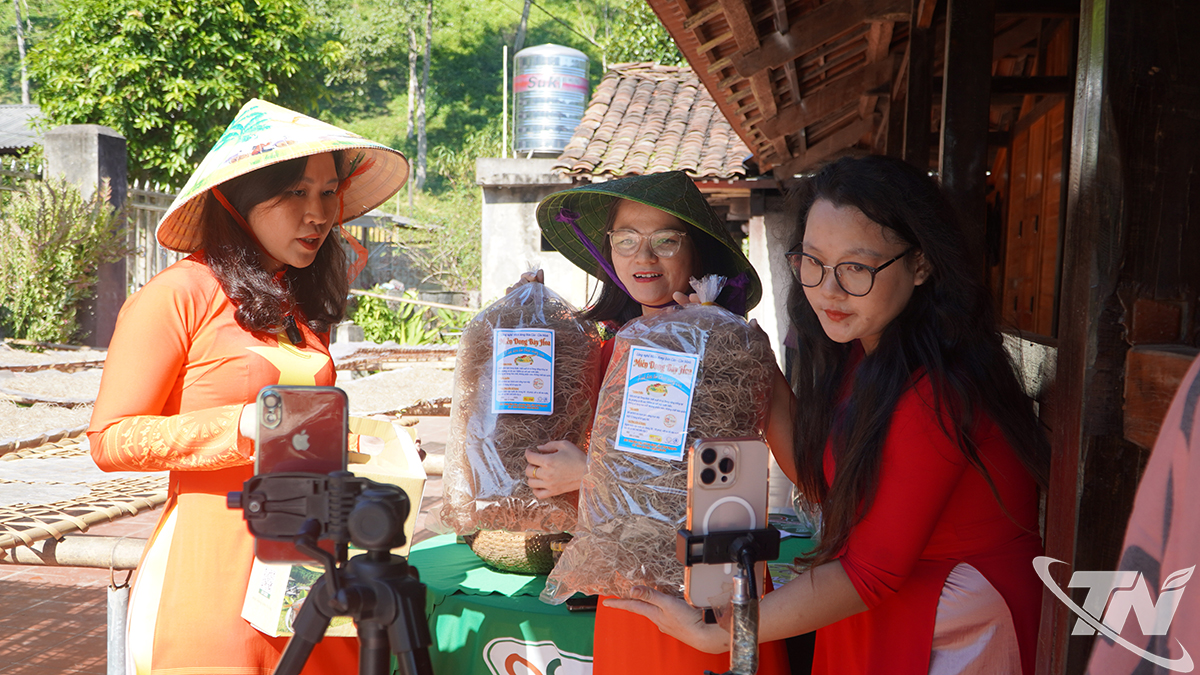 |
| Online sales training class for the Con Minh vermicelli-making village. Photo: Thai Son |
In a highly competitive market, equipping people with the skills to access the digital environment helps them gradually take control of the consumption process, reducing their dependence on middlemen. Not only do they sell their goods, but they also learn how to build product image, focusing on quality and reputation, thereby increasing the value of local production.
From the specific models, it can be seen that the common point of effective vocational training courses is that they all stem from the actual needs of the people. The training content is linked to existing livelihoods or appropriate development directions of each commune.
The flexible organizational format, emphasizing hands-on practice, helps learners master skills and apply them immediately after the course. This is the decisive factor in ensuring vocational training does not become merely a formality or a case of "learning and then forgetting."
Experience shows that vocational training does not yield immediate results, but it creates fundamental and long-lasting changes. From changing production mindsets to forming planned business habits, it gradually improves the quality of the rural workforce.
For ethnic minority workers, this is also key to narrowing the development gap and creating opportunities for advancement through their own abilities. And when people are equipped with the right skills, vocational training will not only be a support program but will become an intrinsic driving force, contributing to sustainable rural development.
Source: https://baothainguyen.vn/xa-hoi/202512/tao-nang-luc-tu-than-mo-duong-phat-trien-ben-vung-4df1990/
![[Photo] Prime Minister Pham Minh Chinh receives the Governor of Tochigi Province (Japan)](/_next/image?url=https%3A%2F%2Fvphoto.vietnam.vn%2Fthumb%2F1200x675%2Fvietnam%2Fresource%2FIMAGE%2F2025%2F12%2F16%2F1765892133176_dsc-8082-6425-jpg.webp&w=3840&q=75)
![[Image] Leaked images ahead of the 2025 Community Action Awards gala.](/_next/image?url=https%3A%2F%2Fvphoto.vietnam.vn%2Fthumb%2F1200x675%2Fvietnam%2Fresource%2FIMAGE%2F2025%2F12%2F16%2F1765882828720_ndo_br_thiet-ke-chua-co-ten-45-png.webp&w=3840&q=75)

![[Live] 2025 Community Action Awards Gala](/_next/image?url=https%3A%2F%2Fvphoto.vietnam.vn%2Fthumb%2F1200x675%2Fvietnam%2Fresource%2FIMAGE%2F2025%2F12%2F16%2F1765899631650_ndo_tr_z7334013144784-9f9fe10a6d63584c85aff40f2957c250-jpg.webp&w=3840&q=75)

![[Photo] Prime Minister Pham Minh Chinh receives Lao Minister of Education and Sports Thongsalith Mangnormek](/_next/image?url=https%3A%2F%2Fvphoto.vietnam.vn%2Fthumb%2F1200x675%2Fvietnam%2Fresource%2FIMAGE%2F2025%2F12%2F16%2F1765876834721_dsc-7519-jpg.webp&w=3840&q=75)



















![[Online Forum] Protecting the Community - Say No to Heated Tobacco Products](https://vphoto.vietnam.vn/thumb/402x226/vietnam/resource/IMAGE/2025/12/17/1765968642669_toan_20251217144430.jpeg)


































![[Live] Closing Ceremony and Award Presentation for the "Impressive Vietnam Tourism" Video/Clip Creation Contest 2025](https://vphoto.vietnam.vn/thumb/402x226/vietnam/resource/IMAGE/2025/12/17/1765974650260_z7273498850699-00d2fd6b0972cb39494cfa2559bf85ac-1765959338756946072104-627-0-1338-1138-crop-1765959347256801551121.jpeg)




















Comment (0)