

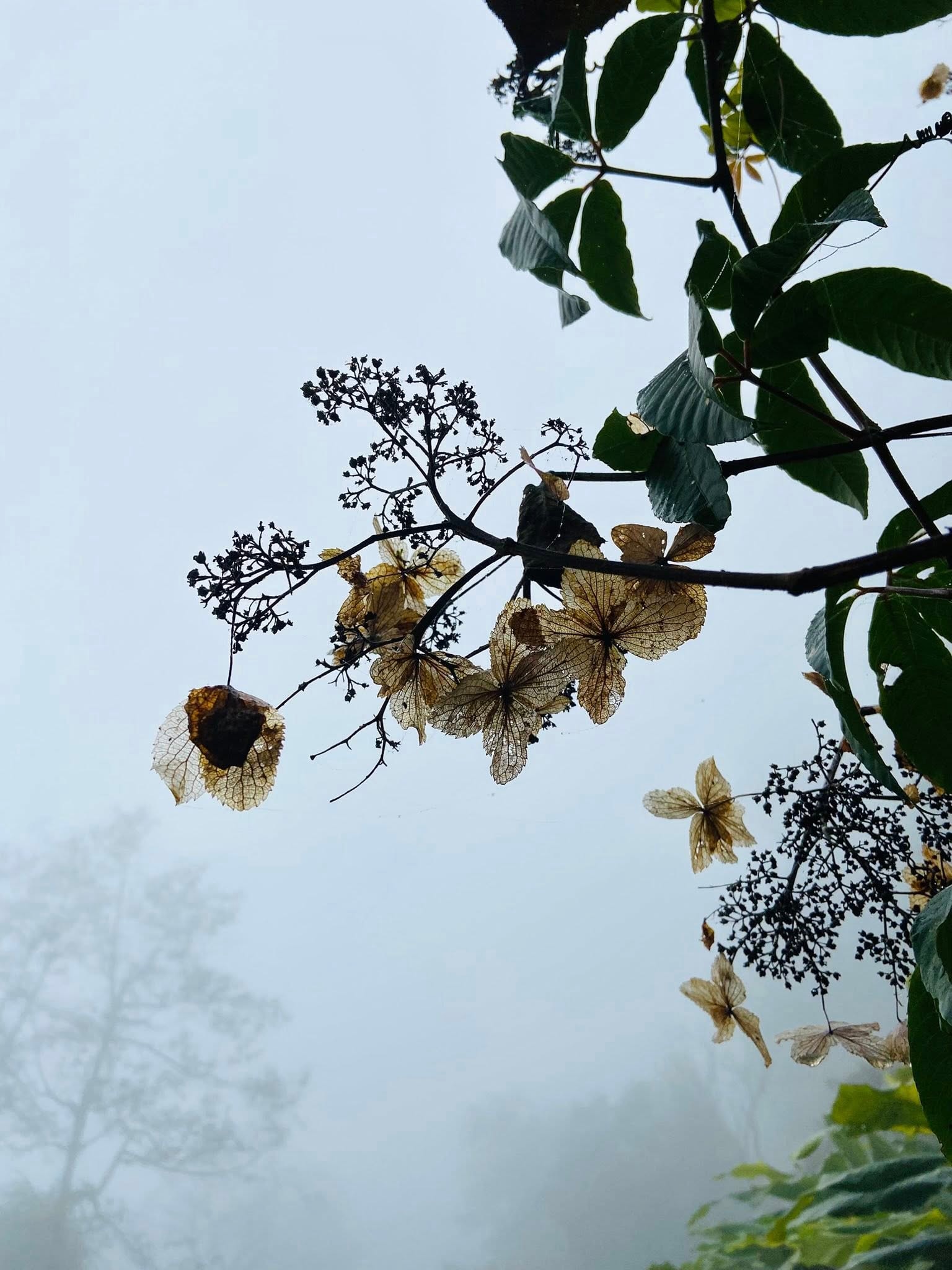
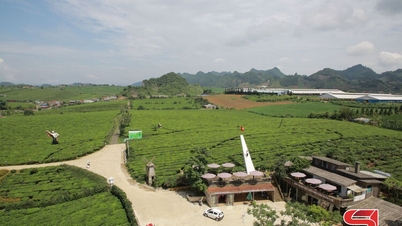
I followed the slope leading to the heart-shaped tea hill. Rows of deep green tea plants stretched out, soft and gentle like brushstrokes on a giant ink painting. The tea bushes were neatly trimmed and arranged regularly, like the heartbeat of the earth. With each step, the clouds opened up a little more space, then closed behind me like an invisible door.
Moc Chau is a place where clouds migrate and move throughout the four seasons. This season, the clouds are in Tan Lap village; next season, they will move to Phieng Luong, Long Luong, Na Ka… The clouds don't stay in one place, but they don't leave completely either; they only change locations to deepen their longing. Amidst this vastness, I suddenly understood why the people of the highlands rarely speak of longing, because the clouds have already spoken for them.
The wind on the tea hills carries the earthy scent of young leaves, mixed with a subtle bitterness on the tongue. No need to touch; simply standing amidst the clouds and tea is enough to feel a unique greeting: "Moc Chau is here, slow-paced, but deeply meaningful."
Evening descended quickly in the highlands. The sun faded, and a chill descended like a giant blanket upon the village. A Thai family invited me into their home for a cup of herbal tea.
The small but cozy house, made of cypress wood, had a roof made of old, faded wooden planks. On the hearth, the wood fire crackled softly. There were no lengthy conversations, but the fire itself was a complete story. In the firelight, I saw the silhouette of a Thai woman warming her hands, the children lying face down watching the roasted sweet potatoes turn a golden hue, and the man silently adding firewood—no words, yet everything he said. Here, warmth doesn't lie in words, but in the rhythm of life.
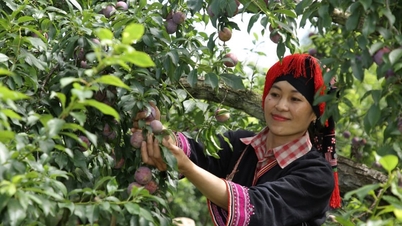
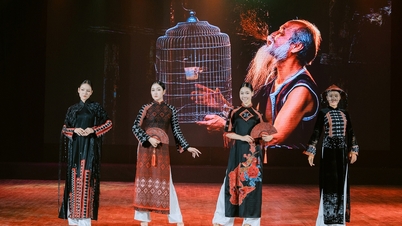
That night in the town, I wandered through the Moc Chau night market. The stalls were filled with brocade fabrics, embroidered scarves, embroidered pao bags, and handcrafted silver bracelets made by the Red Dao people… Highland cuisine was also sold everywhere: corn wine fermented with leaves, warm cow's milk, mountain version of thang co (a traditional stew), pa pinh top (a type of stew), bamboo tube rice…
But what impressed me most wasn't just the food, but the way people celebrated Tet in this modern, integrated setting.
Many young people in the highlands now livestream selling goods, using QR codes for payment, speaking clear and articulate Vietnamese, interspersed with a few ethnic words when introducing products. Digital technology may permeate daily life, but it doesn't penetrate the hearth, the way people bow when offering drinks, or the color of the new piêu scarf that mothers use to tie around their daughters' hair on the first day of the Lunar New Year.
I met a group of young Hmong people practicing pao throwing. They were playing music on a Bluetooth speaker while throwing pao to the rhythm of their traditional game. They talked about integration, about community tourism startups, but when they mentioned Tet (Vietnamese New Year), Het Cha (a traditional dish), Tan Hmong sticky rice, and rice wine brewed with forest leaf yeast… their voices softened, as if they were standing before the altar of their own mountains and forests.
Source: https://baodanang.vn/theo-dau-may-rong-ruoi-3322578.html














![[Video] Sunset at Lap An Lagoon – Where the sun sets over the fishing nets](https://vphoto.vietnam.vn/thumb/340x192/vietnam/resource/IMAGE/2026/05/31/1780192137701_beach-landscape-sea-water-nature-grass-745871-pxhere-com.jpeg)



![[Photo] The General Secretary, President and his wife lay flowers at the Ho Chi Minh Monument in Manila.](https://vphoto.vietnam.vn/thumb/1200x675/vietnam/resource/IMAGE/2026/05/31/1780219759477_anh-man-hinh-2026-05-31-luc-16-29-07.png)



















































Comment (0)