

Prior to 2021, Mr. Chuc tried his hand at various jobs, but his life remained difficult. Undeterred, he continuously learned and sought new ways to develop his economy . Through his research, he learned about the Boer goat breed, originating from South Africa, which has the advantages of fast growth, low susceptibility to disease, easy adaptability, and the ability to be raised in enclosed pens without requiring much space. He boldly borrowed over 100 million VND to build a 200 m² barn and bought 30 breeding goats. Initially, due to lack of experience, the herd grew slowly. To overcome this, he renovated the barn, raising it 1.5 meters above the ground to ensure dryness and ventilation, adjusted the feed ration, and proactively vaccinated the goats. As a result, the herd developed healthily, and the mortality rate decreased significantly.
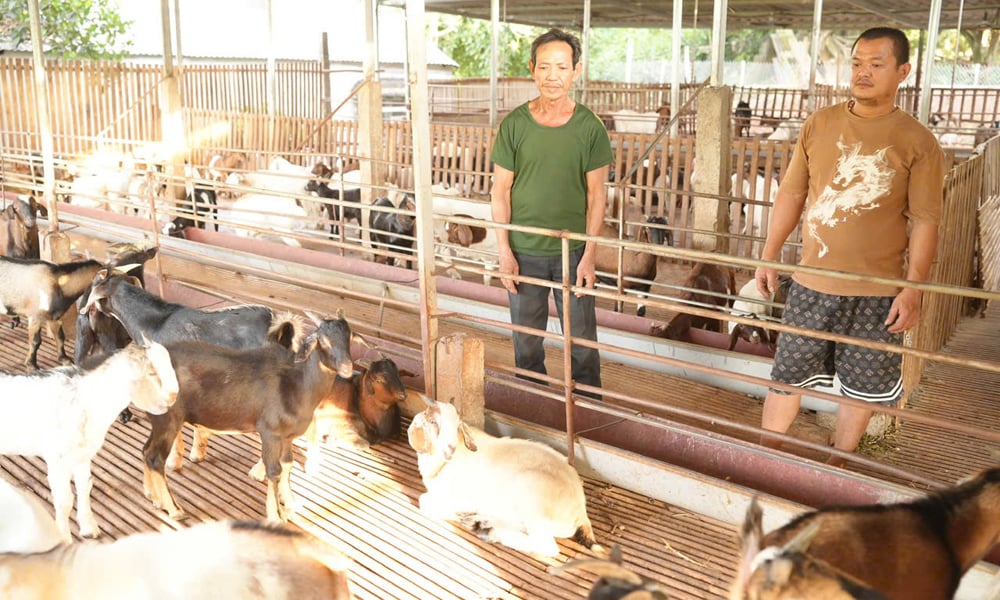 |
The family of Mr. Nguyen Van Chuc (on the right) has a stable income thanks to raising goats. |
“Previously, there was a time when I had to travel to many provinces to work as a laborer to earn a living, which was very hard work and the income was not much. Since I started raising goats, I have time at home and still have the opportunity to develop my economy. Raising Boer goats is advantageous because the investment cost is low, and the main feed is grass, leaves, plus a little bran and soybean meal. After each breeding cycle of 6-8 months, the goats reach 50-55 kg/each,” Mr. Chuc said. Currently, his family regularly maintains a total herd of 400-500 goats, including about 300 commercial goats and the rest are breeding goats. They sell two batches per year, earning a profit of over 400 million VND. Seeing the clear effectiveness, he encouraged relatives and villagers to follow suit; many households have now achieved stable incomes.
The highlight of this model is the utilization of agricultural by-products as feed, which both reduces costs and protects the environment. Besides growing elephant grass, the family also collects jackfruit leaves, sấu leaves, etc., to feed the goats. Goat manure is bagged and sold to ornamental plant growers for 30,000 VND per bag, helping to increase their income.
The consumption of Boer goat meat is currently very favorable; traders come directly to the village to purchase it, and at times there isn't enough supply to meet customer demand. In addition, Mr. Chúc also prepares dishes from goat meat for parties, weddings, and other celebrations, creating jobs and income for people in the village.
According to Ms. Do Thi Quyen, Director of the Nha Nam Commune Public Service Supply Center, Mr. Chuc's goat farming model yields high economic efficiency and is suitable for the weather conditions in Northern Vietnam, thus having the potential for replication. In the future, the Center will continue to connect farmers to visit and learn from Mr. Nguyen Van Chuc's family. They will also advise the Commune People's Committee on establishing a goat farming cooperative, promoting linkages in production and consumption, and contributing to sustainable rural economic development.
Source: https://baobacninhtv.vn/thu-nhap-cao-tu-dan-de-postid431036.bbg

![[Photo] Portraits of the 19 members of the Politburo of the 14th Party Congress](/_next/image?url=https%3A%2F%2Fvphoto.vietnam.vn%2Fthumb%2F1200x675%2Fvietnam%2Fresource%2FIMAGE%2F2026%2F01%2F23%2F1769161873355_z7460119485980-304d85fe10d12298f1db614b0d2aa6bc-jpg.webp&w=3840&q=75)


![[Photo] The Politburo, the Secretariat, and the Central Committee are introduced at the Congress.](/_next/image?url=https%3A%2F%2Fvphoto.vietnam.vn%2Fthumb%2F1200x675%2Fvietnam%2Fresource%2FIMAGE%2F2026%2F01%2F23%2F1769156522913_11.jpeg&w=3840&q=75)




Comment (0)