

The Prime Minister recently issued Decision No. 2371/QD-TTg approving the Project "Making English the Second Language in Schools in the period 2025-2035, with a vision to 2045" (hereinafter referred to as the Project). This is the latest step that brings Vietnam closer to its goal of contributing to building a generation of global citizens, meeting the requirements of Vietnam's international integration, by setting out a clear roadmap from now until 2045 encompassing all levels of education and types of training.
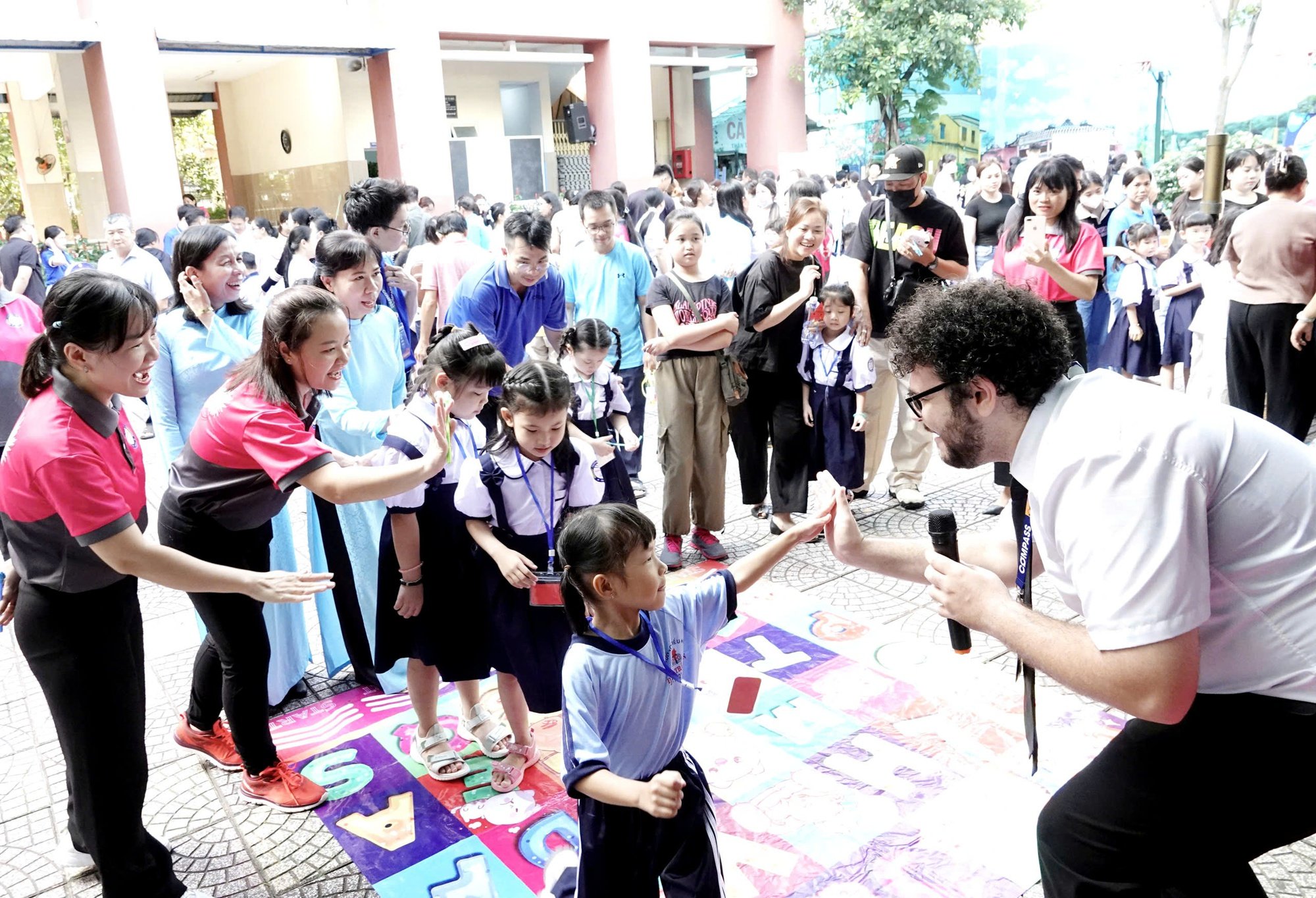
According to the "Making English a Second Language in Schools" project, for the period 2025-2030, 100% of general education institutions nationwide will make English compulsory from grade 1.
PHOTO: DAO NGOC THACH
COMPULSORY ENGLISH LESSONS FROM GRADE 1: 3 IMPORTANT THINGS
Specifically, according to the plan, during the period 2025-2030, 100% of general education institutions nationwide will make English compulsory from grade 1.
According to experts, this is the right vision, reflecting the aspiration for integration and enhancing the global citizenship skills of the new generation. But what is the effective roadmap? If there are not enough primary school English teachers, what should localities do?
According to a report by the Ho Chi Minh City People's Committee on the education situation in Ho Chi Minh City for the 2024-2025 school year, and preparations for the 2025-2026 school year, after the merger, 2,093 out of 3,937 preschools (53.16%) organized English language introductions for children; 206,811 preschool children were introduced to English, and 3,489 teachers participated in organizing English language activities for children.
Ho Chi Minh City recognizes that the rate of preschool children being introduced to English is uneven, mainly concentrated in public schools. The city's education sector plans to increase the number of preschool children introduced to English in the 2025-2026 school year to provide them with a good foundation before entering primary school.
Ms. Le Thi Thu Hang, Principal of Tran Khanh Du Primary School, Tan Dinh Ward, Ho Chi Minh City, believes that in the period 2025-2030, when English will be compulsory from grade 1, primary schools need to prepare now for three things to be most effective. Firstly, adequate facilities (classrooms, functional rooms, equipment) to support teaching. Secondly, a sufficient and qualified teaching staff. Thirdly, raising awareness among parents to foster consensus and support in their children's learning activities.
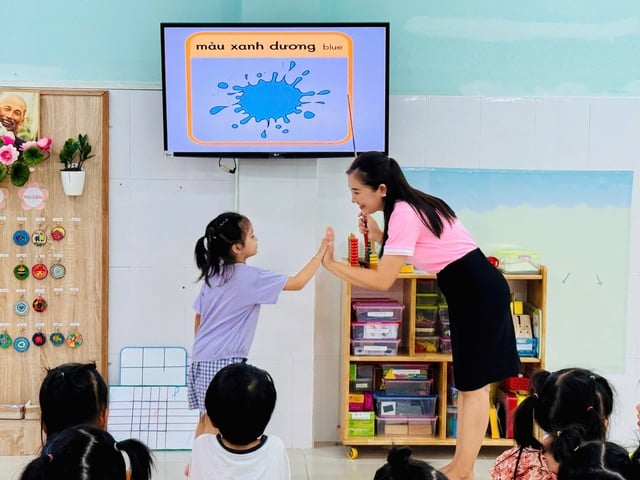
Preschool teachers introduce English to young children.
Photo: Thuy Hang
However, in reality, there is still a localized shortage of teachers in some subjects at certain schools and localities. A report by the Ho Chi Minh City People's Committee on education in the city for the 2024-2025 school year, preparing for the 2025-2026 school year, shows that the number of staff in public general education institutions is insufficient compared to the established standards, especially for teachers of foreign languages, information technology, music , fine arts, technology, and physical education. At the same time, the newly merged city has a large administrative area and diverse types of communities (rural, urban, island communes, special zones, etc.), and the infrastructure and teaching staff are still uneven across localities, with some teachers having limited foreign language and information technology skills.
In many places, class sizes are large, making it impossible to achieve 100% of students attending two sessions per day. This reality poses challenges and requires solutions to ensure the quality and conditions of teaching and learning, especially as English will become a compulsory subject from grade 1 in the period of 2025-2030.
Ms. Hang stated that the Ho Chi Minh City Department of Education and Training annually plans to recruit civil servants for the education sector. In addition, a solution implemented by the city recently is organizing digital classes, a distance learning model for English, broadcasting to primary schools in Can Gio and Cu Chi, and organizing real-time online learning to help schools lacking English and IT teachers organize learning for students, ensuring the quality and curriculum of the subjects…
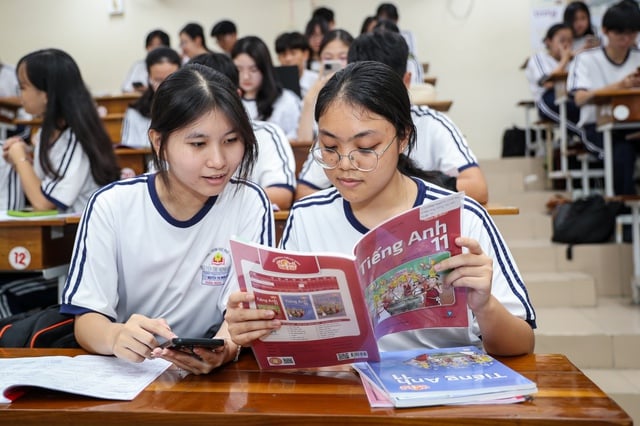
11th grade students in Ho Chi Minh City during an English class.
Photo: Nhat Thinh
P TRAINING PLAN FOR THE DEPARTMENT
Currently working in the English and University Pathways Department at RMIT University Vietnam, Jonny Western, Head of the New Initiative Program, and Dr. Jennifer Howard, Head of the University Preparatory Program, both agree that the success of the project will depend heavily on preparing teachers. These two experts note that teachers need a comprehensive skill set including language proficiency, teaching expertise, and an understanding of pedagogical methods.
According to experts, language proficiency is a key factor. Even teachers with strong subject matter skills may use inaccurate language if they are not proficient in English, negatively impacting students' learning outcomes. Furthermore, when teaching in English to classes with varying language proficiency levels, teachers must adjust materials accordingly to avoid situations where lower-level students struggle, while higher-level students are unable to reach their full potential.
Regarding teacher training, the two experts noted that programs must ensure accessibility for all teachers nationwide, especially by bringing high-quality professional development activities to teachers in remote and disadvantaged areas. Furthermore, policies should establish clear criteria for language proficiency, professional knowledge, and pedagogical effectiveness that teachers need to achieve through periodic evaluations.
Meanwhile, Ms. Nguyen Le Tuyet Ngoc, Regional Director for Asia of MTS (UK) and Director of HEW London (Ho Chi Minh City), commented that the transition of teaching from Vietnamese to English must be carried out smoothly to avoid causing shock to both teachers and students. This process needs to extend over three stages with close supervision and evaluation from management.
The program consists of three phases: Phase 1 focuses on building a foundation in English for subject teachers, while simultaneously designing lesson plans and assessment methods in English for each subject. Phase 2 involves training subject teachers in English classroom teaching skills, along with guidance on teaching based on the prepared lesson plan framework. Finally, Phase 3 involves practical application at educational institutions and evaluation. "After 2-3 years in this phase, subject teachers can confidently teach in the classroom," Ms. Ngoc stated, adding that regarding language proficiency, teachers need to achieve a minimum level of B2 according to the Common European Framework of Reference for Languages (CEFR) to teach subjects such as mathematics, physics, chemistry, history, geography, etc., in English.
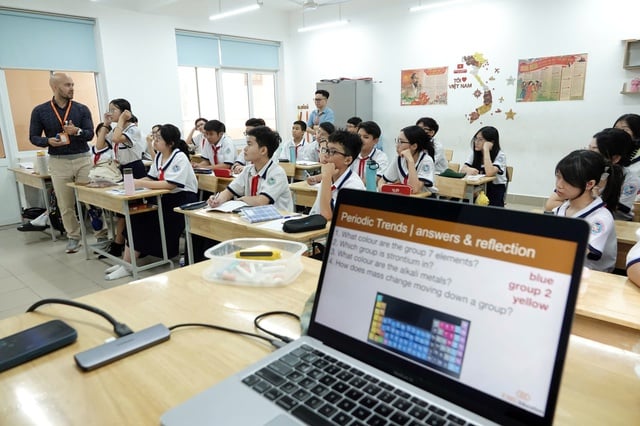
Foreign teachers participate in teaching English to students in Ho Chi Minh City.
Photo: Dao Ngoc Thach
WHAT IS THE NEW ROLE OF ENGLISH TEACHERS ?
Mr. Dinh Quang Duc, Academic Director of SAM English House (Hanoi), said that English teacher training can be done in two main stages to meet the new context. In stage 1, it is necessary to standardize language and pedagogical skills using advanced methods. The core principle is to shift the mindset from teaching in small modules and emphasizing grammar, structure, and translation, to prioritizing the demonstration of real-life communication processes.
In phase 2, English teachers need to adapt to a new role: that of advisor and language expert. "When English becomes a medium of communication for many other subjects, English teachers need to act as advisors to identify core communication issues and simultaneously coordinate the design of learning materials. At this point, subject teachers decide what is taught, while English teachers are the experts ensuring effective communication in English," Mr. Duc emphasized.
Ensure the Vietnamese language is used.
While actively promoting English as a second language in schools, the project also emphasizes the need to "ensure the preservation of the Vietnamese language and the cultural identity of the Vietnamese nation."
Ms. Nguyen Le Tuyet Ngoc further shared that in Singapore, where she lives and works, English is used as the primary communication tool, but the mother tongue is not absent. "In many schools in Singapore, English remains the main language of instruction in subjects like mathematics, science, and social studies, while Mandarin is compulsory for students of Chinese descent and Malay is compulsory for students of Malay descent," Ms. Ngoc explained.
That is also why Ms. Ngoc believes that when teaching in English, teachers need to incorporate contexts rich in national identity into their lessons, and organize activities for students to use English to promote Vietnamese culture, cuisine, and people, such as performing plays in English but based on Vietnamese folk tales.
"Teachers can clearly define which language is used during which time slots and in which areas of the school, helping students respect both languages. Students shouldn't be allowed to prefer using only English, or vice versa," Ms. Ngoc noted.
Source: https://thanhnien.vn/tieng-anh-thanh-ngon-ngu-thu-hai-trong-truong-hoc-giao-vien-la-quan-trong-nhat-185251030213331305.htm

![[Photo] Prime Minister Pham Minh Chinh receives Lao Minister of Education and Sports Thongsalith Mangnormek](/_next/image?url=https%3A%2F%2Fvphoto.vietnam.vn%2Fthumb%2F1200x675%2Fvietnam%2Fresource%2FIMAGE%2F2025%2F12%2F16%2F1765876834721_dsc-7519-jpg.webp&w=3840&q=75)
![[Image] Leaked images ahead of the 2025 Community Action Awards gala.](/_next/image?url=https%3A%2F%2Fvphoto.vietnam.vn%2Fthumb%2F1200x675%2Fvietnam%2Fresource%2FIMAGE%2F2025%2F12%2F16%2F1765882828720_ndo_br_thiet-ke-chua-co-ten-45-png.webp&w=3840&q=75)
![[Live] 2025 Community Action Awards Gala](/_next/image?url=https%3A%2F%2Fvphoto.vietnam.vn%2Fthumb%2F1200x675%2Fvietnam%2Fresource%2FIMAGE%2F2025%2F12%2F16%2F1765899631650_ndo_tr_z7334013144784-9f9fe10a6d63584c85aff40f2957c250-jpg.webp&w=3840&q=75)

![[Photo] Prime Minister Pham Minh Chinh receives the Governor of Tochigi Province (Japan)](/_next/image?url=https%3A%2F%2Fvphoto.vietnam.vn%2Fthumb%2F1200x675%2Fvietnam%2Fresource%2FIMAGE%2F2025%2F12%2F16%2F1765892133176_dsc-8082-6425-jpg.webp&w=3840&q=75)












































































Comment (0)