

General Secretary To Lam's directive at the National Conference on Studying, Understanding, and Implementing the Resolution of the 14th National Congress on February 7th clearly stated the crucial issue facing Vietnam's economy : we do not lack goals or resolutions, but we lack the capacity to translate what has been said into concrete results in real life.
As Vietnam enters a new era with the aspiration for double-digit growth, this message becomes even more relevant. High growth doesn't wait for slow-moving systems; opportunities are impatient with decisions delayed due to fear of responsibility.
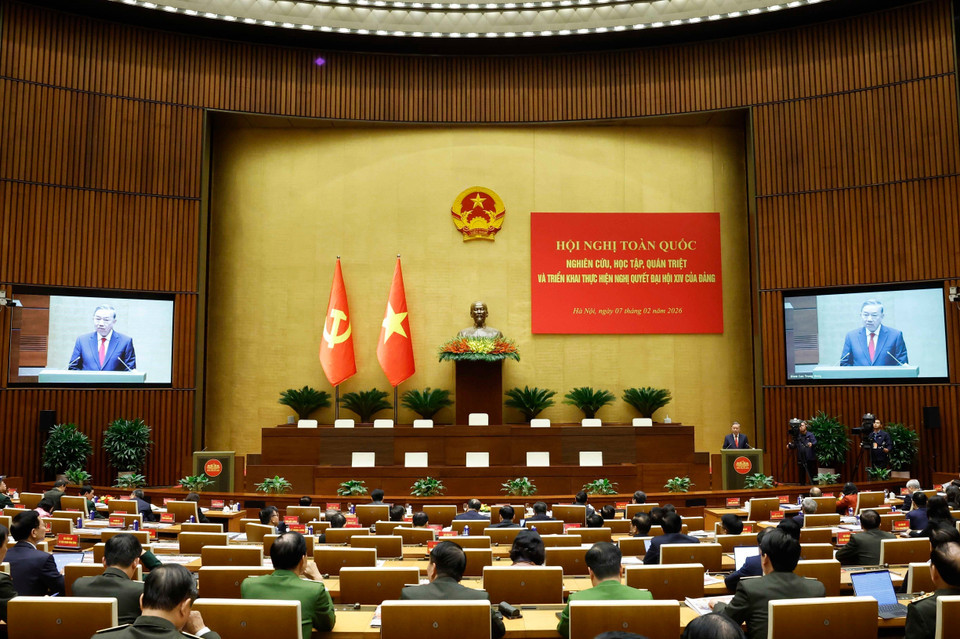
General Secretary To Lam delivers a speech at the National Conference on studying, learning, and understanding the Resolution of the 14th National Congress. Photo: Thong Nhat/TTXVN.
When simply being "right" isn't enough.
Looking back at 40 years of Doi Moi (Renovation), the General Secretary mentioned something that seems obvious: all the country's great achievements are linked to periods of correct policies that were implemented decisively, synchronously, and effectively.
The 1986 reforms were a genuine shift in thinking and action, where barriers were removed, initiative was given to implementers, and results were measured in growth, employment, and living standards.
Compared to that time, Vietnam today is in a very different position. The economy is larger, more open, and there is less room for error.
We have had many correct resolutions and well-structured strategies, but we must also frankly acknowledge that the quality of growth is improving slowly, productivity and endogenous competitiveness are not commensurate, and there is still a gap in governance effectiveness and enforcement discipline.
The assessments of the Central Policy and Strategy Committee on the first five years of implementing the 2021-2030 socio-economic development strategy clearly demonstrate this.
From growth not meeting targets, institutional bottlenecks, and science and technology not yet becoming a driving force, to gaps in regional coordination capacity, resource management, and governance quality.
Looking directly at those limitations isn't about being pessimistic, but about identifying the right areas for breakthroughs.
The "address" of reform
Therefore, the overarching emphasis in the General Secretary's speech was not on setting new goals, but on the need for a strong renewal of organizational capacity for implementation. This involves moving from "talking" to "doing," from slogans to action, and from formal reports to measurable results.
The key year outlined by the General Secretary is essentially an action plan for the entire system.
Institutions must be transformed quickly, synchronously, and effectively to become drivers of development, not obstacles. Enforcement discipline must be strict enough to put an end to shirking and passing the buck. The effectiveness of development must be measured by the satisfaction of the people, not by the impressive numbers in reports.
Above all, we need a team of officials who dare to think, dare to act, and dare to take responsibility for the common good – people who are willing to take the lead instead of choosing the safe option for themselves.
Here, the encouraging message is very clear: innovation is not an administrative order, but a space where capable people can act and be protected when they act correctly.
Double-digit growth cannot come from procrastination.
Putting those demands into the context of double-digit growth targets, one thing becomes clear: high growth cannot come from short-term stimulus or expanding investment at all costs. It is only sustainable when institutions function smoothly, the system responds quickly, and enforcement discipline is strong enough to prevent policy distortion.
Businesses, especially the private sector, are the ones who best sense the government's enforcement capabilities. When policies are clear, compliance costs are reduced, and legal risks are controlled, businesses will dare to invest long-term.
Conversely, if decisions are delayed due to fear of making mistakes or fear of responsibility, those costs will fall on the production and business sector, and the impetus for growth will weaken from the outset.
When responsibility is placed in the right place
Another noteworthy point in the speech was how the General Secretary redefined the role of each link in the system.
The central government provides direction and controls implementation; the National Assembly enacts laws to pave the way for development and monitors them thoroughly; the government shifts strongly from promulgation to implementation; and local governments become the frontline, where resolutions are transformed into concrete growth, jobs, and improved quality of life.
The message here is clear: don't expect too much, don't blindly copy, and don't sugarcoat achievements.
Localities that are slow to reform, waste resources, and miss opportunities will first and foremost be held accountable by their leaders. Time is an irreplaceable resource; delays not only hinder development but also cause the entire economy to lose opportunities.
A groundbreaking urging
The General Secretary's statement therefore carries a spirit of encouragement and foresight. When citizens and businesses are involved in oversight, when data and technology are integrated into governance, and when responsibility is individualized at every level, social trust will be transformed into a driving force for development.
The 14th Party Congress has given the system a blueprint for a new phase. The remaining task is to act faster, more genuinely, and thoroughly.
In an era of double-digit growth, the measure of capability lies not in promises, but in the concrete results produced today.
Source: https://vietnamnet.vn/tu-noi-sang-lam-2489139.html






























































![[Image] Close-up view of the 10-lane road connecting to Long Thanh Airport](https://vphoto.vietnam.vn/thumb/402x226/vietnam/resource/IMAGE/2026/04/04/1775291871988_ndo_br_1-resize-5690-jpg.webp)

































Comment (0)