

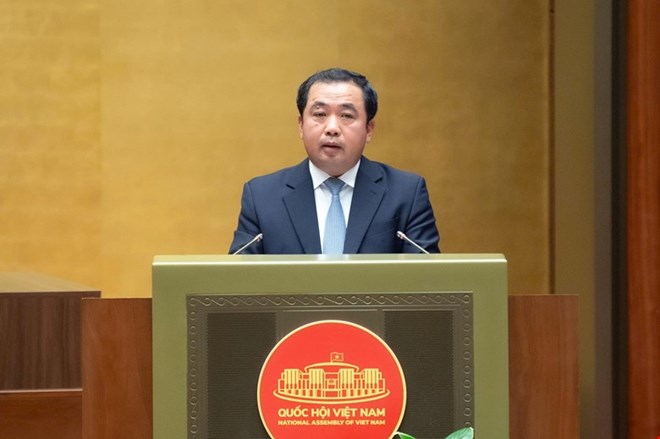
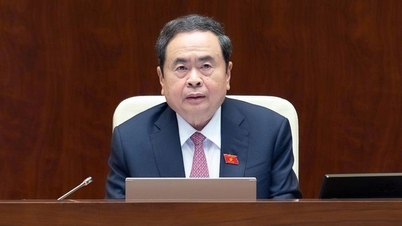
Minister of Agriculture and Environment Tran Duc Thang said that Vietnam has rare earth reserves that are among the top in the world. Photo: Quochoi.vn.
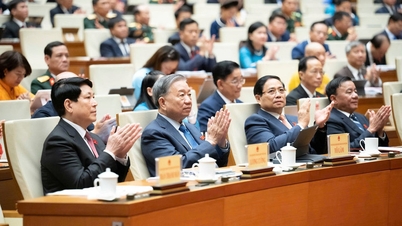
On December 1, the National Assembly discussed in the hall the draft Law amending and supplementing a number of articles of the Law on Geology and Minerals.
One issue that many delegates are concerned about is the management of rare earth minerals .
Explaining and receiving opinions from National Assembly deputies, Minister of Agriculture and Environment Tran Duc Thang said that Vietnam is a country with large rare earth reserves, ranking second and third in the world , distributed in 21 provinces and cities.
According to the Minister, this agency is presiding over the development of a national strategy on rare earths, to be submitted to competent authorities for promulgation in early 2026.
“We have basically demarcated all the mining areas with minerals and organized strict management. After completing the demarcation, the most important thing now is how to put them into exploitation and deep processing to bring benefits to the country,” said Minister Tran Duc Thang.
Minister Tran Duc Thang emphasized that rare earth will truly become an important resource for us to exploit to develop the country in the coming time in the spirit of forming a closed value chain and minimizing the export of raw materials.
Regarding the mechanism for granting licenses for mineral exploitation for public works and key projects , at the meeting, many delegates suggested considering the scope of projects that benefit from policies and decision-making authority; avoiding expanding the scope of subjects that do not need planning, leading to loopholes and profiteering.
Regarding this issue, Minister Tran Duc Thang clearly stated that permission to expand deeper only applies to operating mines, and does not require additional planning for those mines themselves.
Another issue that many delegates are concerned about is the criteria for delimiting areas where mineral exploitation rights are not auctioned.
According to Minister Thang, the draft law has designed specific principles and criteria to ensure a stable source of raw materials for investors carrying out urgent works and mineral processing projects - fields with specific characteristics, large capital, and strong impact on socio-economic development.
The Minister gave an example, with cement factories, once the construction investment license has been granted, the accompanying raw material mine cannot be put up for auction because it is not suitable for practice.
In addition, the law also assigned the Government to specify in detail the conditions and procedures for delimiting areas where mineral exploitation rights are not auctioned.
According to the Minister, the goal is to fully assess factors such as market demand, resource efficiency, investor capacity, environmental impact and people's livelihoods, thereby forming a deep processing chain in the country.
“This approach helps control risks right from the stage of establishing non-auction areas, avoiding taking advantage of policies, especially with particularly important strategic minerals.
During the implementation process, we also pay close attention to the opinions of National Assembly deputies about the risk of abuse of the appointment mechanism leading to losses" - Minister Thang explained.
Regarding the mineral reserve planning, the Minister emphasized that this is a 50-year reserve area. In this area, only level I projects are not allowed to be built; level II projects and below are allowed to invest and build normally.
Source: https://laodong.vn/thoi-su/viet-nam-co-tru-luong-dat-hiem-thuoc-nhom-top-dau-the-gioi-1618380.ldo
![[Photo] Prime Minister Pham Minh Chinh receives President of Cuba's Latin American News Agency](/_next/image?url=https%3A%2F%2Fvphoto.vietnam.vn%2Fthumb%2F1200x675%2Fvietnam%2Fresource%2FIMAGE%2F2025%2F12%2F01%2F1764569497815_dsc-2890-jpg.webp&w=3840&q=75)


































































Comment (0)