The universe may be contracting, heading toward a "Big Bang" instead of perpetual expansion, a groundbreaking study by South Korean scientists has just published, questioning long-held cosmological theories.
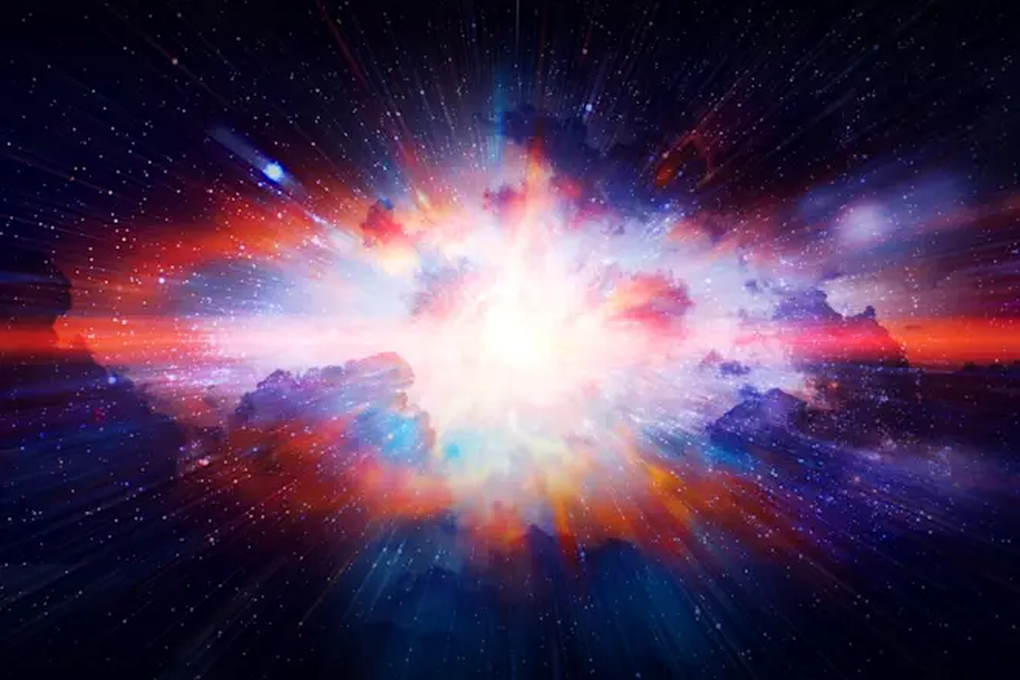
What is the Big Crunch theory? Imagine it's like what happens when you press the rewind button on the Big Bang (image: Quality Stock Arts/Shutterstock).
Contrary to the popular belief that the universe is constantly expanding, new research suggests that dark energy, a mysterious force once thought to be accelerating this expansion, may be weakening, leading to a contraction of the universe and ultimately a terrifying phenomenon known as the "Big Crunch."
Professor Young Wook Lee, head of the research team at Yonsei University in Seoul, South Korea, stated: "The fate of the universe will change."
He explained that the universe may be "running out of gas," leading to a gravitational collapse where all the galaxies would be compressed together.
This research, published in the monthly journal of the Royal Astronomical Society of the UK, has challenged cosmological theories that have existed for decades.

Researchers used a type IA supernova, similar to SN1994d captured in its host galaxy NGC4526, to help determine that the expansion of the universe may have begun to slow down (image: NASA/ESA).
Previously, it was believed that the universe began with the Big Bang about 13.8 billion years ago and then expanded slowly. However, in 1998, scientists discovered dark energy, a mysterious force thought to be accelerating the expansion of the universe.
Analysis of supernovae (brightly exploding stars) has shown that distant galaxies are moving away from each other at increasingly faster rates, potentially leading to a "Big Rip"—a catastrophic event that would cause atoms to disintegrate.
However, new research by Professor Lee and colleagues proposes a different hypothesis: dark energy is changing rapidly, and the universe may be running out of it.
"Our research shows that the universe has entered a phase of slowing expansion at the present time, and dark energy is evolving much faster over time than previously thought," Professor Lee emphasized.
"If these results are confirmed, it would mark a major shift in cosmological models since dark energy was discovered 27 years ago," he said.
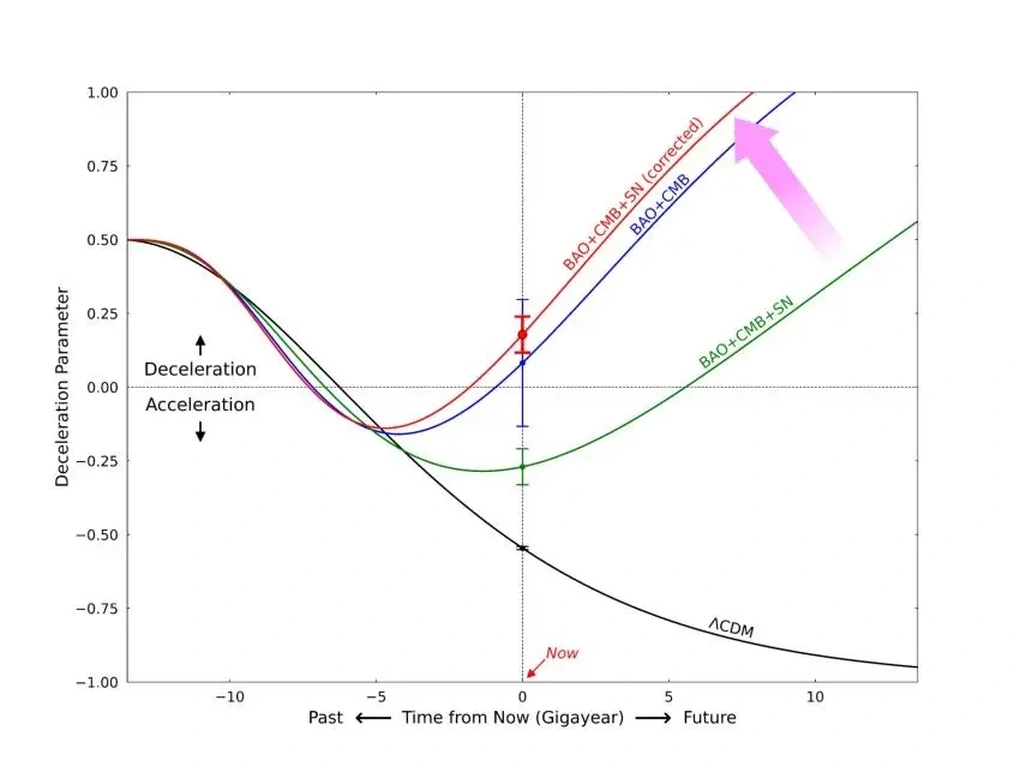
The diagram shows that the expansion of the universe may be beginning to slow down. Professor Lee stated, “Our research suggests that the Universe has entered a phase of slowing expansion at this point in time, and dark energy is evolving over time much faster than previously thought” (image: Professor Lee and colleagues).
To reach this conclusion, the research team examined the brightness of Type IA supernovae, dubbed "standard candles" because they serve as markers of distance in the universe. If these dying stars appear dim, they are believed to be very far away, illustrating the expansion of the universe due to dark energy.
However, after analyzing 300 host galaxies, Professor Lee and his team discovered that the brightness of supernovae is more closely related to the age of the stars before they explode, rather than their distance. Specifically, older stars produce brighter explosions, while younger stars are systematically dimmer.
This refuted the hypothesis that dark energy is a constant force, instead demonstrating that it can gradually weaken over time.
This research is supported by a novel model favored by the Dark Energy Spectrometer (DESI) and is well-fitted to data from the Cosmic Microwave Background (CMB) and Baryon Acoustic Oscillations (BAO).
"Our analysis shows that the universe entered a deceleration phase today," Professor Lee asserted.
Fortunately, this intergalactic catastrophe will probably not happen during our lifetime. Cosmologists at Cornell University predict that the apocalypse will occur within the next 19.5 billion years.
To confirm these results, the Yonsei University research team is conducting a "non-evolutionary experiment" focusing on supernovae in galaxies of similar age.
The final conclusion will likely be confirmed through the Vera C. Rubin Observatory in Chile, which is equipped with the world's most powerful digital camera and is expected to detect 20,000 new supernova-containing host galaxies in the next half-decade.
Source: https://dantri.com.vn/khoa-hoc/vu-tru-se-sup-do-trong-vu-co-lon-20260107004832015.htm




































































































Comment (0)