

On the afternoon of December 1, the National Assembly discussed the draft Law on Digital Transformation in the hall. Regarding online public services, delegate Nguyen Tam Hung (HCMC delegation) said that the draft stipulates that State agencies are not allowed to ask people to resubmit documents that are already in the national database, but has not yet defined legal responsibilities when the data system is faulty or not connected, causing delays in handling procedures for people and businesses.
Delegate Hung suggested considering adding a clear handling mechanism including regulations on accountability, responsibility for compensation for damages and the obligation to publicly disclose technical causes when applications are delayed or rejected not due to the people's fault.

Delegate Nguyen Tam Hung (HCMC delegation)
Mr. Nguyen Tam Hung emphasized that this is the key point for digital transformation to go into reality, with people truly becoming the center.
Sharing the same view, delegate Pham Trong Nhan (HCMC delegation) commented that public digital infrastructure has not been designed to national standards. Components such as identification - authentication, public digital payment, integration platform, data sharing, national digital signature, cloud, data center are the backbone of digital government , but the draft has not affirmed the principle of "one standard - one platform - many services". Along with that, it has not been determined which part the State invests in, which part is socialized; there is no national API, so ministries, branches - localities build their own systems, causing fragmentation and large hidden costs.
Vietnamese businesses are having to run on "someone else's turf "
Worryingly, according to delegate Pham Trong Nhan, a very worrying reality is that 99% of Vietnamese people's digital behavioral data (travel, shopping, entertainment, consumption...) is on the ecosystem of large foreign platforms; while Vietnamese startups are "data hungry", do not have data to train AI, develop products, and compete.
"In the digital economy game, Vietnamese businesses are playing on someone else's turf. When data is not within one's legal borders, it is difficult to protect digital sovereignty and develop domestic digital businesses. Without Vietnamese data, there can be no Vietnamese AI," Mr. Pham Trong Nhan raised the issue.
From there, delegates proposed to supplement the principles of digital economic and digital society development in the direction of combining minimum mandatory requirements in transactions with the State, and maximum incentives for businesses: renting digital services, cloud, sandbox.
At the same time, establish the principles of data economy: data is a new factor of production; non-personal data must be shared in aggregated and anonymous form; prevent data monopoly and data lock-in.
A framework law is needed to end "number discrimination"
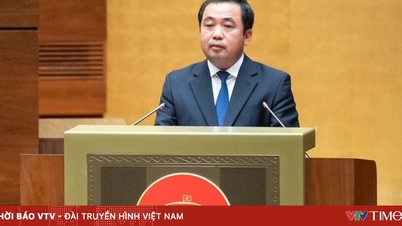
Explaining to the National Assembly about issues of concern to delegates, Minister of Science and Technology Nguyen Manh Hung emphasized that this is a completely new law with no international precedent, so the spirit of drafting the law is "short, framework law and giving flexibility to the Government".
He said that currently, regulations related to digital transformation are scattered in many laws, lacking a technological framework, lacking minimum principles and especially lacking a unified national governance structure. The new law aims to avoid the situation where each industry and each locality follows its own system, leading to fragmentation, waste and difficulty in sharing data.
The Law on Digital Transformation was built, according to the Minister of Science and Technology, to create a unified legal framework for national digital transformation, ensuring digital transformation in the right direction, safely and effectively, and overcoming the situation of digital segregation and digital fragmentation on platforms.
"If we are slower in issuing digital transformation principles, connecting and unifying specialized laws, the blooming of a hundred flowers can ruin the overall picture of national digital transformation," said Minister Nguyen Manh Hung.

Minister of Science and Technology Nguyen Manh Hung
The Minister said that digital transformation is not just about applying technology but also about changing the way of operating, managing and providing services in the digital environment. The biggest difference between digital transformation and traditional information technology application is the emergence of a shared digital platform, operating on the principles of default connection and default data sharing.
He emphasized that when state agencies already have people's information in the national database, people do not have to declare again, because "declaring once is the default, and connecting - communicating - sharing data must also be the default".
The draft focuses on five groups of contents, including the legal framework for a digital nation; the mechanism for developing a digital government, digital economy, and digital society; establishing a unified governance structure; legalizing the mechanism for financial resources and digital human resources; and a system for periodically assessing digital transformation indicators. For the first time, core concepts such as digital transformation, digital data, digital platform, digital infrastructure, and digital environment are defined centrally, along with the overall digital national architecture framework and data governance framework. The National Assembly is expected to pass the Law on Digital Transformation on December 11.
Source: https://phunuvietnam.vn/ai-chiu-trach-nhiem-khi-ho-so-cua-dan-bi-cham-tu-choi-khi-dung-dich-vu-cong-truc-tuyen-238251201190142761.htm


![[Photo] Prime Minister Pham Minh Chinh receives President of Cuba's Latin American News Agency](/_next/image?url=https%3A%2F%2Fvphoto.vietnam.vn%2Fthumb%2F1200x675%2Fvietnam%2Fresource%2FIMAGE%2F2025%2F12%2F01%2F1764569497815_dsc-2890-jpg.webp&w=3840&q=75)






































































































Comment (0)