

In the May earnings report, CEO Tim Cook acknowledged that China is "the most fiercely competitive market in the world ," with sales declining compared to the same period last year. Cook said the company is facing many challenges in China, but he is optimistic that the iPhone 16, with its AI capabilities, will help Apple regain lost market share.
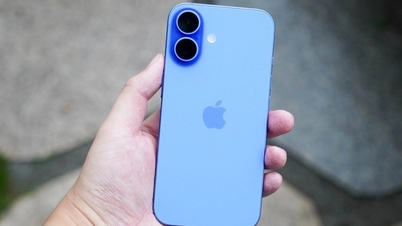
However, at the It's Glowtime iPhone 16 launch event on September 9th, Apple revealed that its most important "weapon" is not yet ready. The most anticipated feature on the iPhone 16, Apple Intelligence, is still delayed. Users will have to wait until December to start experiencing it. However, only some English-speaking markets will be prioritized early; China and many other countries may have to wait until 2025.
It remains unclear whether Apple's new AI feature will soon be available to users in the Chinese market. On Apple's Chinese website, this feature is not mentioned much in the iPhone 16 introductions. The company notes that the launch date of Apple Intelligence depends on regulatory approval.
According to Nikkei Asia, China is tightening control over artificial intelligence-related products. Beijing requires AI models and applications to be registered with regulatory authorities before reaching consumers. OpenAI, the company that developed ChatGPT – Apple's AI partner – has been banned in China since the beginning of this year.
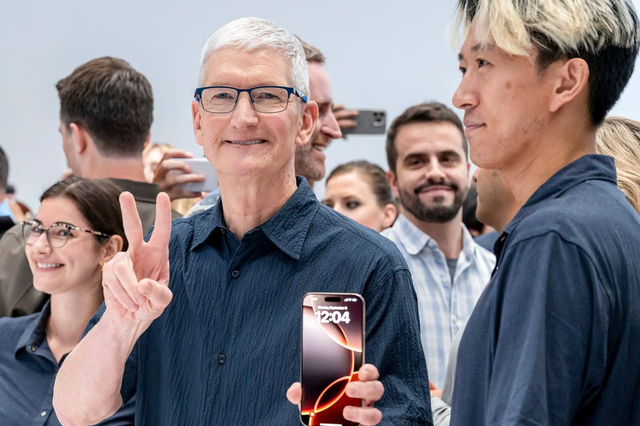
Apple CEO Tim Cook holds the iPhone 16 Pro Max at the It's Glowtime event.
PHOTO: BLOOMBERG
Analyst Ben Wood at market research firm CCS Insight told Nikkei Asia: "Apple Intelligence will be a key weapon for the iPhone 16. However, this feature will be very limited and difficult to access for users in potential markets, including China. Localizing Apple's new AI functions in the billion-person market will be a major challenge."
Wood added that, at this stage, it is difficult to know whether Apple's cloud-based AI approach using its Private Cloud Compute solution will be accepted by the Chinese authorities.
Analysts believe that instead of using OpenAI's GPT or Google's Gemini, Apple may have to use a large-scale language model in China if it wants government approval. Previously, Samsung chose to partner with Baidu to bring Galaxy AI to users there.
Data from China's Ministry of Information Technology and Industry shows that, to date, the regulatory body has approved 188 major language models for domestic use. However, none of these models were released by foreign companies.
Lucas Zhong, an analyst at Canalys, believes that Apple's failure to disclose any details regarding these partnerships will put it at a disadvantage, especially as competitors are already preparing AI features.
Following the launch of the iPhone 16, Chinese social media is raising questions about whether Apple's promise to deploy AI in China will soon materialize. Many users expressed disappointment that Apple Intelligence is not yet ready for the Chinese market. "The most important feature is missing; shouldn't Apple halve the price of the iPhone 16?" one Weibo user wrote. Another user argued that without Apple Intelligence, the iPhone 16 is like "a bird with its wings clipped," leaving the company with no chance to compete with rivals.
Source: https://thanhnien.vn/ai-khong-cuu-duoc-apple-o-thi-truong-khoc-liet-nhat-the-gioi-18524091009093721.htm
![[Photo] Prime Minister Pham Minh Chinh receives the Governor of Tochigi Province (Japan)](/_next/image?url=https%3A%2F%2Fvphoto.vietnam.vn%2Fthumb%2F1200x675%2Fvietnam%2Fresource%2FIMAGE%2F2025%2F12%2F16%2F1765892133176_dsc-8082-6425-jpg.webp&w=3840&q=75)

![[Photo] Prime Minister Pham Minh Chinh receives Lao Minister of Education and Sports Thongsalith Mangnormek](/_next/image?url=https%3A%2F%2Fvphoto.vietnam.vn%2Fthumb%2F1200x675%2Fvietnam%2Fresource%2FIMAGE%2F2025%2F12%2F16%2F1765876834721_dsc-7519-jpg.webp&w=3840&q=75)
![[Image] Leaked images ahead of the 2025 Community Action Awards gala.](/_next/image?url=https%3A%2F%2Fvphoto.vietnam.vn%2Fthumb%2F1200x675%2Fvietnam%2Fresource%2FIMAGE%2F2025%2F12%2F16%2F1765882828720_ndo_br_thiet-ke-chua-co-ten-45-png.webp&w=3840&q=75)

![[Live] 2025 Community Action Awards Gala](/_next/image?url=https%3A%2F%2Fvphoto.vietnam.vn%2Fthumb%2F1200x675%2Fvietnam%2Fresource%2FIMAGE%2F2025%2F12%2F16%2F1765899631650_ndo_tr_z7334013144784-9f9fe10a6d63584c85aff40f2957c250-jpg.webp&w=3840&q=75)










































![[Live] Closing Ceremony and Award Presentation for the "Impressive Vietnam Tourism" Video/Clip Creation Contest 2025](https://vphoto.vietnam.vn/thumb/402x226/vietnam/resource/IMAGE/2025/12/17/1765974650260_z7273498850699-00d2fd6b0972cb39494cfa2559bf85ac-1765959338756946072104-627-0-1338-1138-crop-1765959347256801551121.jpeg)



















Comment (0)