

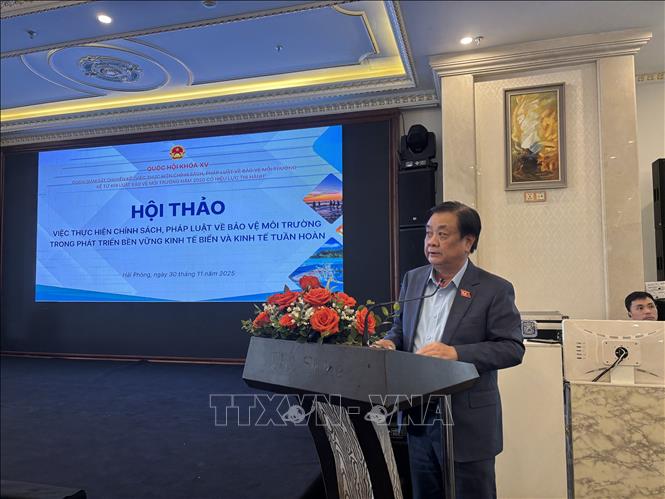
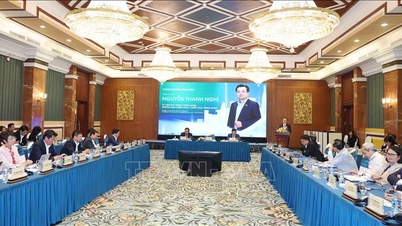
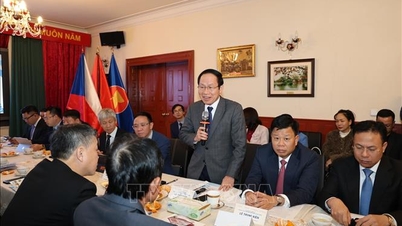
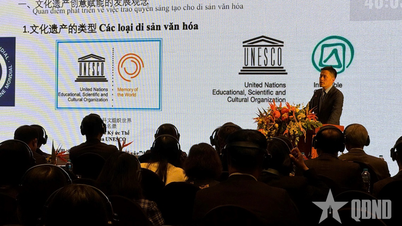
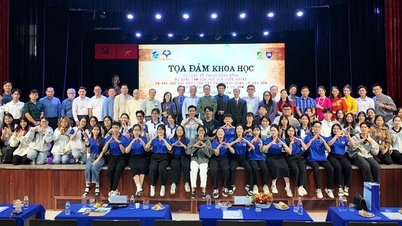
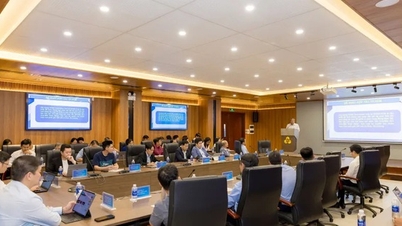
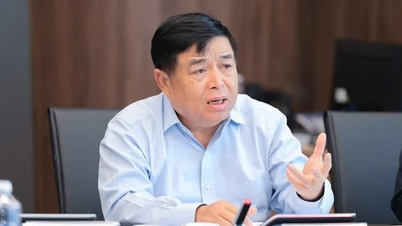
This workshop is part of the National Assembly's Supervision Delegation's Supervision Program on thematic supervision of "Implementation of environmental policies and laws since the Law on Environmental Protection 2020 took effect". Member of the Party Central Committee, Vice Chairman of the National Assembly , Head of the Supervision Delegation Le Minh Hoan chaired the workshop.
Speaking at the workshop, Vice Chairman of the National Assembly Le Minh Hoan highly appreciated the quality of the reports and comments. He emphasized that protecting the marine environment is not only the task of the agricultural and environmental sectors, but also a shared responsibility, creating a foundation for sustainable marine economic development, harmoniously connecting the environment, livelihoods and community prosperity.
"The sea only benefits us if and only if we know how to cherish and nurture it. We need to understand the philosophy: 'We do not inherit the Earth from our ancestors, but are borrowing it from our descendants'," Vice Chairman of the National Assembly Le Minh Hoan emphasized.
Vice President Le Minh Hoan said that systemic thinking sees the sea as a living entity. Marine development cannot be divided into sectors or localities. The marine ecosystem is a network, including: flows, fisheries, livelihoods, urban areas, trade, environment, security, and marine culture. Any policy that touches a link will create a chain effect. Ecosystem thinking requires fishermen, businesses, scientists, governments, and communities to participate. The sea cannot be governed by a "management" mindset, but by a mindset of "co-management, integrated governance" of marine space, respect for indigenous knowledge, and synchronous, responsible inter-sectoral cooperation.
Vice Chairman Le Minh Hoan shared: "Fishermen are the center, livelihood is the fulcrum. Protecting the sea must start with people who live from the sea, on the sea. Fishermen understand the sea intuitively and by tradition, fishermen are the "natural sensors" of the ecosystem. To protect the sea, we must improve our livelihoods, change our exploitation behavior, shift from "exploitation" to "responsible exploitation", have mechanisms to encourage good behavior, in addition to measures to handle violations. Enterprises lead the way, science and technology pave the way. The sea will only truly become a marine economy when enterprises boldly step into high-tech marine farming, green seaports, offshore renewable energy, deep processing, circular economy of aquatic products, and traceability technology. Science and technology are the "navigators", opening a new way out to sea for a nation strong in the sea, rich from the sea".
Mr. Le Minh Hoan affirmed that in nature, nothing exists alone. The sea is a shared space. No one protects the sea alone. It is necessary to form a fishing community, a business community, a scientific community, a consumer community that respects the value of the sea. The sea is protected when fishermen see the benefits of compliance, businesses benefit from investing in clean technology, consumers choose products with traceable origins, and the government takes a long-term view, not "trading the environment for growth".
"From the important information source at this workshop, the National Assembly Supervision Delegation will synthesize and report to the National Assembly Standing Committee; at the same time, it will be the basis for continuing to perfect the legal system on marine resources and environment; ensuring harmony between economic development, environmental protection and social security," Mr. Le Minh Hoan suggested.
Chairman of the National Assembly's Committee on Science, Technology and Environment Nguyen Thanh Hai said: "The sea is not only a resource, but also a cultural space and a development resource. On October 22, 2018, the 12th Party Central Committee issued Resolution No. 36-NQ/TW on the strategy for sustainable development of Vietnam's marine economy to 2030, with a vision to 2045, affirming the aspiration to develop Vietnam into a strong maritime nation, rich from the sea, with sustainable development, prosperity and security. With a group of targets for each period such as striving by 2030, purely marine economic sectors contribute about 10% of the country's GDP; the economy of coastal provinces and cities reaches 60-70% of the country's GDP, the average income per capita in these localities is at least 1.2 times higher than the national average, ... And with a vision to 2045, Vietnam will become a maritime nation strong, sustainable development, prosperity, security, safety,..
Ms. Nguyen Thanh Hai said that, in order to contribute to achieving the main goals such as Resolution 36-NQ/TW, it is necessary to consider marine environmental protection as an essential part of economic growth. It is impossible to develop a sustainable marine economy if human activities impact and damage the sea. Sustainable development of marine economy and circular economy, especially the problems that need to be promptly resolved in real life. Along with that, sustainable development of marine economy according to the mindset of shifting from "exploitation" to "nurturing", decentralization and delegation of power to localities in exploiting and developing marine economy. At the same time, propose breakthrough solutions to develop marine economy, especially in the fields of aquaculture and seafood processing, development of seaports, logistics, tourism, ... issues of strengthening international cooperation in science, technology, and protection of marine environment.
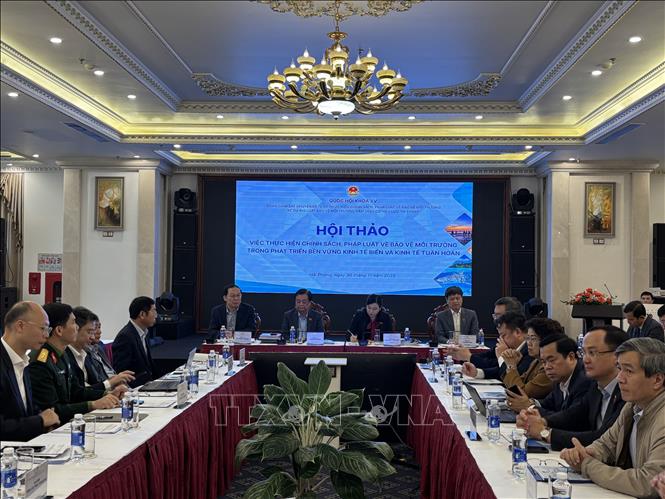
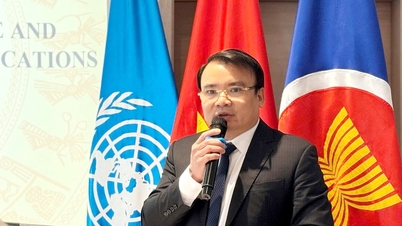
At the workshop, Vice Chairman of Hai Phong City People's Committee Vu Tien Phung stated that the city is also facing significant challenges from pollution sources, climate change risks and increasing demands for marine environmental management according to international standards. This requires the management of marine resources and environment to be upgraded and more systematic, based on a complete database, scientific management methods and effective inter-sectoral coordination mechanisms. To meet the increasing demands in sea and island management and sustainable development of the marine economy, Hai Phong City continues to improve the institutional system, focusing on building specific regulations on marine space management, marine tourism activities, coastal corridor protection, resource exploitation and marine ecological conservation. At the same time, the city reviews and updates coastal planning and marine spatial planning in accordance with the national strategy, strongly promotes the development of a circular marine economy, and applies digital transformation in marine management. mobilizing resources and strengthening international cooperation in marine economic development.
Regarding the basic investigation of marine and island resources and environment to serve the sustainable development of the marine economy, Deputy Director of the Vietnam Sea and Islands Administration Truong Duc Tri said that the basic investigation of marine and island resources and environment creates a synchronous, multi-disciplinary and highly reliable data source, comprehensively reflecting: Natural conditions, topography - seabed geomorphology, hydrology; geological characteristics, minerals, oil and gas, gas hydrates, engineering geology, environmental geology; current state of the environment, biodiversity and marine biological resources; land and water resources, landscapes, positions, ecological and geological wonders of sea, coastal and island areas.
These data are standardized, digitized and integrated into the national marine and island resources and environment database system, serving as a scientific and practical foundation for the development, updating and adjustment of national and sectoral marine plans and strategies. However, the institutional system, mechanisms, policies and technical standards on basic marine surveys are not complete and synchronous; the mechanism for sharing and exploiting data between ministries, sectors and localities is still limited; the exchange of experts and the reception of modern technology transfer are still difficult; there is a lack of long-term cooperation programs with partners with strong capacity in marine science...
Therefore, it is necessary to have solutions such as perfecting institutions, mechanisms and policies on basic investigation and management of marine resources and environment; promulgating technical regulations and standards and mechanisms for sharing and exploiting marine data; developing plans to ensure regular funding sources, while encouraging the mobilization of socialized resources, public-private partnerships and ODA capital for investigation tasks to avoid delays, developing human resources and organizational capacity, investing in modern facilities and equipment for marine investigation, training a team of highly qualified professional staff....
Referring to the potential for waste recycling from industrial marine aquaculture and seafood processing, Deputy Director of the Department of Fisheries Control Nhu Van Can said that the current state of marine aquaculture and seafood processing development shows many systematic problems, directly affecting environmental quality, production efficiency and compliance with international standards, which are reflected in the lack of technical standards and regulations, lack of shared environmental infrastructure, scattered waste collection, lack of organization, low and uneven technology level, and difficulties in accessing credit, land and fishing port infrastructure.
To develop a circular economy in marine aquaculture and seafood processing, the National Assembly Supervisory Delegation is requested to consider recommendations on improving support mechanisms and policies: promulgating technical regulations and standards on management and processing of by-products and seafood waste towards high-value products; environmental standards in industrial marine aquaculture; tax and credit incentives for businesses investing in high-tech, circular marine aquaculture, deep processing technology, biotechnology to create circular products from waste such as collagen, chitin, and biological products. Along with that is investment in technology and infrastructure, promoting the integrated multi-nutrient aquaculture (IMTA) model in marine aquaculture, raising awareness and linking the chain...
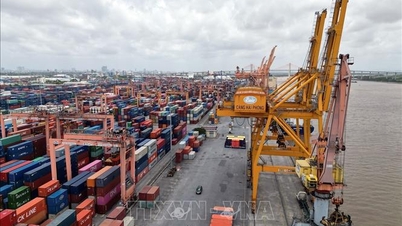
The potential for waste recycling in industrial marine aquaculture and seafood processing in Vietnam is huge, which can create a new value chain, bringing economic, environmental and social benefits while contributing to the commitment to reduce greenhouse gas emissions. To effectively exploit this potential, there needs to be synchronous coordination between management agencies, businesses, scientists and the aquaculture community. Promoting a waste circular economy will be an important step towards sustainable marine aquaculture development, a blue ocean economy, and enhancing the competitiveness of Vietnamese seafood in the international market.
At the workshop, Deputy Minister of Agriculture and Environment Le Cong Thanh emphasized: “Marine resources are limited, but our responsibility to the sea is unlimited. Only when each ministry, each locality, each enterprise properly implements legal regulations, respects the environment and respects the values of the sea, can we build a sustainable, competitive and global marine economy.”
Delegates discussed issues related to the development trends of the marine economy and the orientation of developing marine science and technology to serve the blue marine economy; circular economy in aquaculture and industrial marine farming; green transformation in the maritime and waterway sector of Vietnam; green tourism associated with conservation; science and technology and marine data; biodiversity conservation, application of marine biotechnology; development of fisheries extension work; green energy transformation... At the same time, they also frankly pointed out the major limitations and barriers that are hindering the development of sustainable marine economy and circular economy such as: Lack of a synchronous legal corridor (regulations on circular economy, blue marine economy are still scattered, there is no separate Law or specific instructions on financial incentives, taxes, green credit); weak technical infrastructure (lack of waste collection and treatment systems at fishing ports, aquaculture areas and island districts); Limited resources (Investment in basic research and recycling technology is not commensurate with the potential).
Source: https://baotintuc.vn/kinh-te-bien-dao/bao-ve-moi-truong-bien-tao-dung-nen-tang-cho-phat-trien-kinh-te-bien-ben-vung-20251130123600919.htm


![[Photo] Dan Mountain Ginseng, a precious gift from nature to Kinh Bac land](/_next/image?url=https%3A%2F%2Fvphoto.vietnam.vn%2Fthumb%2F1200x675%2Fvietnam%2Fresource%2FIMAGE%2F2025%2F11%2F30%2F1764493588163_ndo_br_anh-longform-jpg.webp&w=3840&q=75)











































Comment (0)