

This is an important step in equipping students with fundamental knowledge and skills in AI, meeting the requirements of national science and technology development, innovation, and digital transformation.
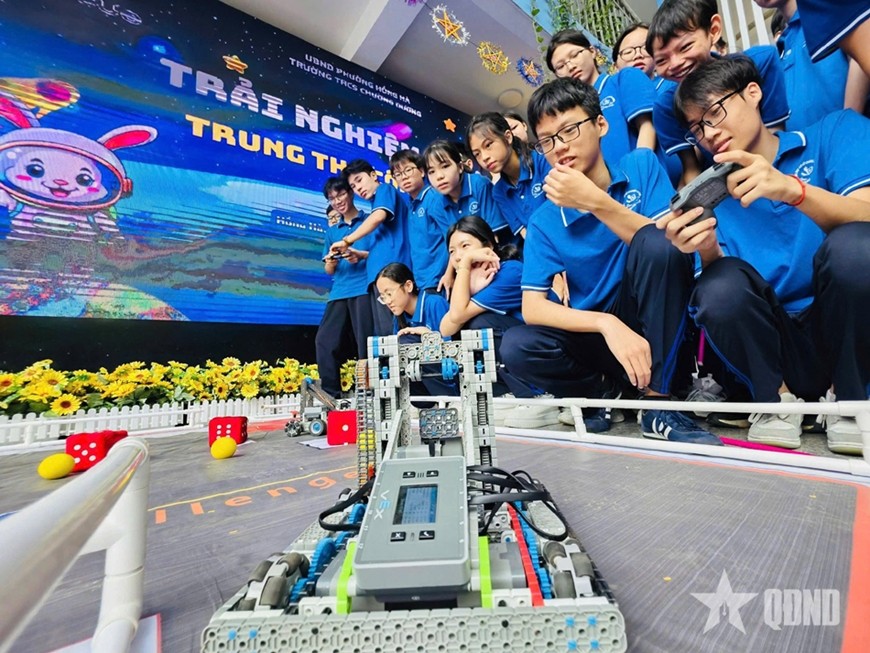
A technology application lesson for students at Chuong Duong Secondary School (Hong Ha, Hanoi ).
The AI education curriculum is built upon the foundation of the 2018 General Education Program, adopting a competency-based approach. The program content is developed along four main knowledge strands, corresponding to four competency domains: Human-Centered Thinking, AI Ethics, AI Techniques and Applications, and AI System Design. These knowledge strands are intertwined and mutually supportive, helping students develop a comprehensive and responsible understanding of AI.
The curriculum is designed to suit two educational stages. In the basic education stage (primary and lower secondary), students primarily experience simple, intuitive AI applications, thereby initially forming concepts and recognizing the role of AI in life. In the career-oriented education stage (upper secondary), students are encouraged to explore, design, and improve simple AI tools through learning projects and scientific research. Besides the core content, students can choose elective topics to enhance practical skills and gain a deeper understanding of AI application areas.
One of the highlights of the AI education framework is its human-centered approach, emphasizing ethics and responsibility. The program focuses on developing students' general qualities and competencies; ensuring scientific, modern, and pedagogical standards; while also being open, flexible, and regularly updated to keep pace with the rapid development of AI technology.
Regarding teaching organization, the content framework requires teachers to apply active teaching methods, enhance experiential learning, practice, and project-based learning. Learning activities are organized flexibly, creating interest for students while ensuring safety and effectiveness. Many topics, such as AI ethics or risk identification, can be implemented through discussion, debate, and case studies, and do not necessarily rely on computers.
Source: https://baolaocai.vn/bo-giao-duc-va-dao-tao-ban-hanh-khung-noi-dung-thi-diem-giao-duc-tri-tue-nhan-tao-cho-hoc-sinh-pho-thong-post889094.html


![[Photo] Prime Minister Pham Minh Chinh receives Lao Minister of Education and Sports Thongsalith Mangnormek](/_next/image?url=https%3A%2F%2Fvphoto.vietnam.vn%2Fthumb%2F1200x675%2Fvietnam%2Fresource%2FIMAGE%2F2025%2F12%2F16%2F1765876834721_dsc-7519-jpg.webp&w=3840&q=75)
![[Photo] Prime Minister Pham Minh Chinh receives the Governor of Tochigi Province (Japan)](/_next/image?url=https%3A%2F%2Fvphoto.vietnam.vn%2Fthumb%2F1200x675%2Fvietnam%2Fresource%2FIMAGE%2F2025%2F12%2F16%2F1765892133176_dsc-8082-6425-jpg.webp&w=3840&q=75)
![[Live] 2025 Community Action Awards Gala](/_next/image?url=https%3A%2F%2Fvphoto.vietnam.vn%2Fthumb%2F1200x675%2Fvietnam%2Fresource%2FIMAGE%2F2025%2F12%2F16%2F1765899631650_ndo_tr_z7334013144784-9f9fe10a6d63584c85aff40f2957c250-jpg.webp&w=3840&q=75)
![[Image] Leaked images ahead of the 2025 Community Action Awards gala.](/_next/image?url=https%3A%2F%2Fvphoto.vietnam.vn%2Fthumb%2F1200x675%2Fvietnam%2Fresource%2FIMAGE%2F2025%2F12%2F16%2F1765882828720_ndo_br_thiet-ke-chua-co-ten-45-png.webp&w=3840&q=75)









































![[Live] Closing Ceremony and Award Presentation for the "Impressive Vietnam Tourism" Video/Clip Creation Contest 2025](https://vphoto.vietnam.vn/thumb/402x226/vietnam/resource/IMAGE/2025/12/17/1765974650260_z7273498850699-00d2fd6b0972cb39494cfa2559bf85ac-1765959338756946072104-627-0-1338-1138-crop-1765959347256801551121.jpeg)
















Comment (0)