

Dong Son bronze drums (a large musical instrument) have been found in large numbers in the northern mountainous region of our country. In Tuyen Quang, four Dong Son bronze drums have been found in Nhan Ly commune (Chiem Hoa), Thien Ke commune (Son Duong) and Xuan Van commune (Yen Son district).
Nhan Ly bronze drum: Found in Cham wharf area (Gam river), Nhan Ly commune, Chiem Hoa district, so also called Chiem Hoa drum.
In April 1989, people discovered the drum lying under the cobblestone layer, at a depth of about 4m from the river surface. The drum is still relatively intact, the body and legs are partially broken. Based on the remaining part, it can be known that the shape of the drum is quite symmetrical, the decorative patterns are delicate and clear.
The drum face has a diameter of 51.5cm, the remaining height is 31.2cm. In the middle of the drum face is a star with 11 pointed points. Between the points of the star are stylized peacock feather patterns. From the inside out, there are 11 circles of patterns. Circles 1, 4, 8, 11 are parallel vertical lines. Circles 2, 3, 9, 10 are double concentric circles with a dot in the middle and tangent lines. Circle 5 is 16 nested diamond boxes.
Round 6 is 42 patterns created by printing short parallel lines, dotted circle in the middle, representing stylized humanoid patterns following the trend of body transformation.
Round 7 is four birds equally spaced, the birds have long beaks, eyes are double circle patterns with tangents, long tails with rounded ends, wings are short dashes.
The birds fly clockwise. Between the four birds are four pin-shaped motifs and eight diamond-shaped nests. On the edge of the drum face are four toad statues rotating counterclockwise (all four have broken bodies, only the legs remain).
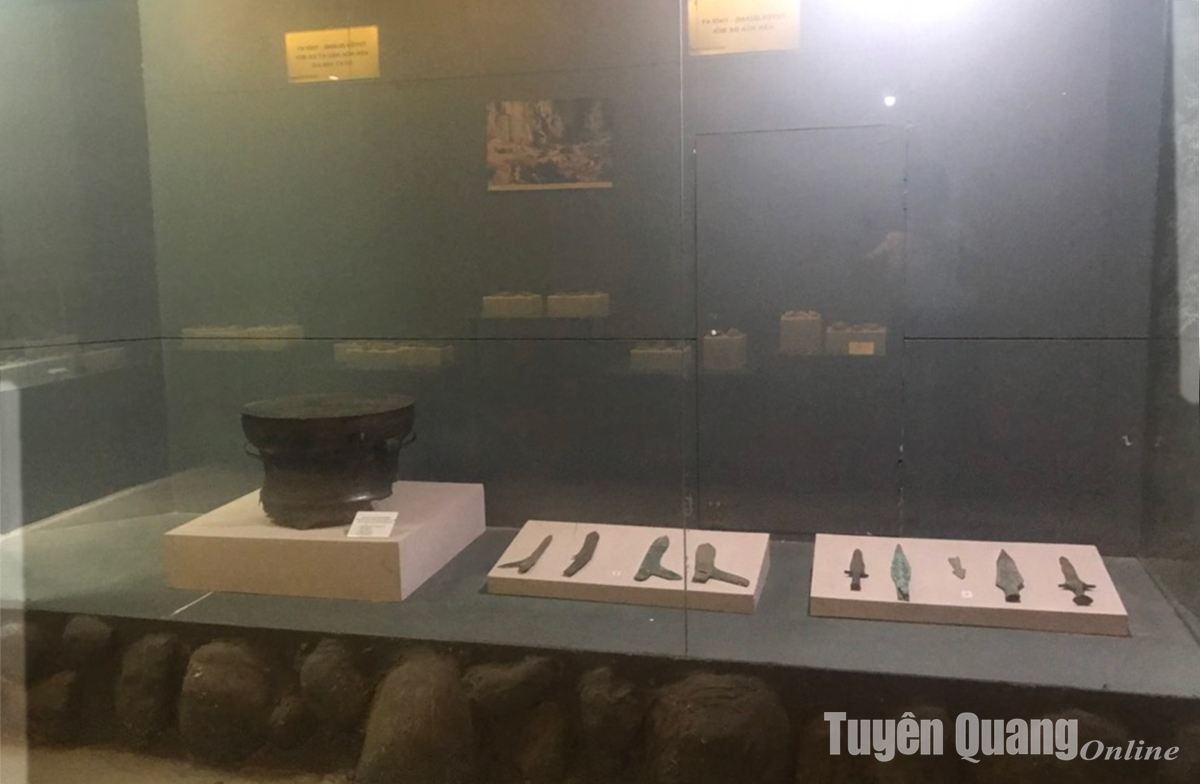
The bronze drum was found in Nhan Ly commune, Chiem Hoa district (Tuyen Quang province) along with other artifacts on display at Tuyen Quang Provincial Museum.
The drum body is decorated with four decorative rings. From top to bottom, rings 1 and 4 are parallel vertical lines, rings 2 and 3 are concentric circles with a dot in the middle.
The drum has two pairs of double straps decorated with rice flower patterns.
The drum body is cylindrical, 11.0cm high. The upper part has geometric patterns running along the body of the drum. Each pattern consists of two concentric circles with a dot in the middle and a tangent in the middle, and on both sides are two parallel lines of short dash patterns.
These decorative bands divide the upper part of the drum body into rectangular panels. The panels are unadorned.
The lower part of the drum body has 4 decorative rims identical to those on the drum body. From top to bottom, rims 1 and 4 are parallel vertical lines, rims 2 and 3 are concentric circles with a dot in the middle and a tangent. The drum's legs are spread out, decorated with patterns, 10cm high, and the bottom diameter is 46cm.
The drum's legs are decorated with a pattern. Above is a raised line, followed by a pattern of two concentric circles with a dot in the middle and tangent. The bottom of the drum's legs is decorated with a pattern of stylized peacock feathers.
Part of the drum body and drum legs were broken, the remaining part of the drum weighed 10.05kg. The drum was cast thinly and evenly, the drum head was 3.5mm thick, the drum body was 2.5mm thick, the drum legs were 3mm thick, and the drum was surrounded by a layer of dark moss green patina.
Based on the shape and decorative patterns, this is a Dong Son drum. Currently, the drum is kept in the storage of Tuyen Quang Provincial Museum.
According to local people, when it was discovered, the core was empty and there was nothing buried around it.
Surveying the adjacent riverbank also found no cultural layer or pottery remains. Therefore, it can be inferred that the Chiem Hoa drum was not originally in the location where it was found, but may have been washed away by the riverbank collapse and buried to the riverbed. In any case, the original burial location of the drum was not too far from the location where the drum was discovered and must have been upstream.
After studying this drum, I have the following initial observations:
- In terms of casting technique, the Chiem Hoa drum is not a product of a skilled casting technique like the Ngoc Lu and Song Da drums. This is shown in the rough, prominent, 0.5cm wide casting lines on both sides of the drum body. The traces of the chicken are all over the drum surface, scattered on the decorative rims 2, 5, 7, 9 and also on the drum body. The traces of the toad statue prove that the toad was cast in addition, not the toad's feet welded to the drum surface, because the casting marks are wider than the toad's feet.
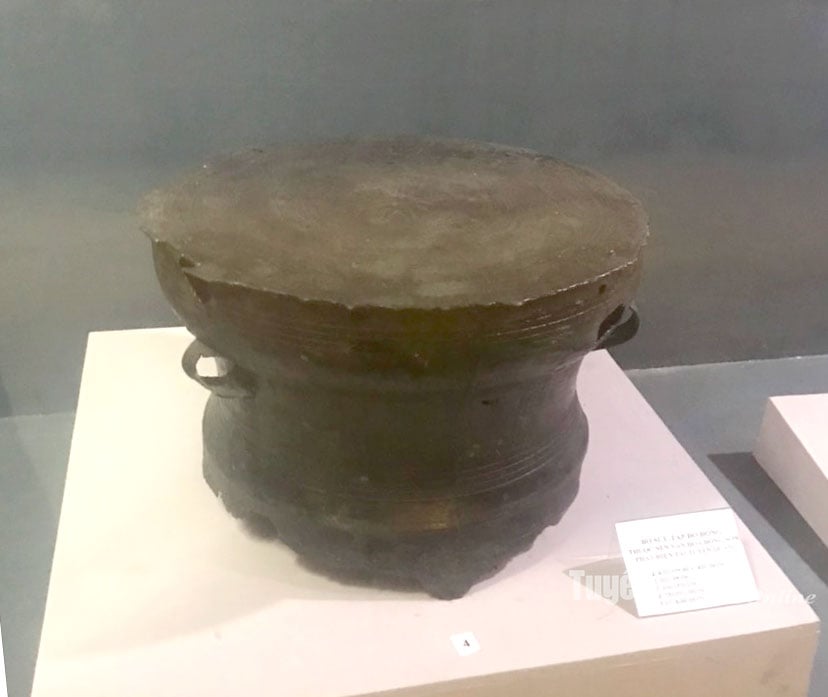
Bronze drum found in Gam riverbed in Nhan Ly commune, Chiem Hoa district (Tuyen Quang province) is on display at the provincial museum.
- Regarding pattern creation techniques, Nhan Ly drum casters knew how to combine pattern creation by carving and printing (for example, patterns of dancers in disguise, zigzag patterns).
This is a late Dong Son drum type, transitional from type I drum to type IV drum, but not as late as Meo Vac drum ( Ha Giang ).
The northern mountainous region, including Tuyen Quang, through research on this drum, further proves that this is a transitional area from type I drums to type IV drums, which is partly meaningful in understanding the origin of some types of bronze drums as well as the origin of some ethnic groups in this area.
Thien Ke bronze drum:
Some documents also call this drum Van Song drum because it was discovered in Van Song village, Thien Ke commune, Son Duong district.
The area where the bronze drum was found is a low hill bordering a field in a fairly wide valley. On January 4, 2003, while digging a bamboo root, people found an ancient bronze drum lying 1.8 meters below ground level. About 1 km west of where the bronze drum was found, relics such as spearheads, javelins, and bronze arrowheads were also found...
The drum was discovered buried upright, with its face facing down. The drum is relatively intact, with a diameter of 70.5cm, a height of 44.5cm, a width of 68cm at the base, and a weight of 33kg.
In the middle of the drum face is a 12-pointed star, between the star's points are stylized peacock feather patterns, followed by 18 circles of patterns: Lac birds flying counterclockwise, people in disguise, hairpins, parallel lines, concentric circles...
There are 4 embossed toad statues (but one is missing). The drum body is bulging, between the body and the drum body there are two pairs of symmetrical double straps, decorated with rope patterns, and the drum legs are spread out.
The body, body and legs of the drum have 16 geometric patterns, mainly carved lines, concentric circles and a cicada wing pattern, this is a rather large pattern band adjacent to the drum's legs (also known as stylized sawtooth pattern).
The entire face, body, body and legs of the drum have many circular marks. This is a Hegbo type I drum and is the second drum found in Tuyen Quang province after the Chiem Hoa bronze drum.
Thien Ke bronze drum was found underground, proving that this is an archaeological site of the Bronze Age.
During the Dong Son culture, this place was a very old settlement, there were even traces of pre-Dong Son culture. The evidence is that more than 1km west of where the bronze drum was found, there is the ancient village of Thien Ke, dating back to the Go Mun culture with a distinct cultural layer and many pottery items.
This is a late bronze drum, decorated with patterns that have many similarities to the Chiem Hoa bronze drum. The drum has highly stylized patterns of dancers in disguise, stylized Lac birds, hairpin patterns, and 4 toad statues.
The concentric circular patterns with dots in the middle and short lines on the drum body and back show that the drum has entered the stage of geometric patterns in large numbers. In particular, the drum foot has a type of triangular pattern, proving that the drum is late in age.
The drum has a casting technique using terracotta molds and a series of support systems that still leave many marks on the drum face and body. In general, the Thien Ke bronze drum is a type I drum, also known as a late Dong Son bronze drum, with elements that have transformed into a type IV drum.
Xuan Van bronze drum I:
Found in November 2004 at a depth of 1.2m, in Dong Dai village, Xuan Van commune, Yen Son district.
The drum was broken into many pieces (10 pieces), but the drum face, drum body, drum body and drum legs were still clearly identified: The drum face has a diameter of 58cm, in the middle is a 12-ray sun star, between the sun rays are decorative motifs of stylized peacock feathers, the decorative circles on the drum face are decorated with carved patterns, concentric circles, Lac birds flying counterclockwise, people in disguise, hairpin patterns and diamond-shaped nested patterns; there are 4 blocks of toad statues rotating clockwise. The drum body is bulging, the drum body is tapered and cylindrical, the drum legs are spread out.
This is a late Dong Son bronze drum, with motifs such as highly stylized disguised figures, hairpins, diamond-shaped patterns, and four toad statues; proving that the drum had begun to have late elements to transition to type IV bronze drums. Because this drum only has fragments left, the more specific details of the motifs are not known.
Xuan Van II bronze drum:
Found in Son Ha 4 village, Xuan Van commune, Yen Son district; only one piece of drum head and two pieces of drum legs remain. The drum may have broken into many pieces a long time ago, because at the cross-section, the broken parts have a layer of rusty copper patina the same color as the patina on the surface of the drum pieces.
The drum face is still quite intact with the shape of a 12-ray sun star, the rim of the star has a diameter of 14cm, between the sun rays are stylized peacock feather patterns; following the star shape is a rim of parallel dashed patterns and a ring of concentric circles (each rim of pattern is 1.1cm wide, forming a concentric circle running around the drum face).
Two drum feet: One piece measures 8.3cm x 16.5cm, one piece measures 8.1cm x 14cm. The drum feet have three decorative rings: two concentric circular rings and one parallel striped ring.
At the bottom is a cicada-shaped pattern (a stylized sawtooth shape resembling an inverted isosceles triangle, with a base of 1.6cm and a height of 2.3cm). The blank pieces all have a layer of dark moss green patina.
This is a late Dong Son bronze drum, with stylized triangle-like patterns at the base of the drum, indicating that the drum had begun to have late elements to transition to a type IV drum. Since only three fragments remain of this drum, it is unclear what other patterns there are on the drum surface besides the star pattern and a few geometric patterns.
Bronze drums in the lives of residents in the Bronze Age in Tuyen Quang:
Up to now, Dong Son bronze drums (a large musical instrument) have been found quite a lot in the northern mountainous region of our country. Tuyen Quang is also the land that contributes 4 bronze drums to the list of bronze drums discovered in our country. What is special is that the bronze drums in Tuyen Quang were all found underground; proving that the ancient Tuyen Quang residents were truly the owners of Dong Son bronze drums.
The Tuyen Quang bronze drums must have played an important role in the spiritual life of the ancient Tuyen Quang people. They may have also had the function of expressing the power of the leader in addition to the musical function.
Source: https://danviet.vn/bon-cai-trong-dong-dong-son-co-xua-dan-vo-tinh-dao-trung-tren-dat-tuyen-quang-20241101224926786.htm






















































![[Infographic] Vietnam's stock market exceeds 11 million trading accounts](https://vphoto.vietnam.vn/thumb/402x226/vietnam/resource/IMAGE/2025/11/09/1762677474332_chungkhoanhomnay0-17599399693831269195438.jpeg)













![Dong Nai OCOP transition: [Part 2] Opening new distribution channel](https://vphoto.vietnam.vn/thumb/402x226/vietnam/resource/IMAGE/2025/11/09/1762655780766_4613-anh-1_20240803100041-nongnghiep-154608.jpeg)









Comment (0)