

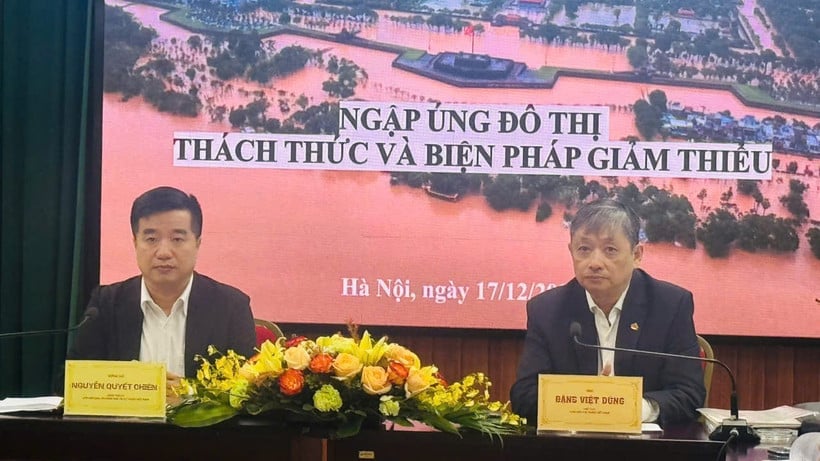
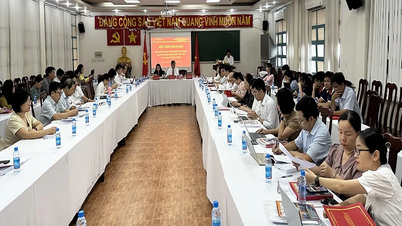
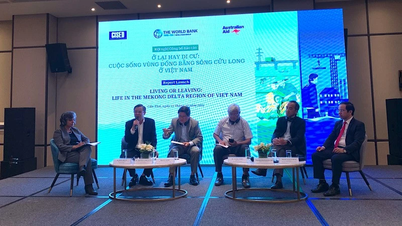
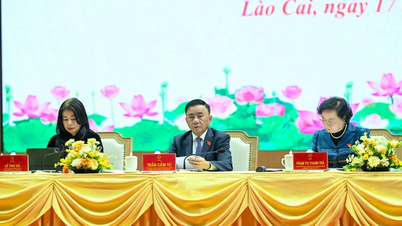
In his opening remarks at the workshop, Mr. Nguyen Quyet Chien, Secretary General of the Vietnam Union of Associations, emphasized that in recent years, the urbanization process in Vietnam has taken place rapidly, achieving many important accomplishments, while also revealing numerous challenges to sustainable urban development.
According to statistics, in 2024, urban areas nationwide recorded approximately 397 flooded areas, affecting a total area of over 900 hectares. Many large cities such as Hanoi , Ho Chi Minh City, Hai Phong, Can Tho, etc., frequently experience flooding in their centers, with common depths ranging from 0.3 to 0.8 meters, and drainage times lasting for many hours.
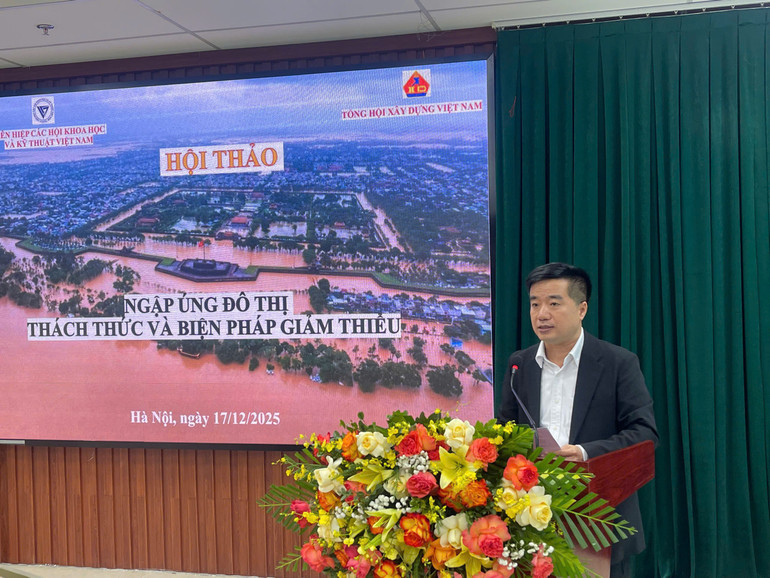
Notably, since the beginning of 2025, flooding has become increasingly complex in many medium-sized cities. In practice, urban flooding is no longer a problem unique to special or large cities, but has become a widespread challenge for the entire Vietnamese urban system. Flooding not only disrupts traffic and severely impacts daily life and production, but also causes estimated economic losses equivalent to 1-1.5% of the city's GDP each year.
According to Mr. Tran Hoai Anh, Deputy Director of the Department of Construction Infrastructure ( Ministry of Construction ), as of July 2025, the whole country has 23 approved specialized drainage planning projects (including plans approved before the Planning Law 2017 came into effect on January 1, 2019). Many plans were drawn up during the 2000-2010 period and are no longer suitable for the pace of urbanization and changes in land use.
The lack of coordination between drainage planning and transportation planning, land use planning, and other technical infrastructure planning leads to a situation where new infrastructure projects are not synchronized, obstructing natural water flow and increasing the risk of flooding.
In coastal or lowland urban areas, the planning of building elevations does not adequately account for the impact of tidal surges, leading to "local elevation" that causes water to shift to lower areas. In many places, the planning of retention ponds and drainage corridors is adjusted, narrowed, or left unprotected, significantly reducing their capacity to store and regulate rainwater.
Pointing out one of the main causes of urban flooding, Dr. Le Bich Thuan, Deputy Director of the Institute for Urban Research and Infrastructure Development, stated that it is due to a lack of comprehensive planning and long-term vision in the development of drainage infrastructure. Many urban construction projects focus only on residential buildings and above-ground infrastructure, without paying attention to surface and underground drainage systems. Some newly developed urban areas are rapidly expanding but are planned separately from the overall drainage network; moreover, the infrastructure is mostly concrete, so the drainage capacity is no longer sufficient...
In previous urban planning, the construction of urban areas often focused on building lakes to regulate water levels (Giang Vo Lake, Thanh Cong Lake, Nam Dong Lake, etc.) and calculating the capacity for surface water infiltration. However, current planning no longer prioritizes water-regulating lakes, and many projects even fill in lakes to replace them with housing projects, commercial centers, etc. As a result, flooding disasters are occurring with increasing frequency.
On the other hand, because a large part of the drainage system was built decades ago, designed for much lower rainfall than today, when rainfall increases or is prolonged, surface runoff far exceeds the system's carrying capacity, leading to blockages and backflow. In addition, the increasing area of urban concrete reduces natural water infiltration, exacerbating flooding. Many drainage lines are not regularly maintained, leading to blockages…
According to Professor and Doctor Tran Duc Ha of the Vietnam Water Supply and Drainage Association, proposing solutions to address urban flooding, in recent years, climate change, with its unpredictable heavy rainfall, has had a clear negative impact on urban drainage and flood control. Flooding in northern cities is on the rise. Therefore, timely analysis and assessment of the causes are needed, along with proposals for short-term and long-term management and technical solutions to minimize this situation.
Solutions for urban flooding and drainage should be divided into two groups: emergency (short-term) solutions and medium- or long-term solutions. Within the short-term solutions group, the first requirement for cities is to establish a Flood Control and Management Center and build a system for monitoring and warning of rainfall and flooding.
Emergency solutions before the rainy season include dredging silt from drainage systems: rivers, canals, and ponds, as well as lowering water levels in drainage canals and reservoirs to the minimum ecological level within a short period when weather forecasts and storm warnings are issued.
In the medium and long term, it is necessary to review the effectiveness of existing retention ponds and drainage pumping stations, and to construct sustainable drainage engineering works to control flooding at the source.
At the workshop, there was a consensus that urban drainage and flood control have received attention from local authorities, and many projects have initially yielded positive results. However, flooding remains a complex issue, with a tendency to increase in severity and scope. This situation highlights the urgent need for comprehensive, long-term, and interdisciplinary solutions, focusing on improving institutions, innovating planning, ensuring investment resources, and sustainably controlling urban flooding.
Source: https://nhandan.vn/cap-thiet-giai-quyet-tinh-trang-ngap-ung-do-thi-post930901.html
![[Image] Leaked images ahead of the 2025 Community Action Awards gala.](/_next/image?url=https%3A%2F%2Fvphoto.vietnam.vn%2Fthumb%2F1200x675%2Fvietnam%2Fresource%2FIMAGE%2F2025%2F12%2F16%2F1765882828720_ndo_br_thiet-ke-chua-co-ten-45-png.webp&w=3840&q=75)
![[Photo] Prime Minister Pham Minh Chinh receives Lao Minister of Education and Sports Thongsalith Mangnormek](/_next/image?url=https%3A%2F%2Fvphoto.vietnam.vn%2Fthumb%2F1200x675%2Fvietnam%2Fresource%2FIMAGE%2F2025%2F12%2F16%2F1765876834721_dsc-7519-jpg.webp&w=3840&q=75)
![[Live] 2025 Community Action Awards Gala](/_next/image?url=https%3A%2F%2Fvphoto.vietnam.vn%2Fthumb%2F1200x675%2Fvietnam%2Fresource%2FIMAGE%2F2025%2F12%2F16%2F1765899631650_ndo_tr_z7334013144784-9f9fe10a6d63584c85aff40f2957c250-jpg.webp&w=3840&q=75)
![[Photo] Prime Minister Pham Minh Chinh receives the Governor of Tochigi Province (Japan)](/_next/image?url=https%3A%2F%2Fvphoto.vietnam.vn%2Fthumb%2F1200x675%2Fvietnam%2Fresource%2FIMAGE%2F2025%2F12%2F16%2F1765892133176_dsc-8082-6425-jpg.webp&w=3840&q=75)






























































Comment (0)