


Intellectual property must become an asset for trading and raising capital.
According to Minister of Science and Technology Nguyen Manh Hung, the overarching principle in this revised Intellectual Property Law is: Intellectual property must transform research results into tradable assets; it must become an asset of businesses, capable of being valued, bought and sold, included in financial statements, and can be used as collateral for loans and capital contributions, especially for new technologies, digital technologies, and AI.
The "assetization" mindset therefore aims to move intellectual property out of the "protected zone," transforming it into a measurable, manageable, and exploitable economic resource – especially in a competitive environment where intangible value increasingly accounts for a larger proportion.
The amended Intellectual Property Law has added many important provisions to create a legal framework for the assetization of intellectual property. The focus is on mechanisms that allow businesses to fully record, track, and value intellectual property assets, thereby managing intellectual property as a portfolio of assets.
Intellectual property assets such as patents, trademarks, software, designs, data, and trade secrets are being legalized to become types of assets that can be managed similarly to tangible assets. In particular, the law allows businesses to value intellectual property assets that are not yet eligible for recognition on the balance sheet through internal accounting records. This is a noteworthy opening, creating a foundation for businesses to better understand their true value, proactively build asset portfolios to raise capital, attract investment, and participate in the market.
Furthermore, the addition of mechanisms for valuing, buying, selling, contributing capital, and mortgaging intellectual property rights is expected to facilitate the development of intellectual property transactions, gradually forming a more dynamic technology and intellectual property market. When intellectual property rights can become collateral, businesses – especially science and technology businesses and digital technology startups – will have more opportunities to access capital, expand production and business, and commercialize innovations.
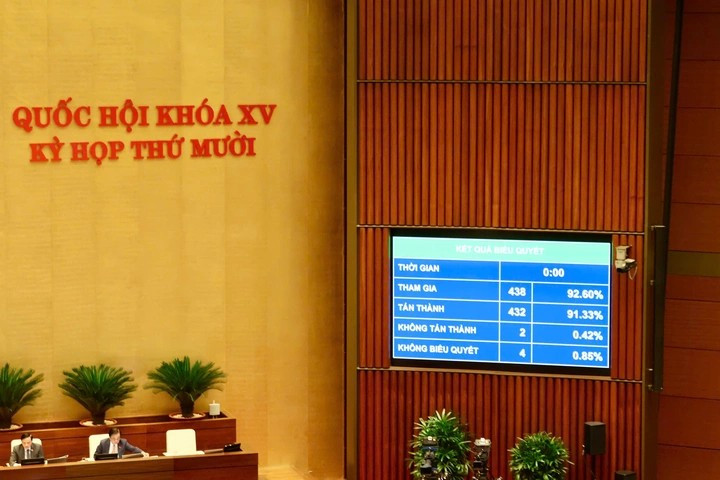
Institutional synchronization to form an innovation ecosystem.
The amended Intellectual Property Law is also aligned with the Party and State's major policies on science, technology, and innovation; it is consistent with the direction of the Law on Digital Technology, the Law on Innovation, the Law on Digital Transformation, and the Law on Artificial Intelligence, which were also recently passed by the National Assembly. This is an important foundation for forming a national innovation ecosystem, in which intellectual property is not only an object of protection but also a financial resource, directly contributing to growth.
From a broader perspective, "integrating intellectual property into the economic flow" demonstrates a new approach to development management: focusing on knowledge and technology, with businesses as the exploiters, and the market as the place for valuing and circulating value.
However, for the real implementation of intellectual property asset ownership, many challenges need to be addressed. Businesses need to improve their intellectual property management capabilities, from identification and protection to portfolio management and commercial exploitation. Valuation organizations need to professionalize to meet the demands of intellectual property valuation – a field requiring advanced methods, data, and expertise. Regulatory bodies need to improve the national database on intellectual property transactions to support transparency, reduce risks, and build confidence in the market.
In particular, credit institutions need to develop risk assessment models that are appropriate for intellectual property, instead of applying traditional standards frameworks that are primarily based on tangible assets. Only when the financial and credit mechanisms keep pace will intellectual property truly become a "lever" of capital for innovation.
Intellectual property asset ownership is a crucial step in enhancing Vietnam's position in the global value chain, where a nation's value lies not only in resources or labor but also in its creative capacity, technological mastery, and intangible assets.
With the newly completed legal framework, the assetization of intellectual property is expected to become a crucial growth driver, creating a boost to promote innovation in businesses, attracting high-quality investment, and forming a dynamic technology market, contributing to bringing Vietnam closer to the group of knowledge-based economies in the future.
Source: https://nhandan.vn/tai-san-hoa-so-huu-tri-tue-cu-hich-thuc-day-doi-moi-sang-tao-post930921.html
![[Photo] Prime Minister Pham Minh Chinh receives the Governor of Tochigi Province (Japan)](/_next/image?url=https%3A%2F%2Fvphoto.vietnam.vn%2Fthumb%2F1200x675%2Fvietnam%2Fresource%2FIMAGE%2F2025%2F12%2F16%2F1765892133176_dsc-8082-6425-jpg.webp&w=3840&q=75)
![[Image] Leaked images ahead of the 2025 Community Action Awards gala.](/_next/image?url=https%3A%2F%2Fvphoto.vietnam.vn%2Fthumb%2F1200x675%2Fvietnam%2Fresource%2FIMAGE%2F2025%2F12%2F16%2F1765882828720_ndo_br_thiet-ke-chua-co-ten-45-png.webp&w=3840&q=75)
![[Live] 2025 Community Action Awards Gala](/_next/image?url=https%3A%2F%2Fvphoto.vietnam.vn%2Fthumb%2F1200x675%2Fvietnam%2Fresource%2FIMAGE%2F2025%2F12%2F16%2F1765899631650_ndo_tr_z7334013144784-9f9fe10a6d63584c85aff40f2957c250-jpg.webp&w=3840&q=75)

![[Photo] Prime Minister Pham Minh Chinh receives Lao Minister of Education and Sports Thongsalith Mangnormek](/_next/image?url=https%3A%2F%2Fvphoto.vietnam.vn%2Fthumb%2F1200x675%2Fvietnam%2Fresource%2FIMAGE%2F2025%2F12%2F16%2F1765876834721_dsc-7519-jpg.webp&w=3840&q=75)













![[Video] 24-hour News on November 17, 2025: General Secretary To Lam: Creating the most favorable legal framework for national development](https://vphoto.vietnam.vn/thumb/402x226/vietnam/resource/IMAGE/2025/12/17/1765977057885_z7337002170021-9489a452b3db436532a1a849149df3ad-jpg.webp)



































![[Live] Closing Ceremony and Award Presentation for the "Impressive Vietnam Tourism" Video/Clip Creation Contest 2025](https://vphoto.vietnam.vn/thumb/402x226/vietnam/resource/IMAGE/2025/12/17/1765974650260_z7273498850699-00d2fd6b0972cb39494cfa2559bf85ac-1765959338756946072104-627-0-1338-1138-crop-1765959347256801551121.jpeg)























Comment (0)