

The 24th Border Guard Training School is developing a new training specialization, aiming to deploy working dogs in United Nations peacekeeping operations.
Colonel Nguyen Quang Thuyen, Principal of the 24th Border Guard Training School (Ba Vi, Hanoi ) - the only institution training working dogs for the military - said that since its establishment in 1959, the school has expanded its training to include combat dogs and guard dogs, starting from two specialized fields: combat dogs; drug detection; explosive detection; search and rescue; and scent detection dogs to assist in criminal investigations.
However, current events necessitate the development of new specialized fields in peacetime. For example, the terrorist attack in Dak Lak in June 2023 demonstrated the need to train counter-terrorism dogs; or to train dogs to detect counterfeit money; to search for the remains of fallen soldiers; and to participate in international missions... "The ultimate goal is to deploy working dogs for peacekeeping, ensuring the security and safety of Vietnamese officers on duty at peacekeeping missions, serving the security work of Brigade 144, or working alongside special forces," Colonel Thuyen said.
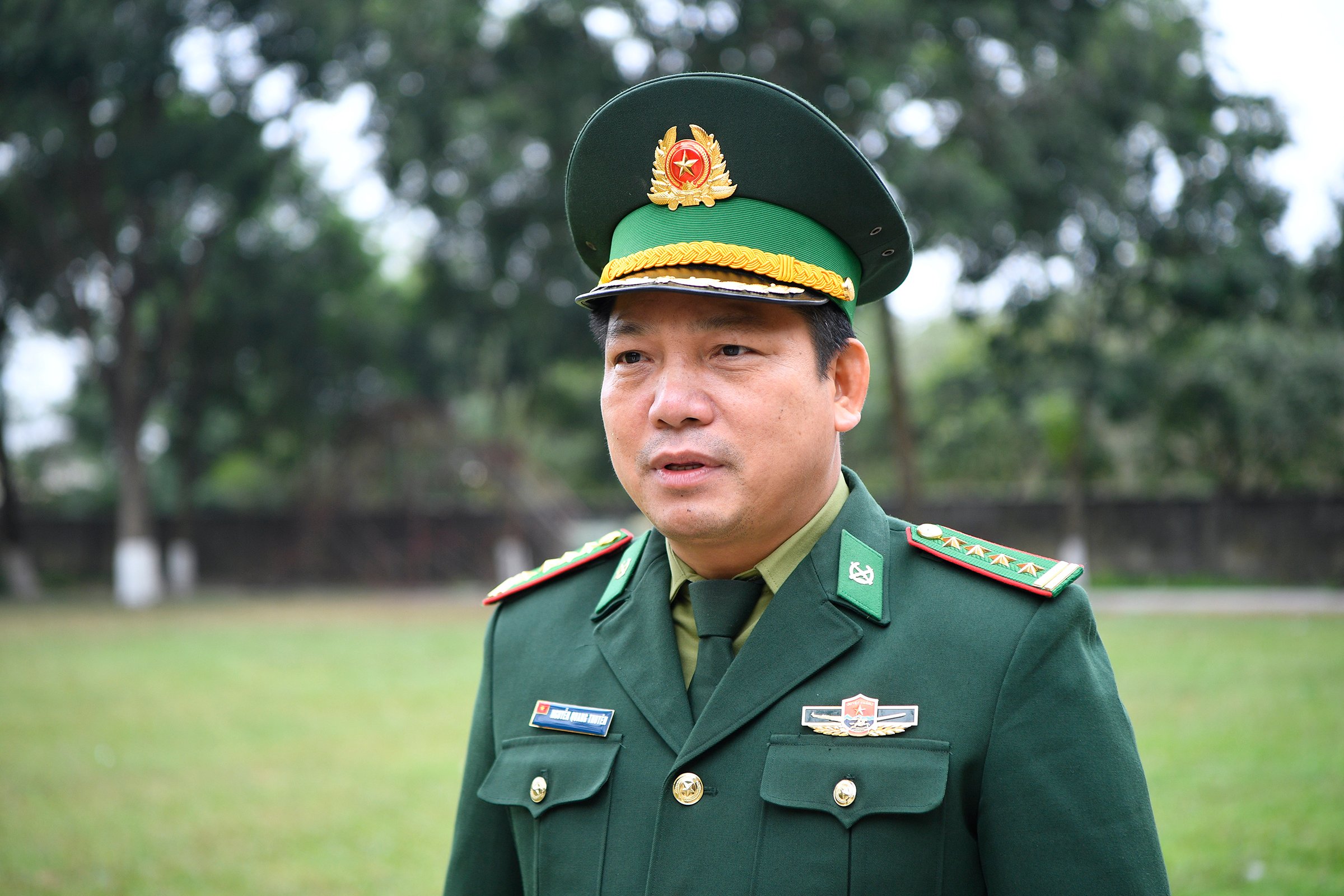
Colonel Nguyen Quang Thuyen speaks about the plan to implement new teaching content. Video : Son Ha
The school currently trains foreign dog breeds, such as German Shepherds, Malinois, Labradors, and Golden Retrievers. Depending on their characteristics and abilities, each breed is suited to a specific task. German Shepherds have strong jaw muscles and a intimidating presence, making them suitable for combat and crime suppression. Malinois have less endurance than German Shepherds, but are intelligent and always energetic, often used for scent detection.
Labradors are primarily trained for drug detection at airports, border crossings, and public areas. The school is proposing to purchase additional breeds for breeding and training, such as Cocker Spaniels and Golden Retrievers from England, and Border Collies from Scotland. These smaller breeds, often kept as pets, are easier to camouflage during drug busts.
According to Colonel Thuyen, most training breeds are of foreign origin, while some native dog breeds are very suitable for training for missions. Therefore, in mid-July 2023, the school experimented with training the Ma River dog and the Mong short-tailed dog to detect drugs, assist in criminal investigations, and search for unexploded ordnance left over from the war in Quang Tri... Native dogs are easier to camouflage when conducting operations at the border, suitable for covert missions, and less likely to arouse suspicion compared to foreign dog breeds.
These two breeds have received basic training and will move on to specialized training in 2024. The school is collaborating with the Vietnam-Russia Tropical Center and the Vietnam Academy of Agriculture to select additional suitable breeds, along with several foreign organizations to provide training and establish a closed-loop process from breed selection and rearing to training. "We aim to put Vietnam's native breeds on the map of working dogs," Colonel Thuyen said.
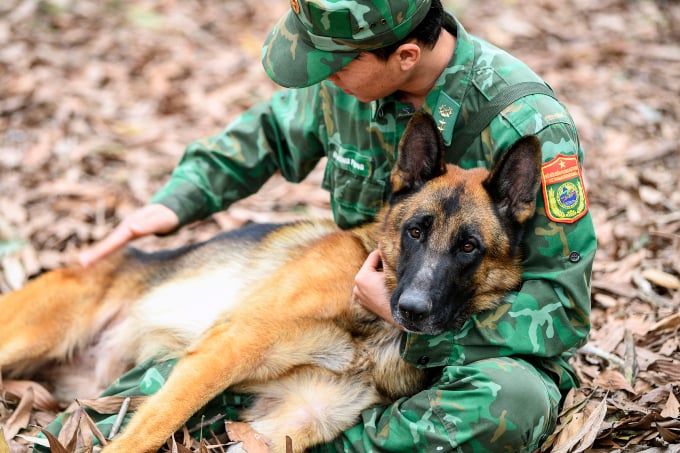
Working dogs and their trainers rest during a training session at the 24th Border Guard Training School. Photo: Giang Huy
The average lifespan of a working dog is 10-12 years, reaching full development and peak performance between 5 and 10 years old. The golden age for training is when the dog is 3 months old because of its high level of excitement and eagerness to learn during play. At the school, dogs over 3 months old begin "kindergarten," learning to recognize their names, playing with balls and rags, eating some roughage, and walking alongside their trainer to become familiar with their scent. At 6 months old, dogs learn obedience discipline, following commands such as stand, lie down, sit, bark, sniff, find, etc. One-year-old dogs transition to specialized training.
According to regulations, the food allowance for working dogs is divided into five levels, ranging from 35,000 to 88,000 VND per day depending on the stage and task. Colonel Thuyen stated that the 35,000 VND allowance for puppies aged 15-121 days is insufficient. Besides nutritious porridge, dogs need additional food to support muscle and bone development, and formula milk. Meanwhile, for working dogs, the 1-9 month age range is a crucial developmental stage requiring ample nutrition to maximize their abilities and physical condition.
The school balances the diet by supplementing the diet of mother dogs when they are nursing their young, and by increasing the supply of supplementary food so that the dogs can eat "delicious, clean, and inexpensive." The school is proposing to the competent authorities to revise the regulations, increase the food allowance for working dogs, as well as the allowance for trainers. "Living conditions and nutrition for working dogs are still inadequate. The veterinary and medical care department for dogs is almost completely lacking, even though injuries and illnesses are unavoidable during training and duty," Colonel Thuyen said.
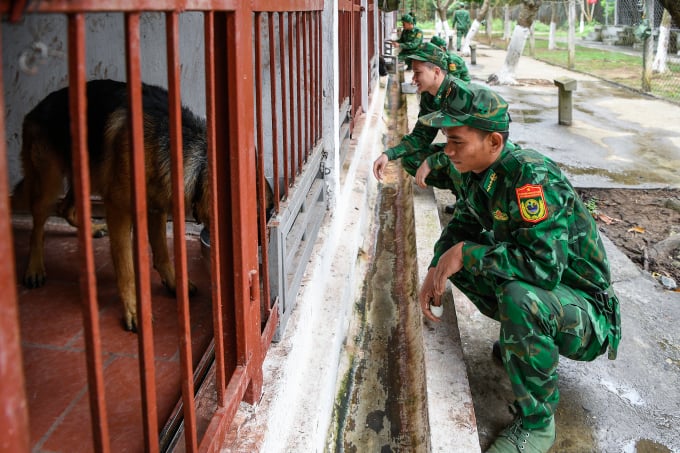
The nutrition and health of working dogs are closely monitored by trainers and experts at the school. Photo: Giang Huy
Since 1959, the 24th Border Guard Training School has trained over 100 courses with 3,000 students and 3,000 working dogs. In addition to its main facility in Ba Vi, the school has five mobile working dog units in six provinces and cities: Hanoi, Dien Bien, Lai Chau, Quang Tri, Gia Lai, and Tay Ninh. These units carry out national defense tasks, combat drug trafficking, participate in border exchanges, compete in the Army Games international military competition, conduct domestic rescue operations, and perform international duties in Türkiye.
In addition, the school provides training for other units throughout the military; the Royal Cambodian Army and Police.
Son Ha - Hoang Phuong
Source link

![[Live] 2025 Community Action Awards Gala](/_next/image?url=https%3A%2F%2Fvphoto.vietnam.vn%2Fthumb%2F1200x675%2Fvietnam%2Fresource%2FIMAGE%2F2025%2F12%2F16%2F1765899631650_ndo_tr_z7334013144784-9f9fe10a6d63584c85aff40f2957c250-jpg.webp&w=3840&q=75)
![[Image] Leaked images ahead of the 2025 Community Action Awards gala.](/_next/image?url=https%3A%2F%2Fvphoto.vietnam.vn%2Fthumb%2F1200x675%2Fvietnam%2Fresource%2FIMAGE%2F2025%2F12%2F16%2F1765882828720_ndo_br_thiet-ke-chua-co-ten-45-png.webp&w=3840&q=75)
![[Photo] Prime Minister Pham Minh Chinh receives Lao Minister of Education and Sports Thongsalith Mangnormek](/_next/image?url=https%3A%2F%2Fvphoto.vietnam.vn%2Fthumb%2F1200x675%2Fvietnam%2Fresource%2FIMAGE%2F2025%2F12%2F16%2F1765876834721_dsc-7519-jpg.webp&w=3840&q=75)

![[Photo] Prime Minister Pham Minh Chinh receives the Governor of Tochigi Province (Japan)](/_next/image?url=https%3A%2F%2Fvphoto.vietnam.vn%2Fthumb%2F1200x675%2Fvietnam%2Fresource%2FIMAGE%2F2025%2F12%2F16%2F1765892133176_dsc-8082-6425-jpg.webp&w=3840&q=75)



















































![[Video] Independence and self-reliance linked with international integration through 40 years of reform](https://vphoto.vietnam.vn/thumb/402x226/vietnam/resource/IMAGE/2025/12/16/1765899635777_1-1-8054-png.webp)
































Comment (0)