

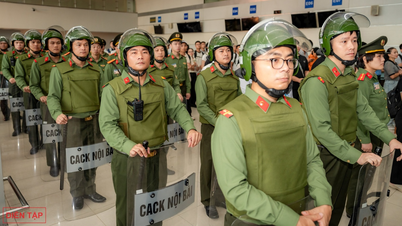
Dozens of residents of CT3 building in Co Nhue urban area (Bac Tu Liem, Hanoi ) stayed up all night guarding the basement and amenities they had just reclaimed from the developer.
Disputes over the area, infrastructure, and amenities belonging to the common and private ownership of CT3 residents and the developer - Nam Cuong Group - have arisen after 9 years of the apartment building's operation. 540 apartment owners, representing over 2,000 residents, elected a Management Board (an organization representing apartment owners) through a residents' meeting. The Management Board then signed a contract with Nam Cuong Management and Services Co., Ltd. (NCP), a subsidiary of Nam Cuong Group, to manage and operate the four buildings.
Ms. Nguyen Thi Thanh Nga, the current head of the management board, stated that at the end of 2022, residents discovered irregularities in the revenue and expenditure of the parking service. The building management recorded 166 cars parked monthly, but according to residents, "there are over 300 cars with monthly passes parked in the two basement levels B1 and B2 of the building." The developer did not pay the basement maintenance fees, while everything from changing light bulbs to managing, operating, and maintaining the two basement levels was funded by residents' money.
The management board and residents subsequently agreed to terminate the building management contract with NCP, and simultaneously requested the developer to provide legal documents proving ownership of basement B2. May 31st was the handover date. Despite agreeing to terminate the management contract, NCP refused to sign the equipment handover documents, destroyed all resident parking card data, and occupied basement B2 and the management office on the first floor of building A.
Representatives from NCP argue that the B2 basement and the first-floor offices of building A are the private property of the developer - Nam Cuong Group. The legal basis for this is a document confirming that the basement is the private property of the developer, signed with the former head of the CT3 building management board in 2015. However, residents' representatives assert that the basement is common property according to the apartment purchase contracts.
The dispute escalated when a group of strangers hired by NCP appeared at building A. Residents quickly notified the group, calling for support from everyone for the new management board. Only with the arrival of the local police and many residents did the group leave.
On the night of May 31st, dozens of residents stayed awake, keeping watch together due to concerns that the basement and first-floor offices would be occupied. "We will protect our ownership rights to the two basements and submit a petition to the authorities to clarify the violations committed by the NCP operating unit," Ms. Nga said.
Located 3 km from CT3 in the Co Nhue urban area, the Dreamland Bonanza apartment building at 23 Duy Tan Street (Nam Tu Liem District, Hanoi) is also experiencing a dispute between the developer and residents regarding the demarcation of shared and private areas and amenities.
According to the Housing Law, private ownership in an apartment building includes the individual area and the equipment installed within the apartment. Common ownership is the remaining area outside of private ownership, comprising various facilities and amenities such as community centers, equipment, and shared technical infrastructure. Therefore, the camera rooms and management/operation rooms belong to the common ownership of the apartment owners.
However, at Dreamland Bonanza, with 378 apartments and over 1,300 residents, the developer, Vinaland Real Estate Investment Joint Stock Company, claims that the camera room and the operation management room belong to them. The company has appointed its subsidiary, MSC Vietnam, to manage this property. The residents disagreed and therefore hired USEM Vietnam as the operation management company.
Mr. Ngo Ngoc Linh, a resident here, recounted that while working at his office, he received a message in the Dreamland Bonanza residents' group chat saying, "They've taken over the camera room again." Hundreds of people in this apartment building took advantage of the two weekend days to gather in the building lobby, fighting to regain control of the building's management from the developer's management board. "But just one day after the residents went to work, the building's operational positions, including the camera room, were taken back by the developer," Mr. Linh said.
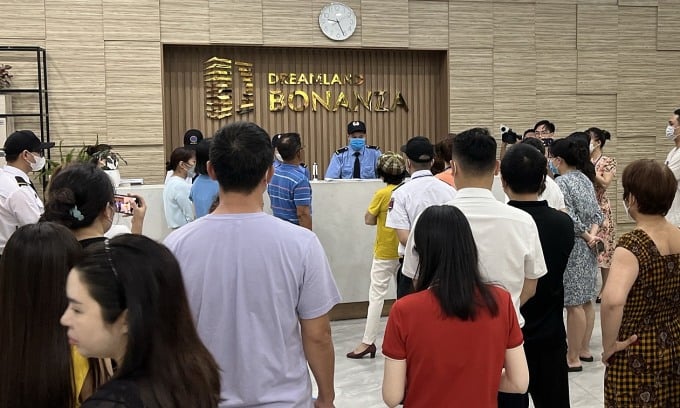
Residents of Dreamland Bonanza gathered in the building lobby to request a resolution to their management and operation dispute. Photo: Provided by the Management Board.
In addition to the aforementioned dispute, this apartment building is also experiencing conflict over the allocation of basement parking space. According to regulations, parking spaces for motorbikes and bicycles in the basement are the common property of apartment owners, while car parking spaces are under the management of the developer, and the developer is not allowed to include these parking spaces in the selling price, lease-purchase price, or construction costs. The allocation of car parking spaces must prioritize apartment owners first, before allocating spaces for public parking.
Vinaland Real Estate Investment Joint Stock Company asserts that the entire area of the three basement levels, including the motorbike, bicycle, and tricycle parking areas, is privately owned because it is not included in the selling price. However, the Management Board representing the residents stated that "the investor has not provided any documents proving ownership, such as the settlement of construction costs for the parking garage, or a certificate of ownership."
An irreconcilable dispute has resulted in the Dreamland Bonanza apartment building having two parallel management boards dealing with the common and private areas owned by both the developer and the residents. The building has two reception desks, two security guards in white and blue uniforms in the basement, a camera room, and many other areas. Residents pay monthly parking fees to the developer's management unit and service fees to the building's operating company.
The management board of Dreamland Bonanza apartment building recently sent a document to the People's Committee of Nam Tu Liem District requesting the district to require the investor to hand over the technical infrastructure, equipment, camera room, operation management room, etc., as these are "common property of the apartment building according to the law".
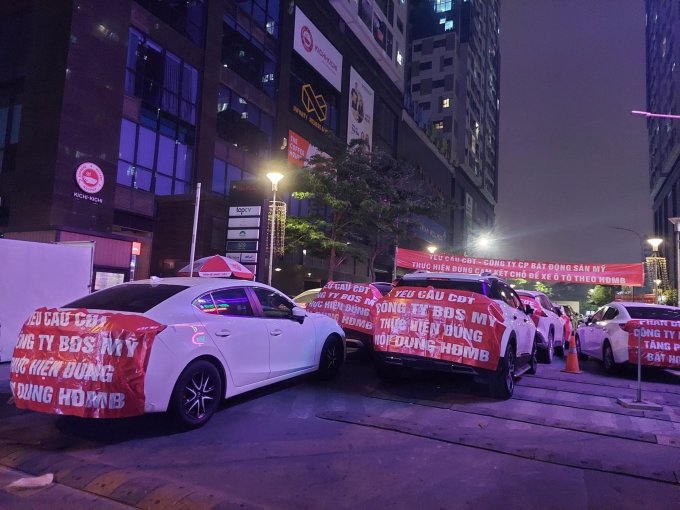
Residents held banners protesting the increase in parking fees at TNR Gold Season apartment complex on April 19. Photo: CTV
Disputes over apartment ownership are common nationwide. According to statistics from the Vietnam Real Estate Association in 2022, Hanoi had 129 out of 845 buildings and complexes with disputes and lawsuits, while Ho Chi Minh City had 105 out of 935. In Hanoi, besides the cases mentioned above, disputes also occurred at Viet Duc Complex; The Legacy, TNR Gold Season 47 Nguyen Tuan (Thanh Xuan District); Housinco Premium (Thanh Tri); Phu Thinh Green Park (Ha Dong); Kosmo Tay Ho, etc.
Mr. Nguyen Manh Khoi, Deputy Director of the Department of Housing and Real Estate Market Management ( Ministry of Construction ), stated that one of the common disputes in apartment buildings relates to issues of common and private ownership; delays in contributing and handing over maintenance funds for common areas between the investor and residents. "In some apartment buildings, the investor and the management board representing the residents cannot agree on the division of common and private areas, and the areas that the investor retains and does not sell or has not yet sold or leased. Therefore, this has led to delays in settling accounts and the handover of maintenance funds for 1-3 years," Mr. Khoi said.
Chief Inspector of the Ministry of Construction, Nguyen Ngoc Tuan, pointed out violations in many apartment buildings due to developers encroaching on and using common areas for private purposes.
In 2021-2022, the Inspectorate of the Ministry of Construction inspected 37 developers and 36 management boards in 43 apartment buildings across 16 localities; imposing administrative fines totaling over 14 billion VND on 20 developers. The Inspectorate required developers to reach an agreement with the management boards regarding the common areas and equipment of the apartment building; to hand over all apartment building documents to the management boards; and compelled 5 developers to return over 2,000 m2 of encroached land to the residents.
Next article: Why are ownership disputes common in apartment buildings?
Doan Loan - Viet An
Source link




































































































Comment (0)