

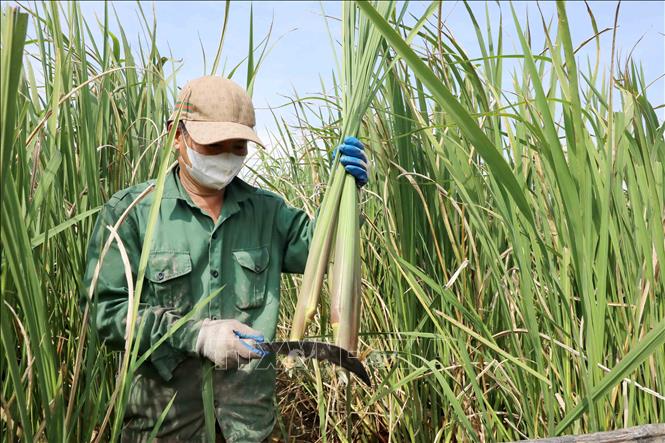
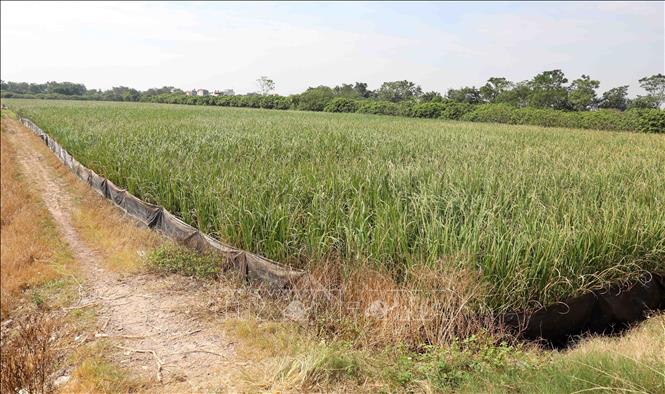
These days, farmers in Hong Chau ward (Hung Yen province) are busily harvesting water chestnuts – the only harvest of the year. After being cut from the fields, the water chestnuts are washed, trimmed, and sorted before being bundled into bunches and sold to traders in the surrounding area. The harvested water chestnuts are bought up as soon as they are harvested, so everyone is happy. This is also the area with the most water chestnut cultivation in Hung Yen province, with about 150 households cultivating over 10 hectares.
Quickly selecting fresh, delicious water chestnut tubers to sell to traders in Hanoi, Mr. Vu Van Sang (Le Nhu Ho village, Hong Chau ward) shared that his family used to cultivate rice, but the fields were low-lying and waterlogged, resulting in low economic efficiency. After boldly switching to growing water chestnuts, he noticed a clear improvement in both production costs and income. To date, he has 20 years of experience growing this crop with a total area of 2 acres (1 acre is approximately 3,600 m2).
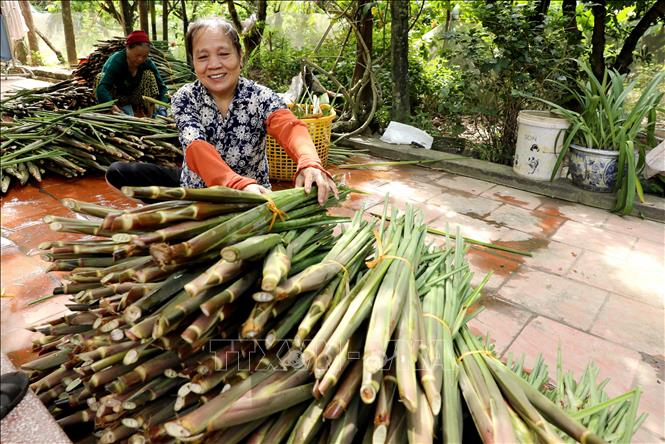
According to Mr. Sang, this year, water chestnut growers are delighted not only because of a good harvest but also because of the good prices. The price of water chestnuts at the beginning of the season fluctuates between 30,000 and 35,000 VND per bundle of 10 tubers. With stable yields and prices, after deducting expenses, Mr. Sang can earn a profit of 6-7 million VND per sao (360 m2) of water chestnuts, 3-5 times higher than rice cultivation.
According to locals, water chestnut, also known as water caltrop, thrives in muddy and waterlogged areas. The plant can reach a height of 1-2 meters. A notable characteristic of water chestnut is its branching ability, robustness, and resilience, making it well-suited to the soil and climate of Hung Yen province. The best water chestnuts are those still enclosed in their sheaths, plump, with few black spots inside, offering a sweeter, richer flavor. Conversely, older water chestnuts have fibrous skins, reducing their crispness, sweetness, and characteristic aroma.
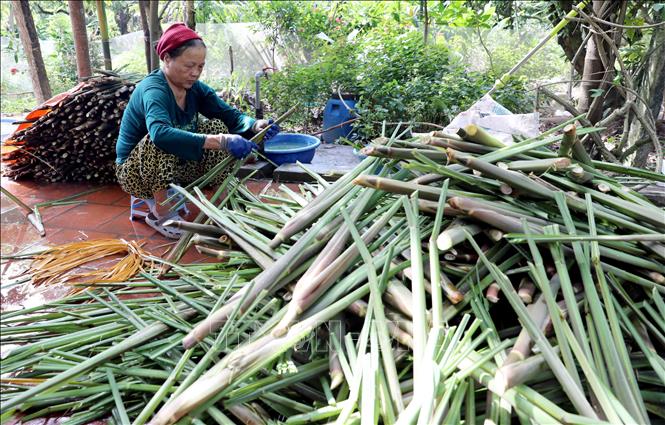
Excited about the high price of water chestnuts, Mr. Le Van Ban (Tan Hung commune) said that he switched from rice farming to water chestnut cultivation more than 10 years ago. Unlike rice farming, water chestnuts only yield one crop per year, with a cultivation period lasting from 7 to 9 months. Water chestnuts are usually planted at the beginning of the year and harvested around mid-September of the lunar calendar. Due to the suitable soil conditions here, the water chestnut plants grow and develop well, producing tubers that are fragrant, delicious, and rich in flavor.
In particular, growing water chestnuts eliminates concerns about seed supply. After harvesting, farmers can use the roots for propagation to replant the following spring, significantly reducing initial investment costs. Furthermore, water chestnuts are considered a clean and safe crop as they do not require pesticides, thus protecting the soil and water environment.
Although the water chestnut season only lasts about 1 to 1.5 months, it is always popular in the market. Mr. Tran Van Nam (Bac Ly commune, Ninh Binh province) said that not only does it have a delicious, unique flavor and is easy to prepare, but water chestnuts also contain many nutrients that are good for health, helping to prevent atherosclerosis, high blood pressure, high urea levels, etc. Therefore, it has become a tradition that every year, around the 9th lunar month, he travels from Chan Ly commune, former Ha Nam province (now Bac Ly commune, Ninh Binh province) to Hung Yen to buy this "specialty" tuber.
With its economic value, water chestnut is gradually becoming a crop whose cultivation area is being encouraged in Hung Yen, especially in converting inefficient rice cultivation areas. This opens up a promising direction for local agriculture from a rustic, traditional plant.
Source: https://baotintuc.vn/kinh-te/dac-san-dong-que-dan-da-hut-khach-thi-truong-mien-bac-20251031071610174.htm

![[Photo] Prime Minister Pham Minh Chinh receives the Governor of Tochigi Province (Japan)](/_next/image?url=https%3A%2F%2Fvphoto.vietnam.vn%2Fthumb%2F1200x675%2Fvietnam%2Fresource%2FIMAGE%2F2025%2F12%2F16%2F1765892133176_dsc-8082-6425-jpg.webp&w=3840&q=75)
![[Live] 2025 Community Action Awards Gala](/_next/image?url=https%3A%2F%2Fvphoto.vietnam.vn%2Fthumb%2F1200x675%2Fvietnam%2Fresource%2FIMAGE%2F2025%2F12%2F16%2F1765899631650_ndo_tr_z7334013144784-9f9fe10a6d63584c85aff40f2957c250-jpg.webp&w=3840&q=75)
![[Image] Leaked images ahead of the 2025 Community Action Awards gala.](/_next/image?url=https%3A%2F%2Fvphoto.vietnam.vn%2Fthumb%2F1200x675%2Fvietnam%2Fresource%2FIMAGE%2F2025%2F12%2F16%2F1765882828720_ndo_br_thiet-ke-chua-co-ten-45-png.webp&w=3840&q=75)

![[Photo] Prime Minister Pham Minh Chinh receives Lao Minister of Education and Sports Thongsalith Mangnormek](/_next/image?url=https%3A%2F%2Fvphoto.vietnam.vn%2Fthumb%2F1200x675%2Fvietnam%2Fresource%2FIMAGE%2F2025%2F12%2F16%2F1765876834721_dsc-7519-jpg.webp&w=3840&q=75)







































































Comment (0)