

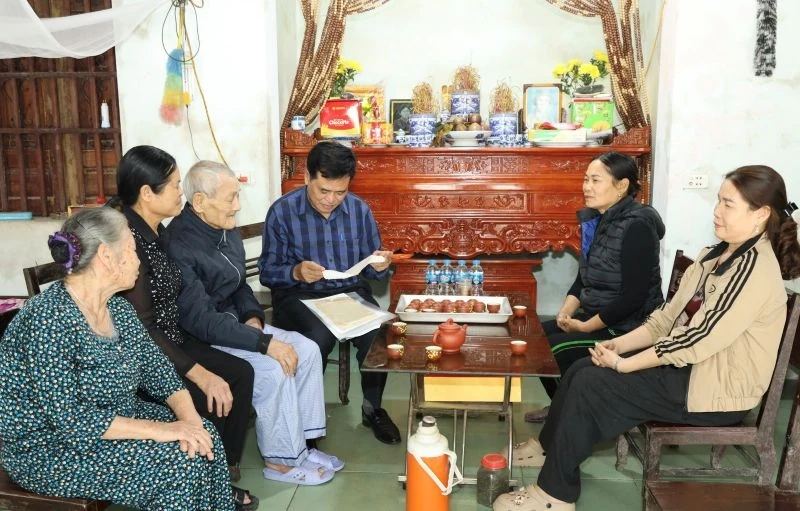
Relatives of Martyr Le Van Quang reread letters written more than 50 years ago.
In a small house in Thinh Hoa village, formerly Hoang Thinh commune (now Hoang Loc commune), Mr. Le Van Nghiem – a retired police colonel – flips through letters stained with the passage of time – silent witnesses of more than half a century of war and separation. As the words in the letters are read aloud, memories of his youngest brother and uncle come alive: Martyr Le Van Quang (1949–1971).
Martyr Lê Văn Quảng was the youngest son in a farming family in Thịnh Hòa village, formerly Hoằng Thịnh commune. His father was a construction worker, and his mother spent her life working in the fields. Of his four siblings, he was the only one who completed the 7th grade.
In 1966, at the age of 19, the young man, full of ambition, left his hometown for Northern Thailand to study at the High School for Mechanical Engineering, Metallurgy, and Iron and Steel. But just two years later, amidst the most intense period of the country's resistance war, he put aside his studies and volunteered to join the army along with countless other young people at that time.
In the handwritten notes for his family, the image of his youngest uncle from over half a century ago remains vivid: tall, with a gentle face. He was a man of few words but sincere, always quietly and warmly caring for his loved ones. |
“Back then, the family only learned about my uncle joining the army through letters he sent home,” Mr. Nghiem recalled. “He told us about his training, his ideals, and the determination of a young soldier. He even instructed my father to carefully preserve his academic certificate so that after the country was unified, he could return and continue his studies…”
Even now, every time they open those letters, the grandchildren of the fallen soldier Quang still can't hide their emotions because in the words written to their family, they still see the image of their youngest uncle from more than half a century ago: tall, with a gentle face, and a scar on his philtrum from an illness he had as a child. He was a man of few words but sincere, always quietly and warmly caring for his loved ones. Their most memorable memory is the time he visited their home before boarding the train to go to the battlefield in the South.
“That year, the train stopped at Thanh Hoa station. My uncle ran across the fields to get home in time. He ran into the house to find my grandparents and parents, talked to them for a short while, and then hurried off to catch the train… Seeing me playing in the yard, he quickly ran over, patted my head, and said just one thing: ‘Play nicely, I’m going now, I’ll buy you candy next time I come back!’ At that moment, I just stood there, mesmerized, watching his figure in his sweat-drenched uniform running across the cornfield in front of the house!” – Colonel Nghiem was only 12 years old then, and his memories flooded back as he recounted them so clearly, as if it happened yesterday.

While reading the letter, Mr. Le Van Nghiem recalled memories of his uncle, the martyr Le Van Quang.
Before marching south, Martyr Le Van Quang spent over four months training in the North. During that time, he sent letters home to his family, each page meticulously written with neat, polite handwriting. Behind the gentle penmanship lay a filial devotion to his parents, a deep affection for his siblings, and boundless love for his young nieces and nephews.
...each line of writing was neat and polite. Hidden behind the gentle brushstrokes was a heart full of filial piety towards parents, a close bond with siblings, and boundless affection for the young grandchildren. |
“Nghiem, Chinh, Huan, and Luyen (the names of the four nephews - PV) be good! Nghiem, try your best to study hard. No matter who asks, tell them that Uncle went to fight the Americans and build the country in the South. Study hard so that later you can come to the South and help build society with Uncle!”
Upon arriving at the battlefield in the South, he wrote a letter to his family on July 25, 1969. This was also the last letter his family received from him.
"Dear parents, uncles, aunts, brothers, and sisters!"
My dearest nephews and nieces!
Today, I, a member of the family, sit here in the far-off southern part of Vietnam, writing this letter to wish my uncle, aunt, parents, brothers, sisters, and all the children in the family good health, youthfulness, and many glorious achievements in their work. That would make me happiest!
"It is only because of the cruel American-backed regime that children are separated from their parents, and siblings from their older relatives. But in just a short time, our family will be reunited and joyful again, parents. I only hope that you, parents, and uncles, will stay healthy and live to enjoy the days of North-South reunification, the day I return to my ancestral homeland..."
In a letter sent home from the battlefield, he confided in and advised his family after seeing the path he had to take:
“Brother and sisters! I'm sure you all have high expectations for my future in every aspect. But I know that the path I'm taking has been, is, and will continue to be fraught with danger, brother and sister!... Now, there's only one thing I want to say: my parents are old and frail. I trust that no matter what, I have you, my brothers and sisters, to support me in this battle, even if it means shedding blood. My parents will have no regrets about this unfilial child now that they are old...”

Each page of the letter is like a "slice" of the past sent to the present.
From that point on, no more letters were sent home. The family lost contact with him, until two years later, news of his return arrived – in the form of a death certificate.
“He sacrificed his life at the young age of 22, leaving behind so many unfulfilled plans and promises to his loved ones. To this day, we still haven’t found his grave…” – Mr. Nghiem’s voice choked up, his tone fading in the cool evening breeze that swept across the porch.

The last letter was the only clue his relatives had in locating the place where Martyr Le Van Quang died, hoping to bring him back to his hometown.
Now, more than half a century later, those time-worn letters are all the family has left of the fallen soldier Le Van Quang. The ink has faded, the paper has withered, but each page is like a "slice" of the past sent to the present – brimming with affection, a yearning for peace , and unwavering faith in the day of national reunification.
He sacrificed his life at the young age of 22, leaving behind so many unfulfilled plans and promises to his loved ones. To this day, we still haven't found his grave...
For Mr. Nghiem's family, these letters are not only sacred mementos of their youngest uncle, but also the few clues they have in their search for his final resting place, hoping to bring him back to his homeland.
“My uncle enlisted in June 1968 and died on January 9, 1971. Following the information in his last letter, the family made efforts to find information and initially learned that he was ambushed while on duty in the Som Rong area of Cambodia and was wounded. He was transferred to the Châu Thành commune health station in Tây Ninh province for treatment but did not survive and was buried in the local cemetery. The family has submitted a request to verify the information at the Châu Thành Martyrs' Cemetery and there is currently one grave with the name Lê Văn Quảng. Currently, the family is completing the DNA testing procedures to determine the martyr's identity…,” Mr. Nghiêm added.
During the years of war, handwritten letters became the only bridge connecting the home front with the battlefront. From the drawers of time, filled with these simple yet sacred memories, we would like to recount a few stories about a generation that "died without regret," who lived, loved, and dedicated their youth to shaping the image of our nation. The following story is also the last letter of a fallen People's Public Security officer, who has never returned. Reading the letter of a fallen soldier, we understand more deeply that love for the homeland, flowing in our veins, originates from boundless love for our family. |
Viet Huong
Lesson 3: "There are still many difficulties and hardships, but please trust me, because I believe in the Party..."
Source: https://baothanhhoa.vn/di-thu-cua-nguoi-linh-bai-2-thay-me-bac-hay-khoe-song-de-huong-nhung-ngay-bac-nam-thong-nhat-ngay-ma-con-tro-ve-que-cha-dat-to-271816.htm
![[Photo] Prime Minister Pham Minh Chinh receives the Governor of Tochigi Province (Japan)](/_next/image?url=https%3A%2F%2Fvphoto.vietnam.vn%2Fthumb%2F1200x675%2Fvietnam%2Fresource%2FIMAGE%2F2025%2F12%2F16%2F1765892133176_dsc-8082-6425-jpg.webp&w=3840&q=75)
![[Image] Leaked images ahead of the 2025 Community Action Awards gala.](/_next/image?url=https%3A%2F%2Fvphoto.vietnam.vn%2Fthumb%2F1200x675%2Fvietnam%2Fresource%2FIMAGE%2F2025%2F12%2F16%2F1765882828720_ndo_br_thiet-ke-chua-co-ten-45-png.webp&w=3840&q=75)
![[Photo] Prime Minister Pham Minh Chinh receives Lao Minister of Education and Sports Thongsalith Mangnormek](/_next/image?url=https%3A%2F%2Fvphoto.vietnam.vn%2Fthumb%2F1200x675%2Fvietnam%2Fresource%2FIMAGE%2F2025%2F12%2F16%2F1765876834721_dsc-7519-jpg.webp&w=3840&q=75)

![[Live] 2025 Community Action Awards Gala](/_next/image?url=https%3A%2F%2Fvphoto.vietnam.vn%2Fthumb%2F1200x675%2Fvietnam%2Fresource%2FIMAGE%2F2025%2F12%2F16%2F1765899631650_ndo_tr_z7334013144784-9f9fe10a6d63584c85aff40f2957c250-jpg.webp&w=3840&q=75)
































![[Photo] Prime Minister Pham Minh Chinh attends the Vietnam Economic Forum 2025](https://vphoto.vietnam.vn/thumb/402x226/vietnam/resource/IMAGE/2025/12/16/1765893035503_ndo_br_dsc-8043-jpg.webp)














Comment (0)