

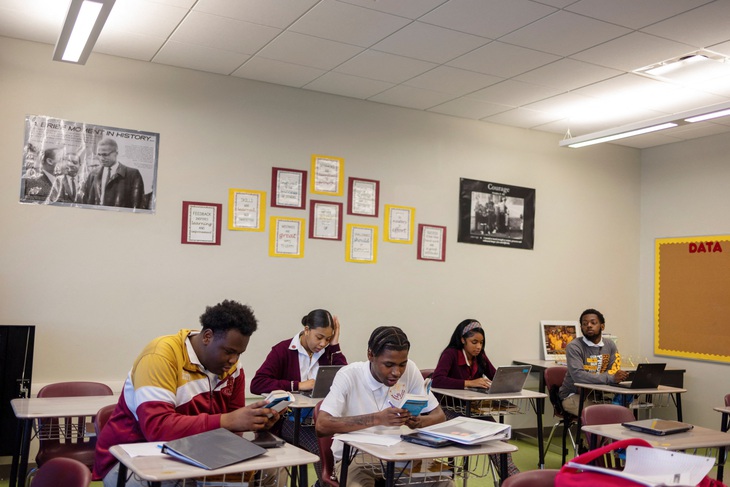
Some teachers observe that students today typically read only a few books a year, instead of dozens as in the past, which means that sustained reading skills are not being developed. - Photo: REUTERS
According to CNN on September 9th, 32% of 12th-grade students in the US lack "basic" reading comprehension skills, meaning they cannot find details in a text to understand its meaning.
The average score for this subject in 2024 was recorded as the lowest since the survey began in 1992.
In mathematics, 42% of 12th-grade students scored below "basic," the highest percentage since 2005, meaning these students have not yet mastered skills such as using percentages to solve practical problems.
Only 33% of 12th-grade students were considered academically ready for college-level math courses, down from 37% in 2019.
The survey results are based on reports from the National Assessment Program for Educational Progress (NAEP), considered the "national scorecard" that accurately reflects the quality of learning.
This is the first time since the pandemic that 12th-grade students have been tested in math and reading comprehension, and 8th-grade students in science .
The survey results reflect a downward trend across all grade levels and subjects compared to previous NAEP reports.
"The scores of the lowest-performing students are currently at record levels," said Matthew Soldner, acting Commissioner of the National Center for Education Statistics. "These results call for focused and concerted action to boost student learning."
Furthermore, the achievement gap between the highest-achieving and lowest-achieving students in the US is widening, particularly in 8th-grade science and 12th-grade math, reflecting growing inequality within the American education system.
The gender gap in STEM (science, technology, engineering, and mathematics) subjects also highlights the problem, with female students' scores declining more sharply than male students'.
According to the New York Times , the decline in students' academic performance may be partly due to the COVID-19 pandemic, including illness, school closures, and forced remote learning.
Experts believe that the lack of practical experience after the pandemic further contributed to the decline in scientific skills. However, data also indicates that the downward trend had begun before 2020.
"It cannot be assumed that the scores wouldn't have declined without COVID-19. In fact, the decline had been observed even before that," emphasized Christine Cunningham, senior vice president for STEM learning at the Boston Museum of Science.
Source: https://tuoitre.vn/diem-so-doc-hieu-va-toan-cua-hoc-sinh-my-roi-xuong-muc-thap-ky-luc-20250910162200658.htm
![[Photo] Prime Minister Pham Minh Chinh receives the Governor of Tochigi Province (Japan)](/_next/image?url=https%3A%2F%2Fvphoto.vietnam.vn%2Fthumb%2F1200x675%2Fvietnam%2Fresource%2FIMAGE%2F2025%2F12%2F16%2F1765892133176_dsc-8082-6425-jpg.webp&w=3840&q=75)
![[Photo] Prime Minister Pham Minh Chinh receives Lao Minister of Education and Sports Thongsalith Mangnormek](/_next/image?url=https%3A%2F%2Fvphoto.vietnam.vn%2Fthumb%2F1200x675%2Fvietnam%2Fresource%2FIMAGE%2F2025%2F12%2F16%2F1765876834721_dsc-7519-jpg.webp&w=3840&q=75)
![[Image] Leaked images ahead of the 2025 Community Action Awards gala.](/_next/image?url=https%3A%2F%2Fvphoto.vietnam.vn%2Fthumb%2F1200x675%2Fvietnam%2Fresource%2FIMAGE%2F2025%2F12%2F16%2F1765882828720_ndo_br_thiet-ke-chua-co-ten-45-png.webp&w=3840&q=75)

![[Live] 2025 Community Action Awards Gala](/_next/image?url=https%3A%2F%2Fvphoto.vietnam.vn%2Fthumb%2F1200x675%2Fvietnam%2Fresource%2FIMAGE%2F2025%2F12%2F16%2F1765899631650_ndo_tr_z7334013144784-9f9fe10a6d63584c85aff40f2957c250-jpg.webp&w=3840&q=75)






























































![[Photo] Prime Minister Pham Minh Chinh attends the Vietnam Economic Forum 2025](https://vphoto.vietnam.vn/thumb/402x226/vietnam/resource/IMAGE/2025/12/16/1765893035503_ndo_br_dsc-8043-jpg.webp)

































Comment (0)