

AI needs to pay if it wants to use content.
OpenAI, Google, Microsoft, and Adobe have met with news CEOs in recent months to discuss the aforementioned copyright issues. Sources say that major media organizations involved in the negotiations include News Corp, Axel Springer, The New York Times, and The Guardian.
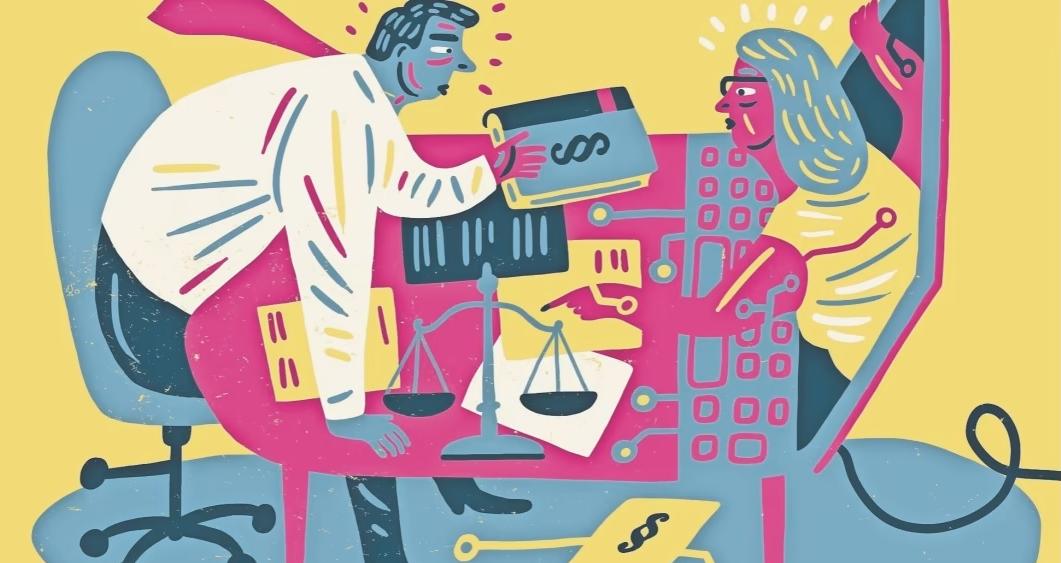
The world of journalism needs to continue fighting against the tech giants for its own benefit and future. (Illustration: FT)
Those involved in the discussions, which are still in their early stages, say the agreements involve news and media organizations being paid a fee by AI companies for using their data to train chatbots such as OpenAI's ChatGPT and Google's Bard.
The talks are taking place as news organizations express concerns about the threat of AI to the journalism and media industry, such as OpenAI and Google using journalistic content and other copyrighted material without permission. Some companies, like Stability AI and OpenAI, are facing legal challenges from artists, photo companies, and programmers who accuse them of breach of contract and copyright.
Speaking in May at INMA, a media conference, News Corp CEO Robert Thomson articulated the outrage of the journalism and media industry, stating: “The collective property of the media is under threat and we should fight hard for compensation.”
He added that AI is “designed so that readers will never visit a news website again, thus seriously undermining journalism.” Meanwhile, the Financial Times stated: “Copyright is a vital issue for all publishers.”
The press needs to avoid repeating past mistakes.
Journalism and media leaders want to avoid the mistakes of the early internet era, when they provided free online articles to third-party platforms, only to ultimately "shoot themselves in the foot."
Large tech groups like Google and Facebook then accessed news and other copyrighted information sources to plunder and dominate the multi-billion dollar online advertising market, despite paying virtually nothing for content creation.
As the prevalence of artificial intelligence increases, the news industry must also be concerned about the potential for AI to have a similar impact, specifically generating articles and responses based on journalistic information, then profiting from it and further suppressing journalism.
Google recently announced a general AI search function that provides an AI-generated answer box, containing only traditional web links it uses to retrieve information that most readers won't click on. It has launched in the US and is preparing for a worldwide rollout.
Some discussions currently revolve around trying to find a pricing model for news content used as training data for AI models. According to one news industry executive, the figure being proposed and discussed by news publishers ranges from $5 million to $20 million per year.
Mathias Döpfner, CEO of Berlin-based media group Axel Springer, has met with leading AI companies such as Google, Microsoft, and OpenAI. He said his first choice was to create a “quantitative” model similar to the one developed by the music industry, that is, a model that charges money each time a piece of music is played.
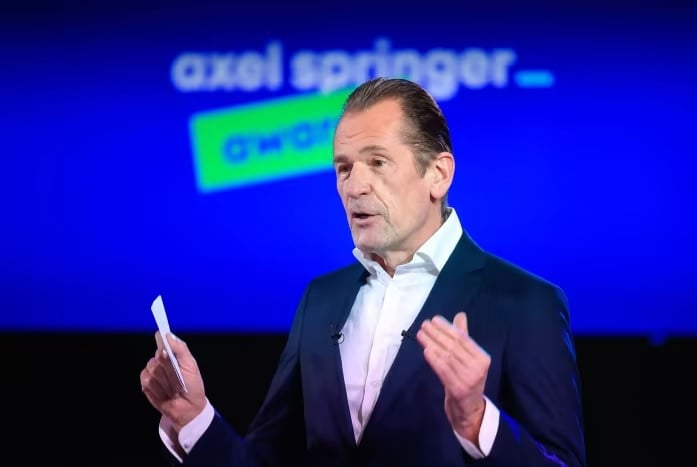
Mathias Döpfner, CEO of the media group Axel Springer. Photo: Getty
To achieve this, AI companies would first be required to disclose how they use their content – something they currently do not.
Mr. Döpfner, from the owner of Politico, Bild, or Die Welt, said that an agreement on an annual subscription package should only be a “second option,” because this model would be difficult to negotiate with smaller regions or local news outlets.
Döpfner emphasized: “We need a solution for the entire journalism and media industry. We must unite and work together on this issue.”
Google has led negotiations with UK news organizations, meeting with the Guardian and NewsUK. The tech and AI giant has long-standing partnerships with numerous media organizations and is believed to have used journalistic data to train its large-scale language models.
An executive from a news group said: “Google has put a deal on the table. They’ve accepted the principle that payment is necessary… but we’re not at the point where we’re just talking about the numbers. They’ve acknowledged that there’s a discussion about money that we need to have in the next few months, which is the first step.”
"Artificial intelligence" or "artificial stupidity"
Since launching ChatGPT in November, OpenAI CEO Sam Altman has also met with News Corp and The New York Times. The company acknowledges it has held talks with publishers and publishing associations around the world about how they can work together.

Without human intellectual property, AI would be nothing more than "artificial stupidity." (Image: GI)
According to publishing leaders, developing a profit-sharing model for using news content to train AI will be extremely difficult. A senior executive at a major US publisher said the news industry is struggling intensely, as tech companies have launched AI products without consulting them, as if journalistic information were a free resource.
“There was no discussion, and so now we have to ask to be paid after it happened,” the CEO said. “The way they launched these products, completely secretly, with virtually no transparency, no prior communication, is cause for concern.”
Media analyst Claire Enders said the negotiations are "currently very complex," adding that, because each organization has its own approach, a single commercial agreement for all media groups is unlikely and could be counterproductive.
Brad Smith, Microsoft's vice president, stated: “In the early days of discussions with the media and news publishers, part of it was simply helping people understand how the models are trained… Then we’ll work with publishers to think about how they can use AI to generate more revenue.”
Adobe CEO Shantanu Narayen said he had met with Disney, Sky and the UK's Daily Telegraph over the past few weeks to discuss the company's use of images, videos and information from news and media organizations to train its AI products.
Axel Springer CEO Döpfner expressed optimism that deals would be reached because media organizations and policymakers alike have grasped the challenges and risks that AI could pose.
He concluded: “AI companies know that regulations are coming and they are worried about it... Everyone benefits from a solution that creates a healthy ecosystem. Without incentives, nobody will want to create intelligent products. And then, artificial intelligence will become artificial stupidity.”
Hoang Hai (according to FT, NYT, Guardian)
Source
![[Video] Sunset at Lap An Lagoon – Where the sun sets over the fishing nets](https://vphoto.vietnam.vn/thumb/1200x675/vietnam/resource/IMAGE/2026/05/31/1780192137701_beach-landscape-sea-water-nature-grass-745871-pxhere-com.jpeg)


















![[Video] Sunset at Lap An Lagoon – Where the sun sets over the fishing nets](https://vphoto.vietnam.vn/thumb/340x192/vietnam/resource/IMAGE/2026/05/31/1780192137701_beach-landscape-sea-water-nature-grass-745871-pxhere-com.jpeg)

















































































Comment (0)