

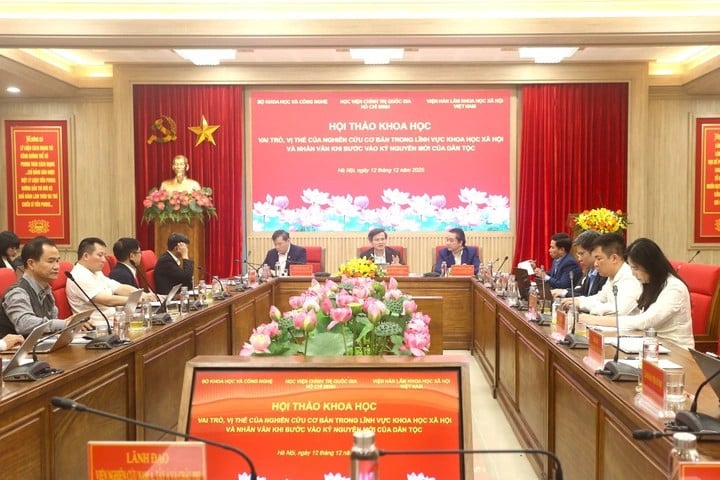
Theory – the “operating system” for development strategy
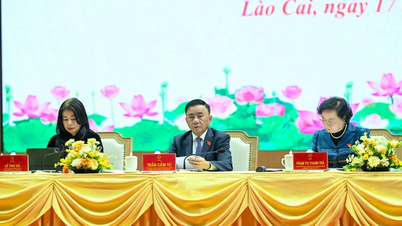
In his opening remarks, Associate Professor, Dr. Doan Minh Huan, Permanent Deputy Director of the Ho Chi Minh National Academy of Politics , emphasized that for each nation, the system of theoretical knowledge plays the role of the "operating system" for all development policies. According to him, without a solid foundation in social sciences and humanities, development will lack direction, innovation will lack sustainability, integration will lack courage, and social progress will lack depth and value.
Associate Professor, Dr. Doan Minh Huan argues that the world is witnessing an explosion of digital technology, AI, and big data, leading to profound changes in economics , politics, and culture. Along with this is the increasing complexity of many global issues such as social inequality, climate change, conflicts of interest, and the need to protect human values. These rapid changes create opportunities but also pose new challenges, requiring a comprehensive renewal of scientific thinking in terms of theory, methodology, and approach.
In this context, social sciences and humanities are seen as fields that help people understand themselves, society, the dynamics of development, and the laws governing life. Responding to the demands of the digital age, Associate Professor, Dr. Doan Minh Huan asserts that basic research in social sciences and humanities not only "builds knowledge," but also contributes to strengthening value systems, shaping the future, preserving identity, and proactively adapting to a changing world.
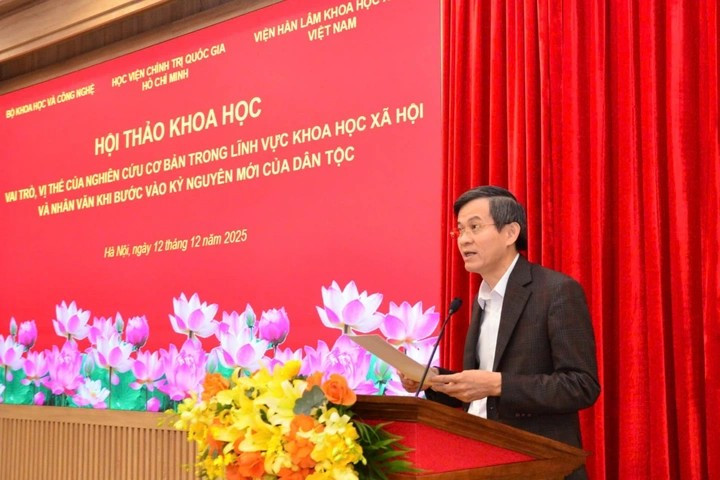
Creating a new knowledge base and improving funding mechanisms.
Sharing the same viewpoint, Associate Professor, Dr. Dao Ngoc Chien, Director of the National Fund for Social Science and Technology Development, emphasized the central role of basic research in building a new knowledge foundation for social sciences and humanities. According to him, basic research helps clarify the nature of social, cultural, and human phenomena; and builds conceptual systems, theories, and methods – the "pillars" of the entire field of social sciences and humanities.
Associate Professor, Dr. Dao Ngoc Chien stated that the Fund has sponsored many basic research projects in social sciences and humanities over the past period, thereby contributing to the formation of research groups, training human resources, and promoting scientific publications. However, the quality of research is uneven, international publications are limited, and the level of connection with practical policy needs further improvement.
In its future direction, the Fund will focus on increasing funding for high-quality research projects; prioritizing young scientists and developing strong research groups; encouraging interdisciplinary research and innovation, especially linking social sciences and humanities with big data, technology, and AI; expanding international integration in funding and research implementation; and promoting digital transformation and reducing administrative procedures.
Knowledge integration, proactive contribution, and warnings about AI.
In his presentation on "International Integration and the Mission of Social Sciences and Humanities," Dr. Dao Ngoc Bau, Director of the Institute of Politics and International Relations (Ho Chi Minh National Academy of Politics), argued that international integration is restructuring the knowledge space, where knowledge becomes a form of "soft power" linked to the ability to shape discourse and enhance national standing.
According to him, Vietnamese social sciences and humanities still primarily operate in a knowledge-receiving role, with limited capacity for theoretical innovation and independent doctrinal contributions, leading to the risk of "knowledge dependence." Therefore, a shift from passive to active is needed: from localizing knowledge to contributing Vietnamese theories with international reference value based on the country's practical realities; while simultaneously reforming investment and evaluation mechanisms to prioritize long-term foundational research and reforming training to foster theoretical innovation and critical thinking.
From a philosophical perspective, Associate Professor, Dr. Nguyen Tai Dong, Director of the Institute of Philosophy (Vietnam Academy of Social Sciences), warns that digital transformation could present social sciences and humanities with challenges regarding identity and methodology. He points out the risk of tool dependence and a decline in critical thinking when researchers leave intellectual tasks to AI, reducing the ability to gain deep understanding; and also notes the risk of "cognitive colonization" when using foreign AI systems that are not primarily trained on Vietnamese data and values.
Based on the analyses and recommendations, many opinions at the conference agreed that basic research in social sciences and humanities is not only a foundation of knowledge but also a soft power, a self-reliance capability, and an "operating system" for national development strategies.
Strengthening values, developing human resources, protecting identity, designing institutions, and elevating Vietnam's position in the global knowledge space requires sustained investment in basic research, while simultaneously innovating mechanisms and methods so that social sciences and humanities can proactively enter a new phase of development—more creative, more deeply integrated, and more closely aligned with the country's sustainable development requirements.
Source: https://nhandan.vn/dinh-hinh-vai-role-nghien-cuu-co-ban-khoa-hoc-va-xa-hoi-nhan-van-trong-ky-nguyen-so-post930917.html

![[Live] 2025 Community Action Awards Gala](/_next/image?url=https%3A%2F%2Fvphoto.vietnam.vn%2Fthumb%2F1200x675%2Fvietnam%2Fresource%2FIMAGE%2F2025%2F12%2F16%2F1765899631650_ndo_tr_z7334013144784-9f9fe10a6d63584c85aff40f2957c250-jpg.webp&w=3840&q=75)
![[Photo] Prime Minister Pham Minh Chinh receives the Governor of Tochigi Province (Japan)](/_next/image?url=https%3A%2F%2Fvphoto.vietnam.vn%2Fthumb%2F1200x675%2Fvietnam%2Fresource%2FIMAGE%2F2025%2F12%2F16%2F1765892133176_dsc-8082-6425-jpg.webp&w=3840&q=75)
![[Photo] Prime Minister Pham Minh Chinh receives Lao Minister of Education and Sports Thongsalith Mangnormek](/_next/image?url=https%3A%2F%2Fvphoto.vietnam.vn%2Fthumb%2F1200x675%2Fvietnam%2Fresource%2FIMAGE%2F2025%2F12%2F16%2F1765876834721_dsc-7519-jpg.webp&w=3840&q=75)

![[Image] Leaked images ahead of the 2025 Community Action Awards gala.](/_next/image?url=https%3A%2F%2Fvphoto.vietnam.vn%2Fthumb%2F1200x675%2Fvietnam%2Fresource%2FIMAGE%2F2025%2F12%2F16%2F1765882828720_ndo_br_thiet-ke-chua-co-ten-45-png.webp&w=3840&q=75)










![[Video] 24-hour News on November 17, 2025: General Secretary To Lam: Creating the most favorable legal framework for national development](https://vphoto.vietnam.vn/thumb/402x226/vietnam/resource/IMAGE/2025/12/17/1765977057885_z7337002170021-9489a452b3db436532a1a849149df3ad-jpg.webp)






























![[Live] Closing Ceremony and Award Presentation for the "Impressive Vietnam Tourism" Video/Clip Creation Contest 2025](https://vphoto.vietnam.vn/thumb/402x226/vietnam/resource/IMAGE/2025/12/17/1765974650260_z7273498850699-00d2fd6b0972cb39494cfa2559bf85ac-1765959338756946072104-627-0-1338-1138-crop-1765959347256801551121.jpeg)























Comment (0)