

Mentioning the words "poverty" and "hardship" immediately brings to mind hardship and difficulty. But contrary to its name, visiting the "Poverty-Hardship Zone" in Hoi Xuan town (Quan Hoa district) offers a very different perspective. The stilt houses, paved roads, and rice paddies on the mountainside symbolize the prosperity of this place.
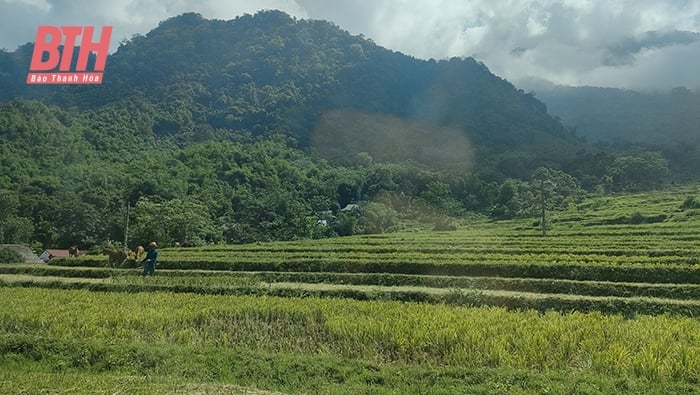
The villages of Nghèo and Khó, formerly part of Hồi Xuân commune, were merged in 2019 by Quan Hóa town and Hồi Xuân commune in accordance with Resolution No. 37-NQ/TW of the Politburo and Directive No. 20-CT/TU of the Provincial Party Committee on the reorganization of district and commune-level administrative units. Consequently , Nghèo and Khó villages became the Nghèo and Khó zones.
According to the elders, the villages of Kho and Ngheo are over 400 years old. Located at the foot of the Pu Luong mountain range, they are home to the Thai ethnic minority. The name Kho and Ngheo (meaning "difficult" or "poor") was given because in the past, transportation from the commune center to the villages was very difficult and arduous. In the Thai language, "Khó - Nghèo" means a winding, steep, and uphill road. Life for the people of Kho and Ngheo villages was extremely difficult and arduous in the past. To reach the villages, there was only one single, winding road that snaked through the long, continuous mountain slopes. Although only about 10 km from the center of Quan Hoa district town, the villagers faced a difficult journey to get to the town center due to the arduous road, separated by deep rivers and high mountains. The self-sufficient lifestyle, lacking trade and commerce, left the villages of Kho and Ngheo seemingly isolated from the outside world . To make the journey to the commune center less arduous and dangerous, the people of these villages worked together day and night, breaking rocks and carrying soil to build a road from their village to the Hoi Xuan commune center. Nearly 10 years ago, the government invested in building and expanding the asphalt road to the village. Thanks to this, children from both villages can now attend school in the commune center more easily, trade and commerce have developed, and the lives of the people have gradually improved.
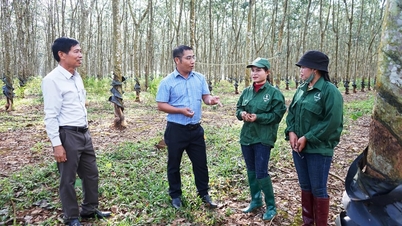
According to Cao Van Khanh, Party branch secretary and head of the Nghèo neighborhood: "Previously, the lives of the people here were very difficult. Hunger and poverty constantly plagued the residents. At one point, the poverty rate reached over 70%. Unwilling to accept poverty, the Party members in the branch discussed and found many suitable ways to help people change their mindset and work effectively. Given the locality's characteristics – a large area of forest land and a small area of agricultural land (only 13 hectares for rice cultivation) – the Party branch has assigned each Party member to be in charge of groups of households in the village to develop the economy . This allows them to promptly understand the people's thoughts and aspirations; to propagate and encourage each household to change their production practices, diversify crops and livestock; and to apply scientific and technological advancements to production." Based on the specific conditions of each household's farmland under their responsibility, Party members advised them to switch to suitable crops and livestock, such as growing sweet potatoes, bamboo, peaches, and plums. Currently, the average income is nearly 40 million VND per person per year. Along with economic development, the people of Nghèo village also pay attention to education. According to the elderly in Nghèo village, due to the difficult and arduous life in the past, with little arable land, the people here have chosen to rise up and become wealthy through knowledge. The first successful person in Nghèo village was Mr. Cao Ngọc Bích (born in 1926). Before 1954, thanks to his participation in the resistance war, Mr. Cao Ngọc Bích was the first person in the village to learn the national language. After 1954, Mr. Bích completed the 7th grade, then joined the revolution, working as an official and teacher in "popular literacy" classes in the communes of Quan Hóa district. Mr. Bích retired as the head of the cultural department. He was the first person from the poor village to achieve success and become an official. Following in his footsteps of that pursuit of education, to date, about 70 people have graduated from universities and colleges, and many officials in Quan Hoa district also come from the poor village.
Leaving the Poor Quarter, we arrived at the Difficult Quarter. Through discussions with Party member and respected figure Pham Quang Hau, we learned that the Party branch has 20 members. In recent years, with the support and assistance of the Party committee and government of Hoi Xuan town, the Difficult Quarter, situated against the majestic Pu Luong mountain range, has 10 hectares of agricultural land where two rice crops are grown on terraced fields around the village. Currently, along with developing the economy through production, the people in the quarter are very concerned about their children's education. The village has established a scholarship fund to encourage children to study; cultural activities are maintained and preserved. With its cool climate, the Party branch is being guided by the Party committee and government to develop community tourism, attracting domestic and international tourists to Quan Hoa and the Difficult Quarter.
According to Comrade Ha Van Tuy, Chairman of the People's Committee of Hoi Xuan town, in recent years, under the direct guidance of the town's Party Committee, Party members and people of all ethnic groups in the area in general, and Party members and people of the two poor and disadvantaged neighborhoods in particular, have actively accessed knowledge and information to apply to production, economic development, and building a clean and strong political system. Currently, the town is paying attention to developing community tourism in the poor and disadvantaged areas. With the cool climate, majestic mountain scenery, terraced rice fields, and unique cultural and culinary features of the Thai people here, it will be a destination that attracts tourists from all over, thereby helping the people to prosper in their own poor and disadvantaged land.
Minh Hieu
Source

![[Video] Sunset at Lap An Lagoon – Where the sun sets over the fishing nets](https://vphoto.vietnam.vn/thumb/1200x675/vietnam/resource/IMAGE/2026/05/31/1780192137701_beach-landscape-sea-water-nature-grass-745871-pxhere-com.jpeg)








![[Video] Sunset at Lap An Lagoon – Where the sun sets over the fishing nets](https://vphoto.vietnam.vn/thumb/800x450/vietnam/resource/IMAGE/2026/05/31/1780192137701_beach-landscape-sea-water-nature-grass-745871-pxhere-com.jpeg)


































![[Video] Sunset at Lap An Lagoon – Where the sun sets over the fishing nets](https://vphoto.vietnam.vn/thumb/402x226/vietnam/resource/IMAGE/2026/05/31/1780192137701_beach-landscape-sea-water-nature-grass-745871-pxhere-com.jpeg)































Comment (0)