

The transition to urban agriculture is not only a change in production model, but also a breakthrough in the application of science and technology, contributing to increasing value, gradually improving life and increasing income for people.
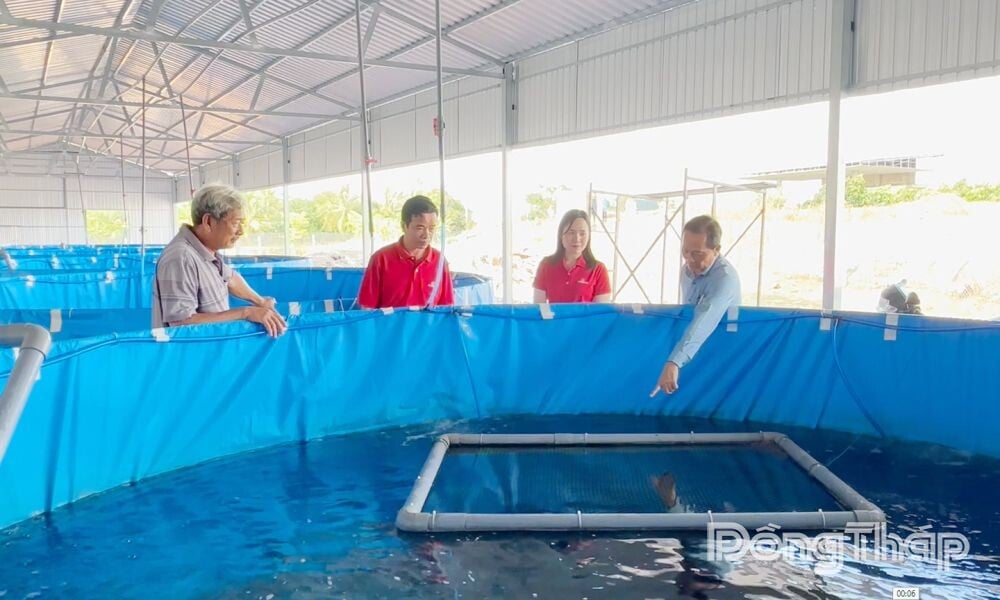
The reality in An Binh ward shows that many traditional production models are gradually losing their effectiveness. A typical case is that of Mr. Vuong Quang Quyen, 57 years old, residing in An Loi hamlet.
Having been involved in eel farming for many years, he faced a series of difficulties such as: scarce seed sources, high feed costs, polluted water environment making farmed eels susceptible to disease, increased loss rate and decreased profits, making him no longer bold enough to expand the scale.
Based on the analysis of economic efficiency, suitable water source conditions and market demand, local leaders encouraged Mr. Quyen to boldly convert from eel farming model to raising eel fry with high economic value, easily adaptable to the local environment.
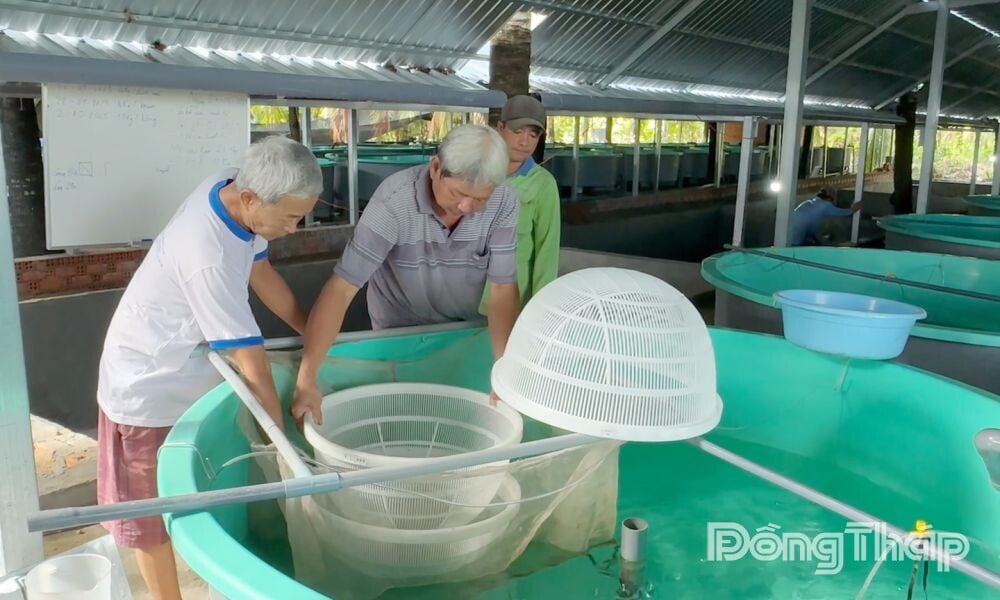
The timely guidance not only helped Mr. Quyen’s family overcome difficulties in their livelihoods, but also opened up a new direction in the development of urban agriculture in the ward. This demonstrates the leading and accompanying role of the government in transferring production techniques and thinking to the people.
The success of the eel breeding model in An Binh ward cannot be achieved without the support and companionship of local authorities such as: Investing in and upgrading facilities for production and establishing professional associations to gather and share breeding experiences.
Chairman of An Binh Ward People's Committee Huynh Van Tai affirmed: "The Party Committee and the Ward People's Committee determined that although the locality still has its own characteristics, that is, semi-urban and semi-rural. Therefore, in addition to developing trade and services, it is necessary to focus on developing agriculture in an urban, modern, safe and sustainable direction. In the coming time, the Ward People's Committee will continue to accompany people to replicate effective agricultural models in the ward. |
In particular, training courses on safe and effective aquaculture techniques were organized to help farmers become familiar with and master new farming processes. The Party Committee and the Ward People's Committee coordinated with banks to help farmers access preferential loans, expand production scale, invest in quality breeds and modern farming systems.
At the same time, the locality proactively connects and cooperates with owners of fish rafts on the Tien River to find stable output for products and build a supply chain for eel fry.
With timely guidance and support from local leaders, Mr. Quyen was motivated to innovate his thinking, learn about the growth characteristics, farming techniques and sources of eel breeds.
He boldly converted the entire eel farming area to raising eel fry, with a total of 74 tanks. Eels are a high-value aquatic species, but are known to be "difficult" and require meticulous care techniques. With perseverance and constant learning, Mr. Quyen has mastered the farming process, with a total land area of about 700 m2.
Mr. Quyen shared: “Up to now, the eel farming model is not only more stable, but also brings in many times more income than the previous eel farming. Every year, I export about 1 million eel fry to the market, meeting the market demand in and outside Dong Thap province.”
The model of raising eel fry proves that if farmers know how to exploit the available potential, they can completely get rich on their own land; at the same time, it opens up a direction for sustainable aquaculture development, contributing to promoting the agricultural economy in a sustainable direction.
DUONG UT
Source: https://baodongthap.vn/dot-pha-trong-phat-trien-nong-nghiep-do-thi-a233487.html


![[Photo] Prime Minister Pham Minh Chinh receives President of Cuba's Latin American News Agency](/_next/image?url=https%3A%2F%2Fvphoto.vietnam.vn%2Fthumb%2F1200x675%2Fvietnam%2Fresource%2FIMAGE%2F2025%2F12%2F01%2F1764569497815_dsc-2890-jpg.webp&w=3840&q=75)
































































Comment (0)