

On November 22, 2014, the Secretariat of the 11th Central Committee of the Communist Party of Vietnam issued Directive No. 40-CT/TW on strengthening the Party's leadership over social policy credit (Directive No. 40). After 10 years of implementation, in Ninh Binh province, the Directive has truly become a part of daily life, creating a breakthrough and connecting the strength of the entire political system with the Social Policy Bank (SPB) to support and promote vulnerable groups in society to rise up and change their lives; ensuring that no one is left behind, further highlighting the humanitarian nature of the unique social credit policy for the poor of the Vietnamese Party and State.
Over the past 10 years, under the guidance of Directive No. 40, policy credit has become a lever and a bright spot in poverty reduction efforts and in promoting agricultural and rural economic development in Ninh Binh province.
Providing sustainable livelihoods
Visiting households that have accessed preferential loans from the Vietnam Bank for Social Policies (VBSP) in Cuc Phuong commune, Nho Quan district, and witnessing the firm handshakes and warm conversations between VBSP staff, local authorities, and the households, we felt the close collaboration and support they provide to the community in social welfare and economic development in this mountainous commune, which still faces many difficulties.
The house of Ms. Phung Thi Thuy's family (village 1, Phu Long commune) is small but cozy and well-equipped, with fruit trees in the garden, chickens, pigs, and more. Years before her husband passed away, Ms. Thuy never dared to imagine having the life she has today. Without a stable job, she toiled day and night, struggling to raise her two children, so poverty and hardship constantly plagued her. Then, thanks to the guidance and support of local organizations and associations, she was able to access preferential loans from the Social Policy Bank, enabling her to raise livestock, cultivate crops, develop her economy, and support her children's education. Her eldest daughter, born in 2002, despite having a height disability, has strived to excel in her studies and is currently a fourth-year student at the University of Foreign Languages.
Ms. Thuy happily shared: “When my husband passed away, raising two young children alone, I didn't know when I would ever escape poverty. It's thanks to God's blessing of good health and the timely care and assistance from the local authorities and the Social Policy Bank that my family is where we are today.”
Not only in the mountainous district of Nho Quan, but also in Yen Mo, we met and heard stories from many people about overcoming difficulties and improving their family lives thanks to policy credit funds, such as the case of Ms. Pham Thi Oanh and Mr. Nguyen Ngoc Chi in Thai Binh hamlet, Yen Dong commune.
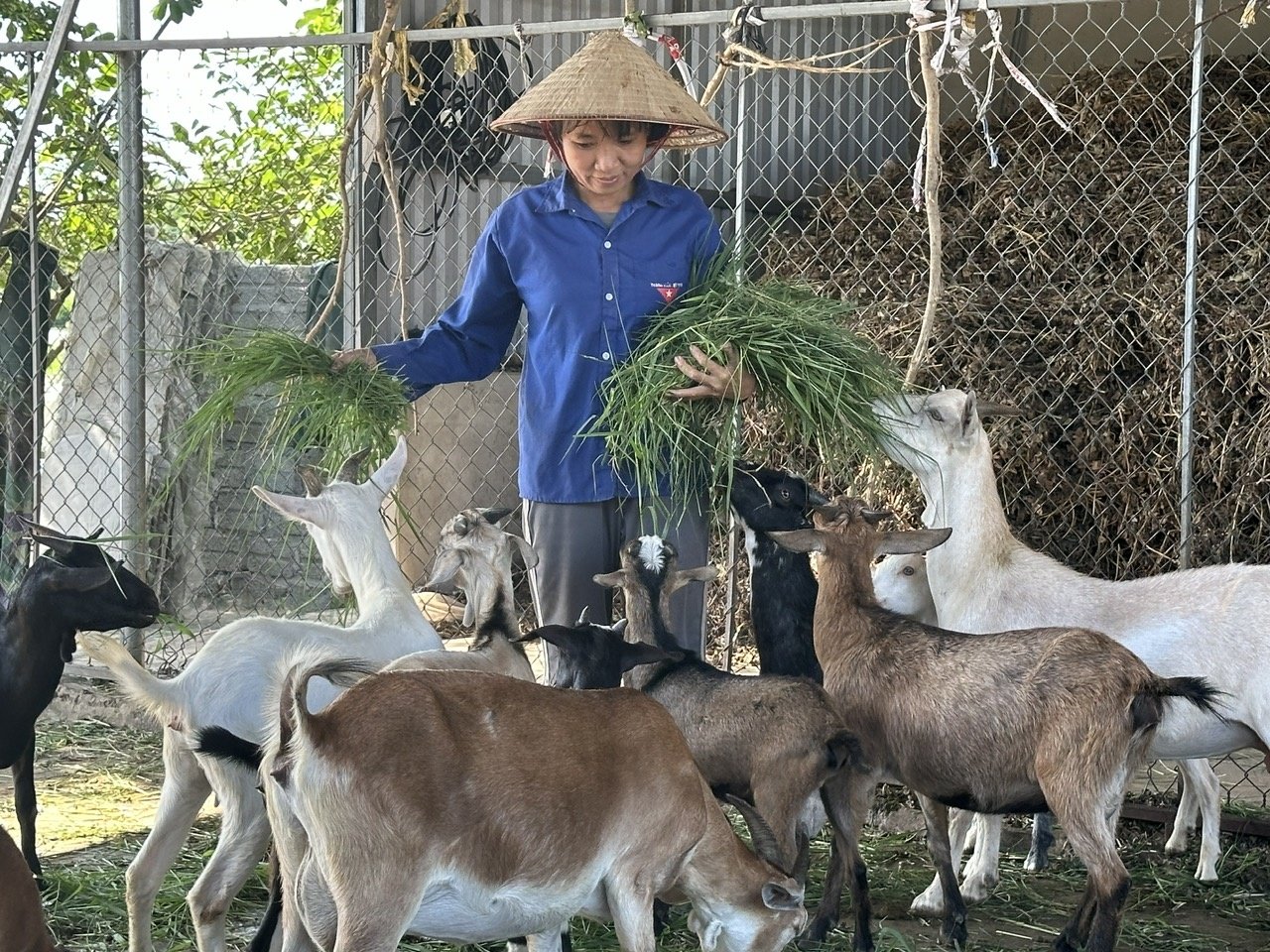 |
| Thanks to policy-based funding, Ms. Pham Thi Oanh (Thai Binh hamlet, Yen Dong commune, Yen Mo district) has had the opportunity to develop goat farming and escape poverty. |
Previously, Ms. Oanh's family was classified as a poor household because both husband and wife lacked stable employment, while they had to raise three young children, one of whom was disabled. Understanding the family's circumstances, the women's association officials at the commune and village levels visited their home to educate and guide Ms. Oanh in applying for a loan from the Social Policy Bank to develop her economy.
Ms. Oanh shared: "Back then, in 2018, with 50 million VND in hand, my husband and I were incredibly excited but also worried because we didn't know how to use the money effectively. Fortunately, with advice and guidance from local organizations on goat farming techniques, my husband and I boldly bought several pairs of goats to raise, and at the same time renovated the pond behind our house to raise fish... To date, our family has escaped poverty sustainably, built a spacious house, and purchased many essential household items."
The story of Ms. Oanh and her husband escaping poverty thanks to preferential loans from the Social Policy Bank is not uncommon in Yen Dong commune, a low-lying area. Comrade Tran Xuan Dong, Secretary of the Commune Party Committee, said: Yen Dong is a particularly difficult, purely agricultural commune. Ten years ago, the poverty rate in the commune was over 10%, and the average per capita income was less than 20 million VND/person/year. Recognizing that policy-based credit is the "pillar" helping the locality reduce poverty, in recent years, the locality has always paid attention to and directed the coordination and integration of credit activities with national target programs, agricultural and rural development policies, education development, vocational training, and job creation to help those on the list of poor and near-poor households use loan capital effectively and for the right purpose, gradually changing their lives and escaping poverty. As a result, the commune's economy has developed, and the lives of the people have improved. Average per capita income has increased rapidly, reaching 75 million VND/person/year, and the poverty rate has dropped sharply to just over 1%. Recently, the locality was recognized as a commune meeting the standards of an advanced new rural commune.
The poverty reduction stories in Nho Quan and Yen Mo districts clearly demonstrate that social policy credit is a crucial "pillar" of the National Target Program on Sustainable Poverty Reduction. In fact, tens of thousands of poor households in other rural areas of Ninh Binh province have also escaped poverty and transformed their lives thanks to policy capital. This capital, when provided to the poor, has encouraged them to find ways to improve their lives, gradually reducing their dependence and fostering proactive and confident efforts to improve their living standards.
According to statistics from the Vietnam Bank for Social Policies (VBSP) branch in Ninh Binh province, over the past 10 years, nearly 81,000 households in the province have risen above the poverty line thanks to policy-based capital. In 2023, the poverty rate in the province was only 1.86%. These results demonstrate the correctness of the Party's policy, shifting from giving the poor "fish" to giving them "fishing rods," creating a breakthrough in connecting the strength of the entire political system with the VBSP to support the poor and policy beneficiaries in overcoming poverty so that no one is "left behind."
Leveraging to boost rural economic development
The "fishing rods" provided by social policy credit have helped tens of thousands of households in the province escape poverty sustainably. Furthermore, the effective use of social policy credit tools also serves as a "lever" for the sustainable economic development of entire localities and regions.
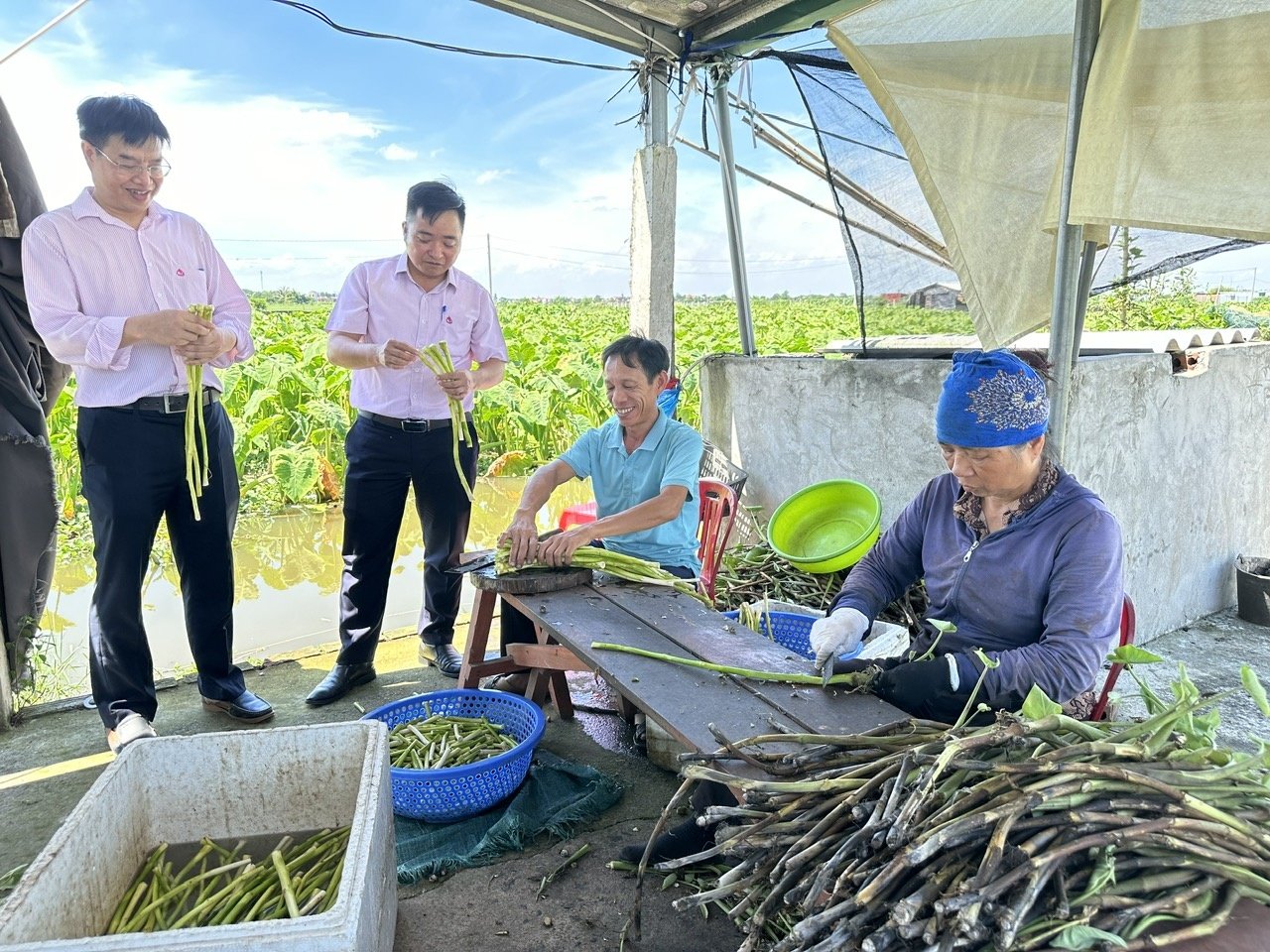 |
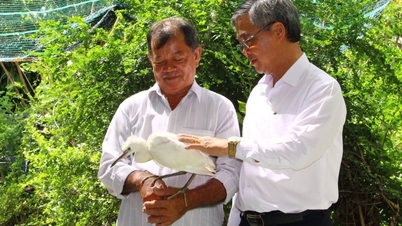
| Policy funding has "ignited the flame" that helped Mr. La Phu Thuan (in the blue shirt), from Hamlet 1, Khanh Thinh Commune, Yen Mo District, successfully start his organic farming business. |
Mr. La Phu Thuan, residing in Hamlet 1, Khanh Thinh Commune (Yen Mo District), has always aspired to develop an organic, natural agricultural economic model to bring safe agricultural products to consumers. However, production capital has always been a concern for him. A loan of 500 million VND from the Social Policy Bank's Job Creation Program provided him with the motivation to invest in developing sweet potato cultivation on 4.2 hectares. In 2023, his production model supplied the market with 30 tons of sweet potato shoots and over 6 tons of commercial snails, generating over 1 billion VND in revenue and providing stable employment for 6 workers with an income of 200,000 VND per person per day.
Mr. Thuan shared: "Having ideas and ambitions is important, but without capital, you can't do anything. I'm very happy that in recent times, the State has paid special attention and provided timely support policies regarding capital so that farmers like us have the opportunity to expand production, enrich our families, and create more jobs and increase income for workers in the region."
In Khanh Trung commune, Yen Khanh district, we visited the garment processing workshop of Mr. Pham Van Thuy. Nearly 50 workers, mostly women and elderly people, were diligently working at their sewing machines to fulfill orders for winter coats.
Having worked at the garment factory for many years, Ms. Pham Thi Ngoan shared: "Because I was too old to apply for jobs at companies, I used to only work in the fields, and my income was almost nonexistent. Fortunately, since this garment factory opened, I have had more work and additional income. Especially, because it's near my home and the working hours are flexible, I can still take care of farming and my family."
Mr. Pham Van Thuy, the owner of a garment factory, said that he opened the factory with the desire to both develop his family's economy and create jobs for local women. However, due to the impact of the COVID-19 pandemic and the lack of orders, production faced many difficulties, at times seemingly impossible to sustain. Fortunately, his family was able to access preferential loans from the Social Policy Bank to invest in purchasing raw materials, which gave them the opportunity to revive production, anticipate the recovery of the garment industry, and maintain jobs and income for their workers.
The dynamic economic models that the Social Policy Bank branch in Ninh Binh province is "igniting" in the community, such as those of Mr. Thuan and Mr. Thuy, have been contributing to promoting production activities and industries in rural areas, actively shifting the agricultural economic structure, improving the lives of a segment of the population, effectively implementing the National Target Program for Sustainable Poverty Reduction, creating jobs, and developing socio-economic conditions and building new rural areas in the locality.
Source: https://thoibaonganhang.vn/dot-pha-tu-chi-thi-so-40-cttw-ky-1-158912.html
![[Image] Close-up view of the interchange connecting the two expressways and Long Thanh Airport.](https://vphoto.vietnam.vn/thumb/1200x675/vietnam/resource/IMAGE/2026/05/25/1779703378210_ndo_br_z7863716673926-224453a31600126cce10622af6290afd-4549-jpg.webp)



![[Image] Hanoi's urban life under the challenge of a "scorching hot" environment](https://vphoto.vietnam.vn/thumb/1200x675/vietnam/resource/IMAGE/2026/05/25/1779706979265_nang-nong-t5-2026-minh-duy-7-4636-jpg.webp)












































































Comment (0)