

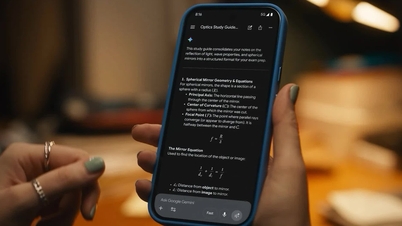
Amidst the booming digital revolution, a fascinating trend has emerged in the Chinese lottery industry. Surprisingly, AI chatbots, known for their intelligent and versatile responses, are now being used for a novel task: predicting lottery results. While this innovative approach has generated much excitement, it has yet to deliver any real financial benefits to players.

Chinese lottery players bet on AI chatbots to find the winning numbers, but no one has become a millionaire yet. (Image: DALL·E 3)
Proof of this story comes from a woman named Gu Xiangnan from Anhui Province, China. Her experience involved buying lottery tickets using numbers generated by Google's Gemini-Pro AI chatbot, which in fact used historical data from Super Lotto (the most popular lottery in China, requiring players to choose 5 numbers from a set of 35 balls) that she provided to the chatbot.
Despite the efforts of the Gemini-Pro model, Gu Xiangnan's experiment yielded no financial success when she played the lottery. This trend is not limited to Gu Xiangnan's experience; it has also been attracting attention from the lottery enthusiast community in China, a group of nearly 200 million people who contribute to the country's annual lottery revenue of approximately 600 billion yuan.
The growing trend of using AI to select lottery numbers is also emerging elsewhere in the world . From Thailand to Singapore, stories of modest wins using AI-generated numbers have surfaced, sparking curiosity and hope in many.
In April 2023, a Thai man, Patthawikorn Boonrin, claimed on TikTok that he had won 2,000 baht (US$56) using ChatGPT, according to digital media outlet Mashable. A month later, a Singaporean man, Aaron Tan, won a US$40 cash prize with numbers generated by ChatGPT, according to Yahoo News.
However, it's important to remember that lotteries are fundamentally games of chance. AI, with all its sophistication, still cannot possess a predictive advantage in this game of chance. Experts and AI alike advise treating lotteries as a form of entertainment, not an investment strategy.
HUYNH DUNG (Source: Gizmochina/Scmp)
Source





![[Photo] General Secretary and President To Lam presides over the meeting to approve the draft report on the results of the second inspection by the Politburo of the Standing Committee of the Hanoi City Party Committee.](https://vphoto.vietnam.vn/thumb/1200x675/vietnam/resource/IMAGE/2026/05/26/1779789811432_a2-bnd-4430-9620-jpg.webp)







































































Comment (0)