

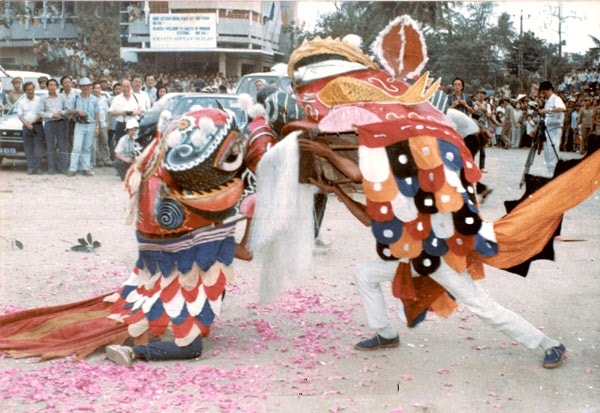
Street during lion dance season
Throughout the wards of Tam Ky, Ban Thach, Huong Tra, and Quang Phu, starting from mid-July in the lunar calendar, the bustling atmosphere of the festival season begins with artisans, young men, and even the elderly and children, crafting lion and dragon costumes. This lively atmosphere lasts until the Mid-Autumn Festival.
What's remarkable is that in the aforementioned localities, almost every neighborhood within the ward seems to have its own lion dance troupe. These troupes exchange experiences in crafting lion heads and lion dance techniques, passing on the craft to younger generations. During festival seasons, crowds of people flock to the streets, joining the lion dance troupes in their festivities and praying for peace and prosperity.
The Tu Ban hamlet now belongs to two wards, Tam Ky and Huong Tra. Although separated by only a small alley, Tu Ban has been famous for decades for its lion and dragon head making. This area, home to many talented artisans, has produced beautiful, intricate, and highly sought-after lion and dragon heads. Besides lions and dragons, the artisans also create equally eye-catching dragon, turtle, and phoenix heads.
Mr. Truong Van Dung, a veteran lion and dragon dance craftsman from Tu Ban hamlet, said that initially he made lion and dragon dances for his children and grandchildren to play and dance in the hamlet. Then, word spread, and he started selling lion and dragon dances to individuals, units, and organizations throughout neighboring provinces and cities.
“The lion and dragon dance performances during the Mid-Autumn Festival are an occasion for reunion, unity, and cooperation within the community. The lion and dragon dances symbolize peace, joy, and tranquility for the land and each family in the community. They also represent a custom that strengthens community bonds and a tradition that guides people towards truth, goodness, and beauty,” Mr. Dung said.
Connecting to create cultural destinations.
According to the recollections of Hoi An's elders, as early as the 18th century, the people of Hoi An had the custom of hanging lanterns in front of their houses during the Mid-Autumn Festival. From this tradition, along with consumer demand, the craft of lantern making gradually developed in Hoi An to serve the needs of decoration, entertainment, and as souvenirs for tourists visiting the ancient town.
.jpg)
In the celestial dog dance, a unique and distinctive ritual performance in Hoi An that wishes for good fortune for people and peace and prosperity for the country, lanterns are an indispensable element.
According to documents preserved in Hoi An, lanterns are not merely decorative objects but hold deep significance for the people of Hoi An. In the beliefs and culture of Hoi An's inhabitants, lanterns symbolize light, carrying hopes for prosperity, guidance, good fortune, and happiness.
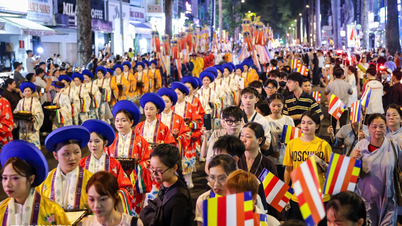
On the Mid-Autumn Festival night, lanterns bring families, friends, and relatives together in a warm, cozy, and joyful atmosphere, symbolizing unity, sharing, closeness, and harmony among the people of Hoi An.
Many tourists, especially European and American visitors, particularly appreciate the groups of children lighting lanterns and excitedly parading under the full moon during the Mid-Autumn Festival in Hoi An, considering it a beautiful cultural tradition. Hoi An lanterns, therefore, are not only a long-standing traditional beauty but also a profound harmony between people and nature.
According to Mr. Pham Phu Ngoc, Deputy Director of the Hoi An World Cultural Heritage Conservation Center, the Hoi An Mid-Autumn Festival, with its core values formed on the basis of local traditions and the interaction and adaptation with the cultures of Japan and China, has always been preserved by the Hoi An community. The Hoi An Mid-Autumn Festival is vibrant because of its rich cultural and religious values.
Mr. Ngoc stated that this year's Hoi An Mid-Autumn Festival is organized to continue preserving and honoring traditional cultural values, connecting the community, bringing joy to locals and tourists, and conveying cultural and historical significance. "This year's Mid-Autumn Festival in Hoi An will recreate the living space, lifestyle, and cultural and artistic activities of the people of Hoi An in the past, combined with the light of lanterns to create a relaxing and peaceful experience," Mr. Ngoc affirmed.
It is no coincidence that the traditional Mid-Autumn Festival, social customs, and beliefs of Hoi An were recognized as a National Intangible Cultural Heritage by the Ministry of Culture, Sports and Tourism in 2023. The festival affirms Hoi An's creative spirit in utilizing tangible and intangible heritage to create vibrant experiences for tourists.
It is believed that the Hoi An Mid-Autumn Festival, when combined with the vibrant festivals in Ngu Hanh Son, Son Tra, and the city center, will become a series of Mid-Autumn Festival activities, creating a unique cultural journey for Da Nang to develop its brand as a cultural and tourism destination in the region.
Source: https://baodanang.vn/gan-ket-va-gin-giu-ban-sac-3305448.html















































































Comment (0)