

At the close of trading yesterday, Arabica coffee prices fell 5.3% to $8,724 per ton, while Robusta coffee prices decreased 2% to $5,641 per ton.
According to the Vietnam Commodity Exchange (MXV), the global raw materials market showed mixed performance yesterday (February 20). Notably, the metals market recorded a positive trading session with most commodities in the group showing gains. Conversely, in the industrial raw materials market, the prices of two commodities, coffee, reversed sharply downwards due to strong inventory recovery pressure. At closing, buying pressure prevailed, supporting the MXV-Index to rise 0.1% to 2,379 points.
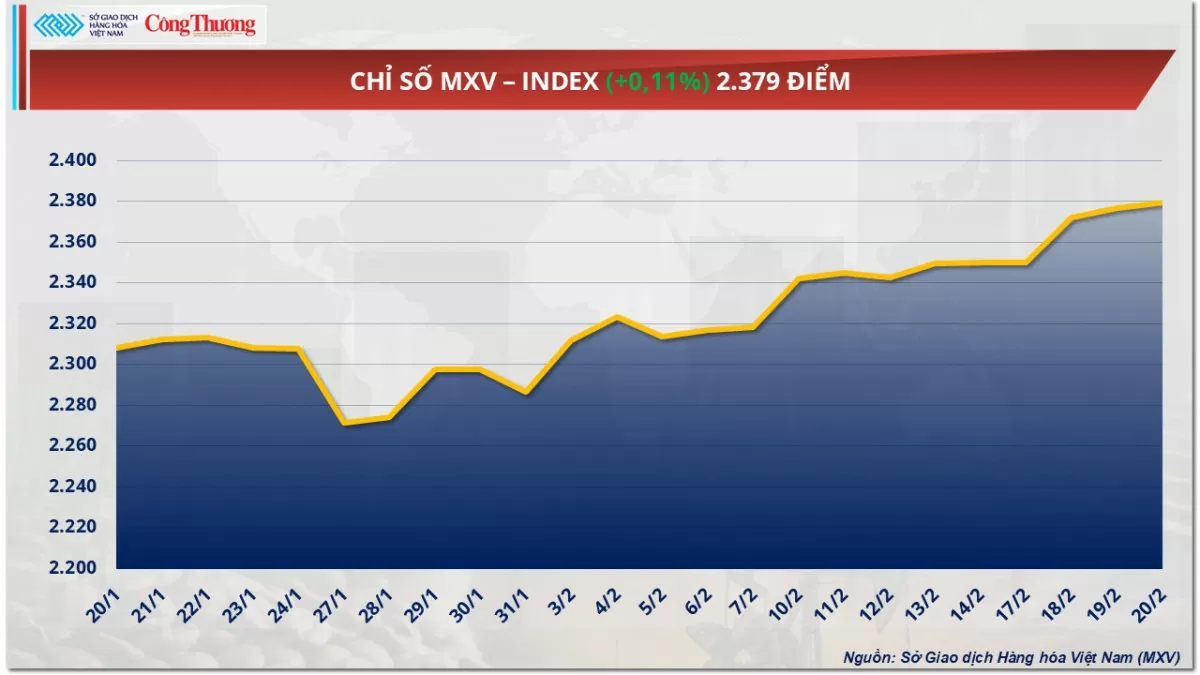 |
| MXV-Index |
Coffee prices plummet across the board.
At the close of yesterday's trading session, coffee prices showed a sharp decline as the market reacted to a strong recovery in inventories, triggering a wave of profit-taking by investors. Specifically, Arabica coffee prices fell 5.3% to $8,724 per ton, while Robusta prices decreased 2% to $5,641 per ton.
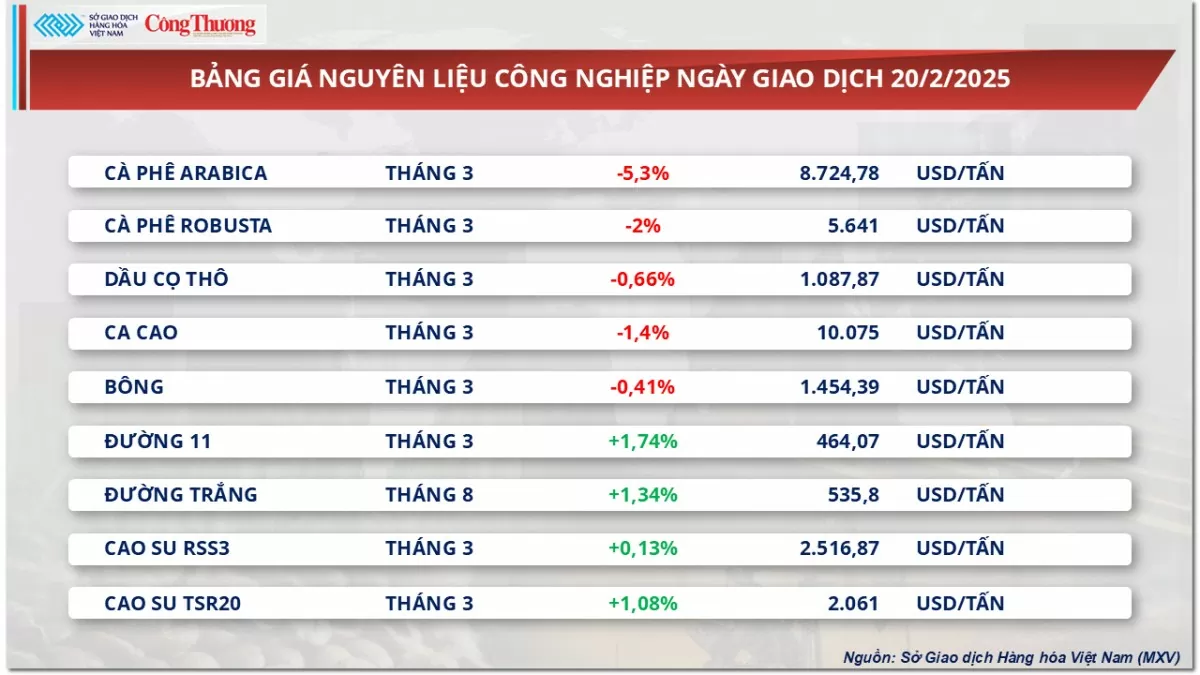 |
| Industrial raw material price list |
According to the latest inventory report from ICE, Arabica coffee inventories increased by 2.7% to 779,063 bags in the last two trading sessions, recovering from a nine-month low of 758,514 bags. Similarly, Robusta inventories also showed signs of improvement, rising from 257,820 bags to 260,820 bags. This information prompted investors to close long positions, increasing selling pressure and pushing prices down.
Furthermore, the supply and demand picture shows several noteworthy signs. Safras & Mercado reported that as of February 11th, sales progress for the 2024-2025 crop in Brazil reached 88%, far exceeding the 79% of the same period last year and the 82% average over the past five years, reflecting continued strong market demand. This figure also indicates that farmers no longer have significant inventory, contributing to reduced selling pressure.
 |
| Arabica coffee prices fell 5.3% to $8,724 per ton, while Robusta prices dropped 2% to $5,641 per ton. Photo: Hien Mai |
Conversely, in yesterday's trading session, the price of sugar 11 increased by 1.74% to $464/ton, marking a six-session winning streak and reaching its highest level in over two months.
The price increase is primarily driven by concerns about supply shortages from India – the world's second-largest sugar exporter. According to the latest figures from the Indian Sugar and Bioenergy Producers Association (ISMA), sugar production from the beginning of the crop year (October 1, 2024) to mid-February 2025 reached only 19.7 million tons, a 12% decrease compared to the same period last year.
Notably, the number of operating sugar mills in India has plummeted from 477 to 377, with 77 forced to close prematurely due to raw material shortages. This situation is expected to significantly impact export supplies in the coming months, further supporting the upward trend in raw sugar prices on the world market.
Strong buying pressure in the metals market.
The metals market was dominated by green in yesterday's trading session. At closing, silver prices recovered 1.34% to $33.49 per ounce – the highest level since late October 2024. Meanwhile, platinum prices also rose 1.12%, reaching $997.2 per ounce, up 4% from the previous month.
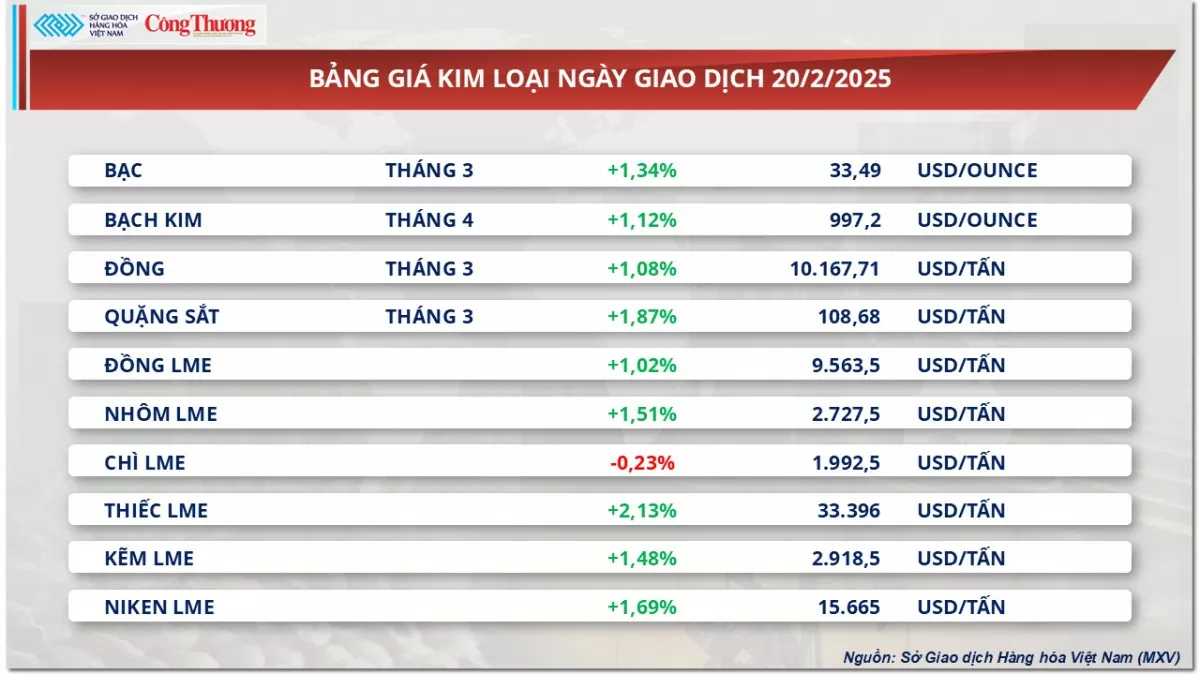 |
| Metal price list |
According to MXV, the main reasons driving the rise in metal prices stem from concerns about rising inflation in the US and signs of recovering consumer demand in China.
In a speech at a conference hosted by the Saudi Arabian Public Investment Fund in Miami on February 19, US President Donald Trump pledged to work with the Republican Party to implement a series of deep tax cuts aimed at boosting consumption and investment. His plan includes tax exemptions for service bonuses, social security benefits, and overtime pay, as well as tax incentives for domestic oil and gas producers. He also proposed allowing businesses to deduct all costs incurred in new plant investments and other capital expenditures.
Although these policies are expected to stimulate economic growth, experts warn that they could increase budget deficits and put upward pressure on prices, bringing inflation back. This would fuel safe-haven asset purchases and support the prices of precious metals.
In addition, during yesterday's trading session, the Dollar Index fell 0.75%, to 106.37 points – far from the peak reached in nearly two years. The weakening USD makes silver and platinum more attractive to investors holding other foreign currencies.
In the base metals market, COMEX copper prices rose more than 1% to $10,167 per ton, up nearly 16% year-to-date. Iron ore prices also increased by 1.87%, reaching $108.68 per ton, marking their highest level since early October 2024.
Shanghai Metals Market Analysis Company (SMM) forecasts that the operating rate of copper wire and cable businesses in China will increase from 70.08% to 78.39% next week. This improvement is attributed to increased demand as production gradually recovers after the Lunar New Year holiday, along with increased buying from intermediaries due to expectations of continued upward copper prices.
Meanwhile, according to a report by Chinese metal market analysis firm Mysteel, demand for rebar – a key material used in construction – surged by 163% compared to the previous week, reaching 1.69 million tons as of February 20th. This strong growth in the construction steel industry indicates that Beijing's previous economic stimulus measures are beginning to take effect, thus opening up positive prospects for iron ore consumption and driving prices higher.
Prices of some other goods
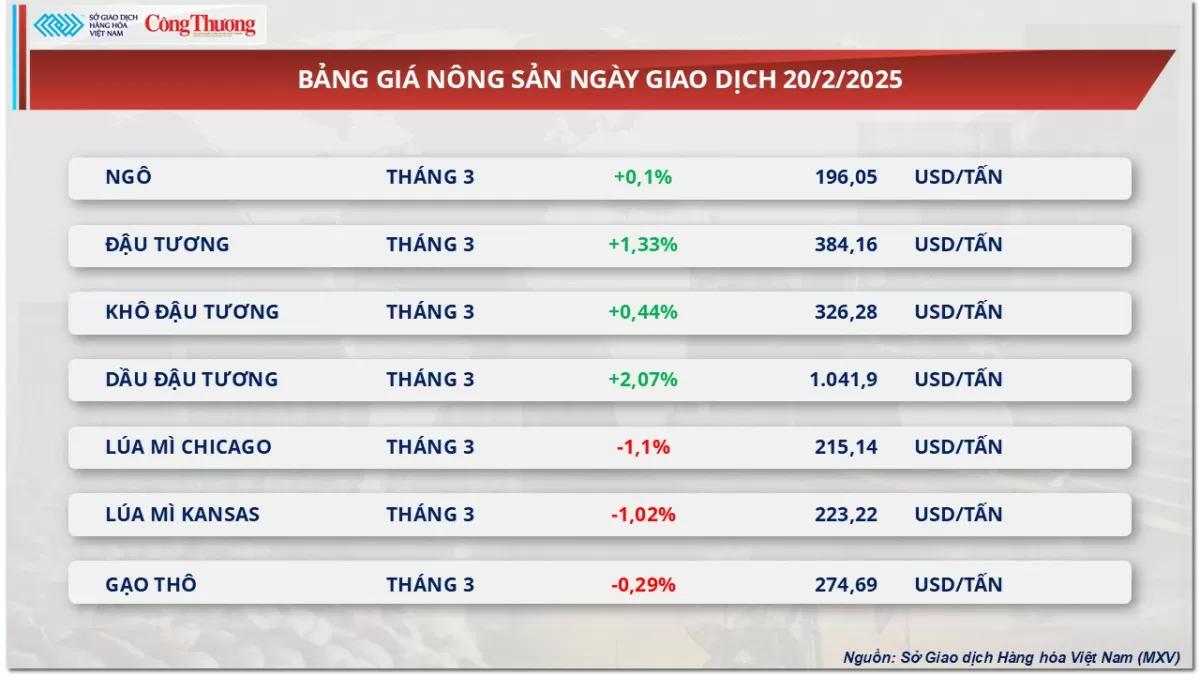 |
| Agricultural product price list |
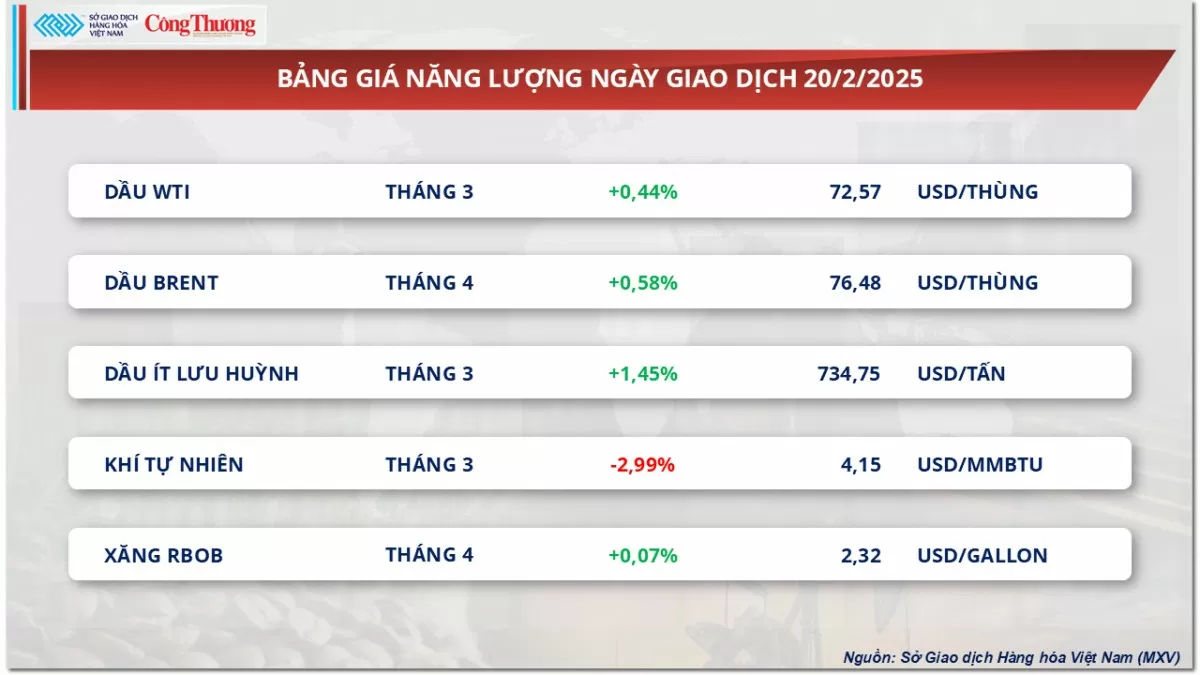 |
| Energy price list |
Source: https://congthuong.vn/thi-truong-hang-hoa-gia-ca-phe-robusta-giam-con-5641-usdtan-374914.html


![[Photo] First session of the 14th Congress of the Vietnam Trade Union](https://vphoto.vietnam.vn/thumb/1200x675/vietnam/resource/IMAGE/2026/06/03/1780465947883_ndo_br_img-3852-jpg.webp)
![[Photo] Secretary of the National Assembly Party Committee, Chairman of the National Assembly presides over the meeting of the Standing Committee and Executive Committee of the National Assembly Party Committee.](https://vphoto.vietnam.vn/thumb/1200x675/vietnam/resource/IMAGE/2026/06/03/1780480353201_ndo_br_bnd-2585-jpg.webp)

![[Photo] General Secretary and President To Lam presides over a meeting with the Central Organizing Committee.](https://vphoto.vietnam.vn/thumb/1200x675/vietnam/resource/IMAGE/2026/06/03/1780482764658_a1-bnd-4741-3342-jpg.webp)

















































![[Video] Sunset at Lap An Lagoon – Where the sun sets over the fishing nets](https://vphoto.vietnam.vn/thumb/1200x675/vietnam/resource/IMAGE/2026/05/31/1780192137701_beach-landscape-sea-water-nature-grass-745871-pxhere-com.jpeg)

































Comment (0)