

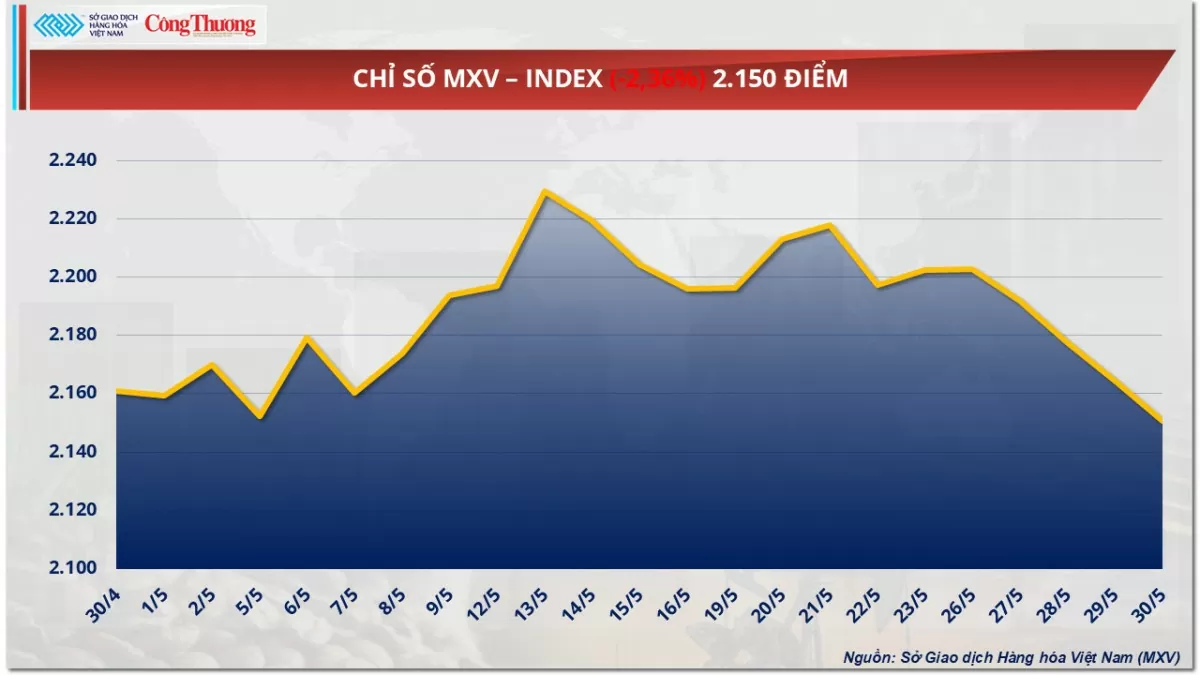
The Vietnam Commodity Exchange (MXV) reported that the global raw materials market was in the red during the past trading week. With four consecutive days of declines, the MXV-Index closed down 2.36% at 2,150 points on the last trading day of the week (May 30th). Notably, strong selling pressure in the energy market fueled the overall market downturn. In a similar trend, many industrial raw materials such as coffee and rubber saw sharp declines of over 5%.
 |
| MXV-Index |
Robusta coffee prices have fallen to their lowest level in over 6 months.
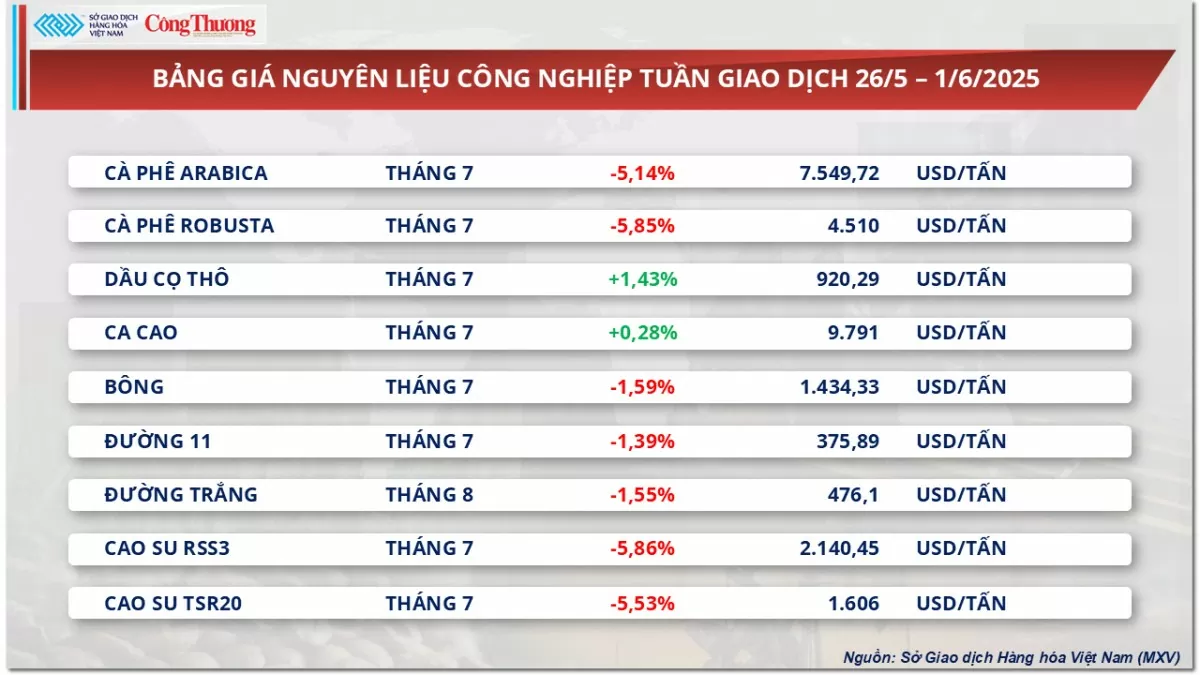
At the close of trading last week, the price of Arabica coffee futures for July delivery on the New York exchange fell for the third consecutive week, losing 5.14% to $7,550 per ton; the price of Robusta coffee futures for July delivery on the London exchange also dropped sharply by 5.58%, settling at $4,510 per ton. Arabica coffee prices reached their lowest level in 7 weeks and Robusta coffee prices fell to their lowest level in 6.5 months.
 |
| Industrial raw material price list |
Robusta coffee is leading the overall downward trend, as shipments from the new harvest in Brazil and Indonesia are putting pressure on prices across the entire coffee market. Last year, the Robusta market led Arabica prices to rise, but this year it is dragging Arabica down.
The Arabica coffee harvest in Brazil follows the Robusta harvest, and while production is expected to be lower, many agencies and companies have revised their forecasts upwards compared to earlier estimates. Initial reports from brokers indicate fairly good bean size but lower yields.
 |
| Robusta coffee prices fell to their lowest level in six and a half months, reaching $4,510 per ton. |
Colombia, the world's largest producer of wet-processed Arabica coffee, is projected to produce 13.20 million bags of coffee in the current crop year (October 2024 to September 2025), a 4.68% increase compared to the previous 2023-2024 crop year, with the mid-year crop currently being harvested.
In the next crop year, from October 2025 to September 2026, weather conditions so far have been favorable, with a forecast of a slight increase in production of 2.45% compared to the previous crop year, estimated to reach a total of 12.5 million bags in the 2025-2026 crop year.
The National Federation of Colombian Coffee Growers also reported that the country's total coffee exports in the first seven months of the current crop year (October 2024 to September 2025) increased by 15.5% compared to the same period of the previous crop year, reaching a total of 7,920,000 bags.
Coffee exports from Mexico and Central American countries, which are the main producers of high-quality wet-processed Arabica coffee, are drawing to a close with only four months remaining in the current crop year (October 2024 to September 2025). Total exports from these countries since the beginning of the crop year reached 5.88 million bags, a 2.26% increase compared to the same period last year.
Information on coffee exports from Brazil and Vietnam continues to be a factor restraining the recent decline in the coffee market. Specifically, according to the latest preliminary statistics from Cecafe, Brazil's coffee exports in May reached over 2.6 million 60kg bags, a decrease of 35.8% compared to the same period last year. In addition, according to the Import-Export Department ( Ministry of Industry and Trade ), Vietnam's coffee exports from the beginning of the year to May 15th reached over 736,580 tons, a decrease of 5.5% compared to the same period last year.
Oil prices extended their decline for a second week.
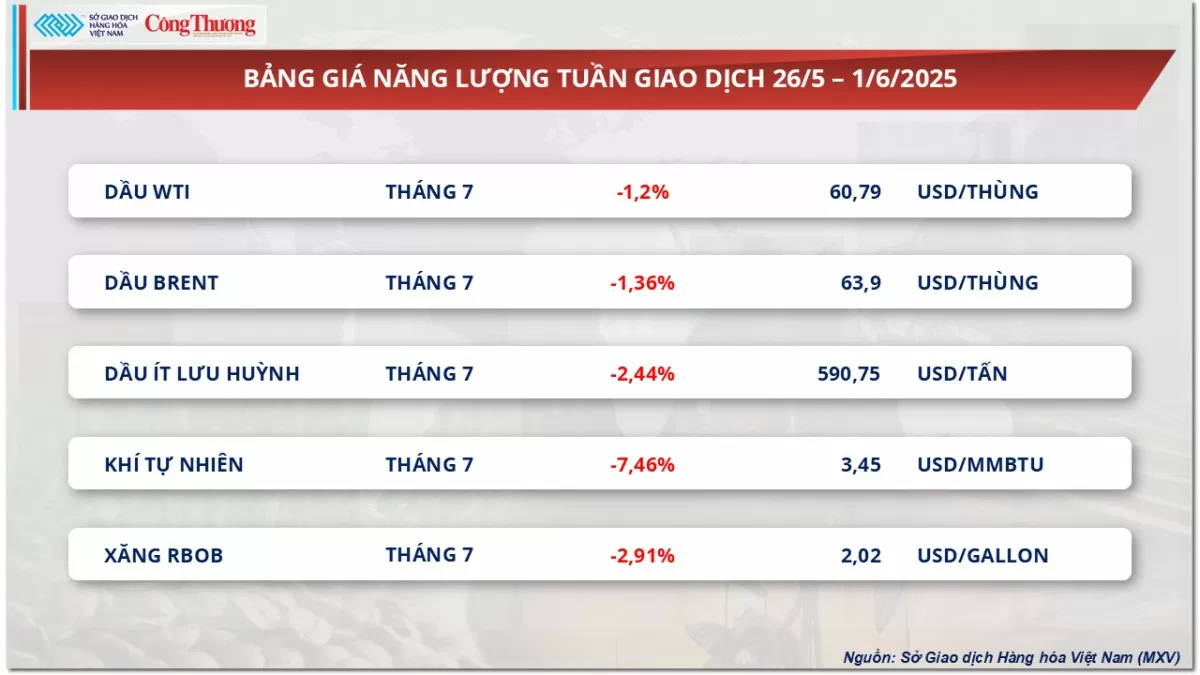
According to MXV, all five energy commodities were in the red during the past trading week. The downward trend in oil prices, driven by market expectations regarding OPEC+'s production decision, continued for the second consecutive week, despite new information about temporary supply disruptions.
At the close of trading this week, WTI crude oil prices fell 1.2% compared to the May 23rd trading session, dropping to $60.79 per barrel. Meanwhile, Brent crude oil futures for July delivery fell to $63.9 per barrel, a decrease of 1.36%.
 |
| Energy price list |
After nearly two weeks of waiting, OPEC+'s official decision on July production levels was finally announced on Saturday, May 31st, following a virtual meeting of the group's eight key member countries. As largely predicted by the market, OPEC+ set a July production increase of 411,000 barrels per day, the third consecutive increase this year. This decision is likely to continue the downward trend in oil prices in early trading this week.
Prior to this, market speculation had been the main driving force behind the 3-4 declining trading sessions last week.
In an interview with Bloomberg, the Managing Director of the International Energy Agency (IEA), Fatih Birol, warned of declining oil demand in China, further reinforcing investor concerns about the supply-demand imbalance, especially given the ongoing issue of OPEC+ member countries exceeding their production quotas. On May 29th, Kazakhstan's Deputy Energy Minister Alibek Zhamauov stated that the country had informed OPEC that it had no intention of reducing oil production, despite pressure from other member countries to cut production.
In addition to concerns about demand in China, the future of oil demand in the US also looks uncertain as the macroeconomic situation of the world's largest economy shows no positive signs.
Currently, US oil demand remains supported during the peak travel season. Both the US Energy Information Agency (EIA) and the American Petroleum Institute (API) have reported a sharp decline in commercial crude oil inventories, contrary to many predictions of an increase. In the week ending May 23rd, the EIA reported a decrease of approximately 2.8 million barrels, while the API reported a decrease of 4.24 million barrels, thus helping to curb the downward trend in oil prices throughout the week.
Also contributing to curbing the decline were supply disruptions last week, notably in Canada and Venezuela. On May 28, Chevron was ordered by the US government to halt operations at its oil fields in Venezuela, as well as its oil exports and expansion activities. Meanwhile, a wildfire in Alberta, Canada, forced the temporary shutdown of some oil and gas production.
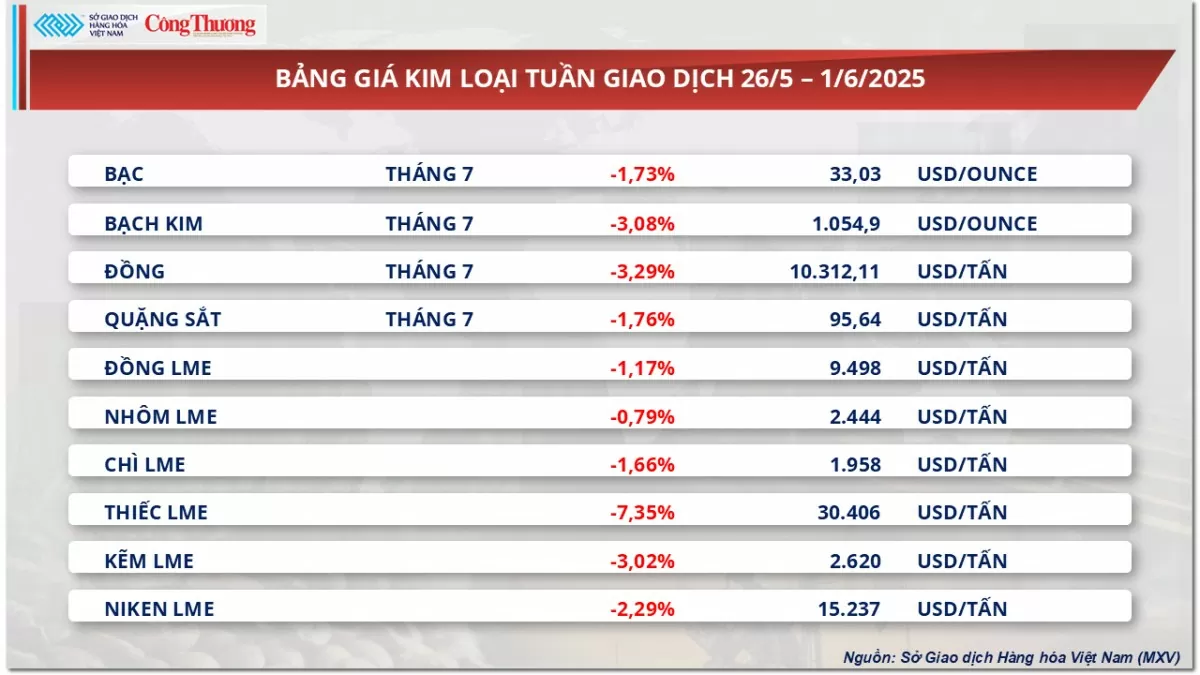
Prices of some other goods
 |
| Metal price list |
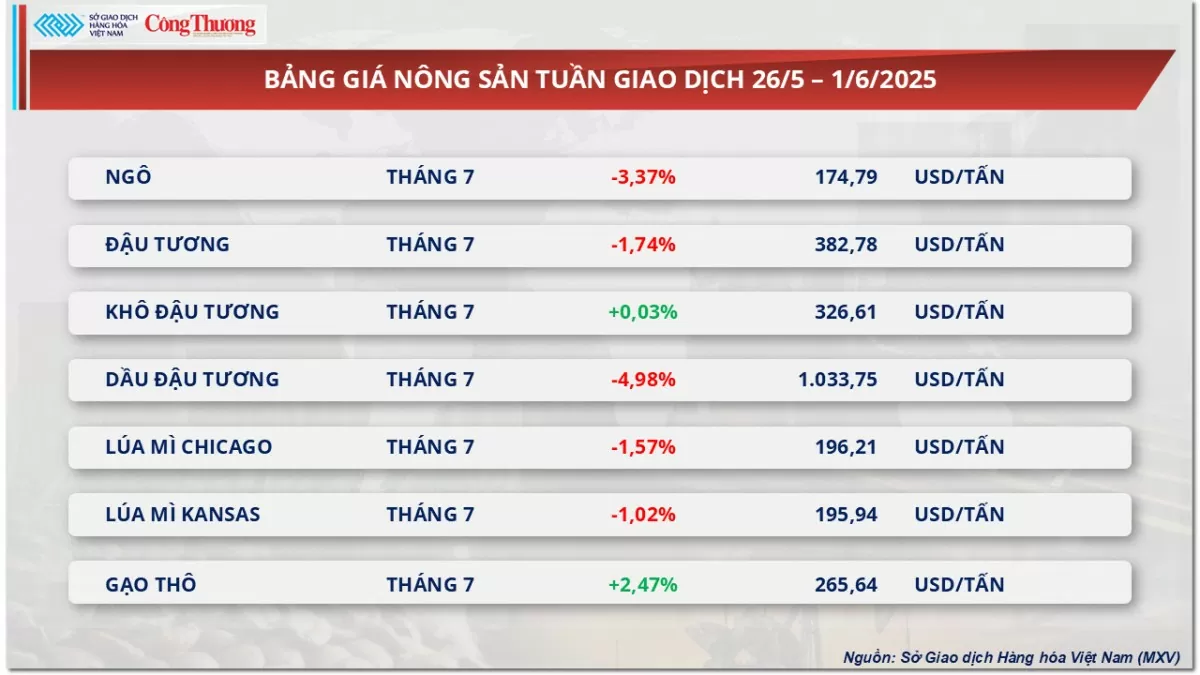 |
| Agricultural product price list |
Source: https://congthuong.vn/gia-ca-phe-robusta-giam-xuong-muc-day-con-4510-usdtan-390388.html
























































































Comment (0)